All species › Waders, gulls and terns › Plovers and lapwings › Mountain Plover
Mountain Plover | Anarhynchus montanus
Prairieplevier | Chorlito Llanero
The Mountain Plover is a plover that does without water: it walks the shortest and driest ground of the high plains, far from any shoreline, and is the only small plover of the region with no breast band at all. Its name points to the mountains, but it breeds on flat land, by preference where prairie dogs and cattle keep the grass cropped to the soil. Fewer than twenty thousand are left, and the great majority of them winter on a handful of farmed valleys in California.
Voice
The voice is low, soft and short-ranged; out on a plain where the wind never stops you usually hear the bird only once it has taken off. The common call is a single low krip or weep that is easily lost in the rustle of the grass. In display, in the early morning, the male produces a deep rolling sound most like a cow lowing far away. There is also a drawn-out gurgling trill that seems to travel along the ground. Anyone who comes too near a nest gets a repeated, sharper kip-kip.
No recording with a suitable Creative Commons licence has been found for this species yet; what to listen for is described below.
Identification
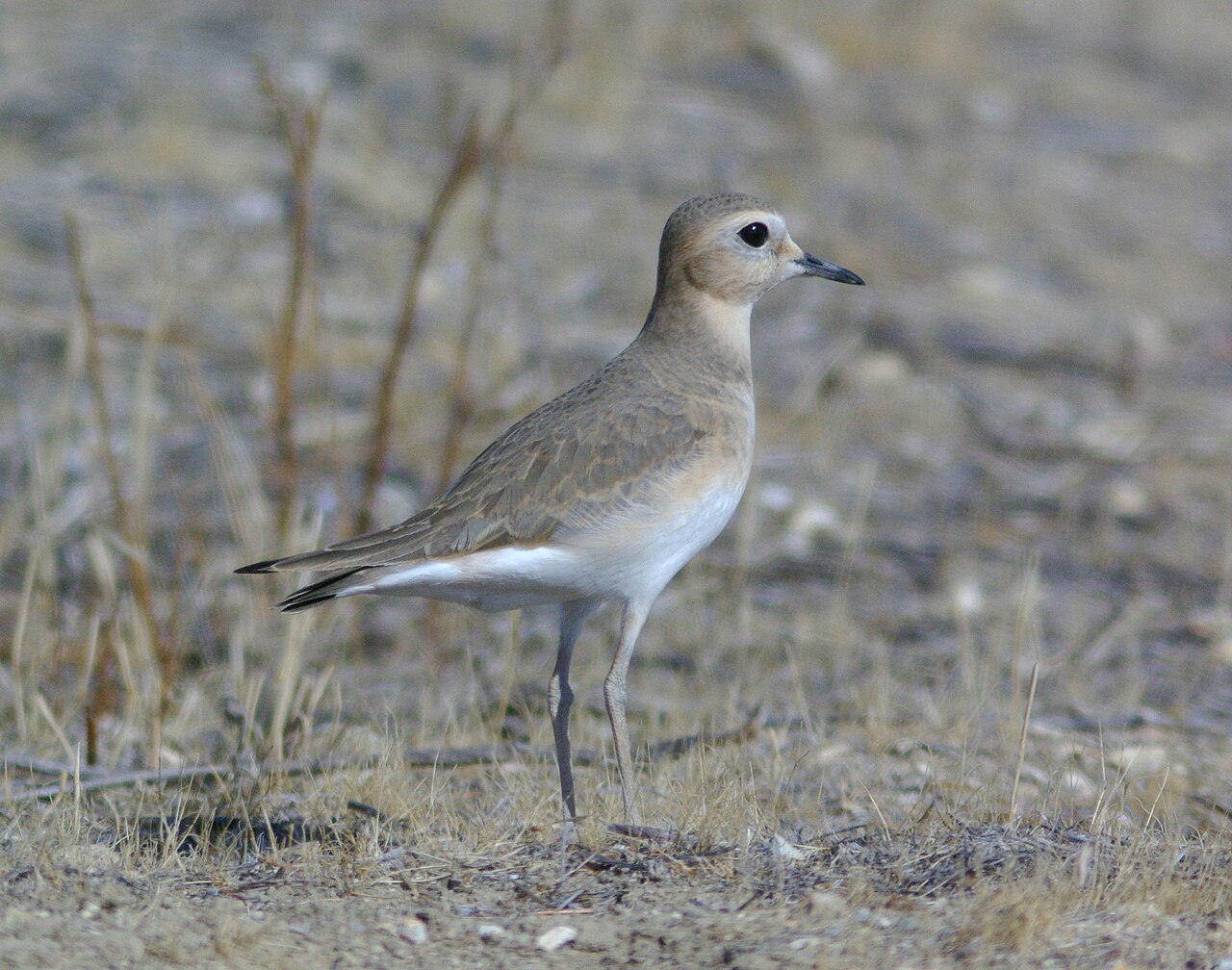
Plain sandy brown above, white to pale buff below, and without a trace of a breast band — that last point identifies it at once among the small plovers of the region. In breeding plumage it carries a black forecrown and a black line between eye and bill, with a white forehead and a white supercilium between them. Outside the breeding season the black drops out and an almost featureless sandy bird remains; juveniles look scaled as well, from the pale fringes of the back feathers. The bill is short and black, the legs pale grey-yellow, and the large dark eye stands out from an otherwise blank face. It stands tall and upright and moves in short dashes with abrupt stops, as plovers do. In flight it shows a narrow white wingbar, a white underwing, and a dark band across the tail tip with a white fringe.
Confusion species
Killdeer uses the same open ground but has two black breast bands, a far longer orange tail and calls continually, while Mountain Plover stays silent. Snowy Plover is considerably smaller and paler and has a dark ear patch and a dark shoulder mark. In winter plumage American Golden-Plover suggests it at a distance, but is larger, finely spangled above instead of plain, and shows a dark cap over a pale supercilium. The most similar species is Buff-breasted Sandpiper (Calidris subruficollis), which uses the same bare fields: scaled above, with yellow legs, a short straight bill and no white wingbar.
Habitat
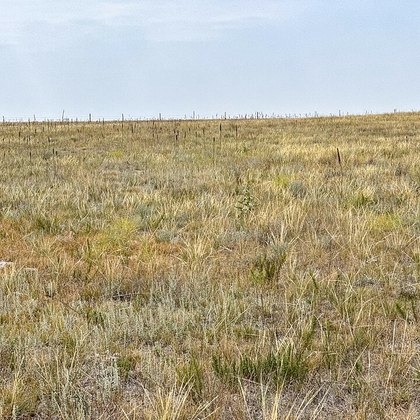
Shortgrass prairie on the high dry plains, and within it the shortest ground of all: grazed and trampled soil where the sward is open and the vegetation barely reaches ten centimetres. Prairie dog colonies are its best terrain, because they keep the grass low and the earth bare. It also uses dry lake beds, alkali flats, fallow ground and freshly ploughed fields, and in winter mown, grazed or recently burnt land. It avoids tall grass, scrub and every kind of shoreline; unlike almost all plovers it comes to water only by accident.
Where the bird is most often found, arranged by the USNVC — the vegetation classification of the United States and Canada — and CMECS for sea and coast.


Range and movements
Breeds on the western Great Plains from extreme south-eastern Alberta south through Montana, Wyoming, Colorado, western Nebraska and Kansas, the Oklahoma panhandle, New Mexico and northern and western Texas, with a separate population in the Uinta Basin of Utah. The centre of gravity is Colorado, which holds most of the breeding birds. In winter it shifts to the south-west: by far the greater part stands in the San Joaquin Valley and the Imperial Valley of California, the rest in southern Arizona, southern Texas and northern Mexico. The range contracted sharply during the twentieth century — with the loss of the bison and the clearing of prairie dog colonies the short sward disappeared — and in Canada only a few pairs remain, in the south-eastern corner of Alberta and around Grasslands National Park in Saskatchewan.
- Resident
- Breeding (summer)
- Winter
- dark = core range, pale = thinly spread
Where and when to look
Drive the gravel roads of the shortgrass prairie at sunrise in May — Pawnee National Grassland in Colorado is the classic place — and watch for the shadow rather than the bird: on bare ground a motionless Mountain Plover is all but invisible, and it gives itself away only when it runs a few paces. Work along prairie dog colonies and around cattle water tanks, where the ground is barest. In winter the freshly harrowed fields of the Imperial Valley and the Carrizo Plain in California are the best places, with flocks of tens to hundreds standing together.
Conservation
The species is assessed as Near Threatened (NT): an estimated eleven to fourteen thousand adults, fifteen to twenty thousand birds in all, and the numbers are falling. The heaviest pressure comes from the conversion of shortgrass prairie to cropland and from the control of prairie dogs, which removes exactly the short open sward the bird depends on. Nests on arable ground are lost to spring cultivation, although the bird settles there readily; on rangeland, grazing works in its favour.
Scientific name
Anarhynchus montanus | (Townsend, 1837)
Townsend described the species in 1837 as Charadrius montanus, among the plovers; because it was later placed in another genus, author and year stand in parentheses. The description appeared in the Journal of the Academy of Natural Sciences of Philadelphia, from a bird taken on the central tableland of the Rocky Mountains, near the Sweetwater River in Wyoming. montanus is Latin for 'of the mountains', and that is misleading: the bird breeds on flat land and does not go up into the hills anywhere. The genus Anarhynchus was introduced in 1830 by Quoy and Gaimard, from Greek ana- 'back, sideways' and rhunkhos 'bill', after the sideways-bent bill of the New Zealand bird the genus was originally made for.