All species › Passerines › New World sparrows › Song Sparrow
Song Sparrow | Melospiza melodia
Zanggors | Chingolo cantor
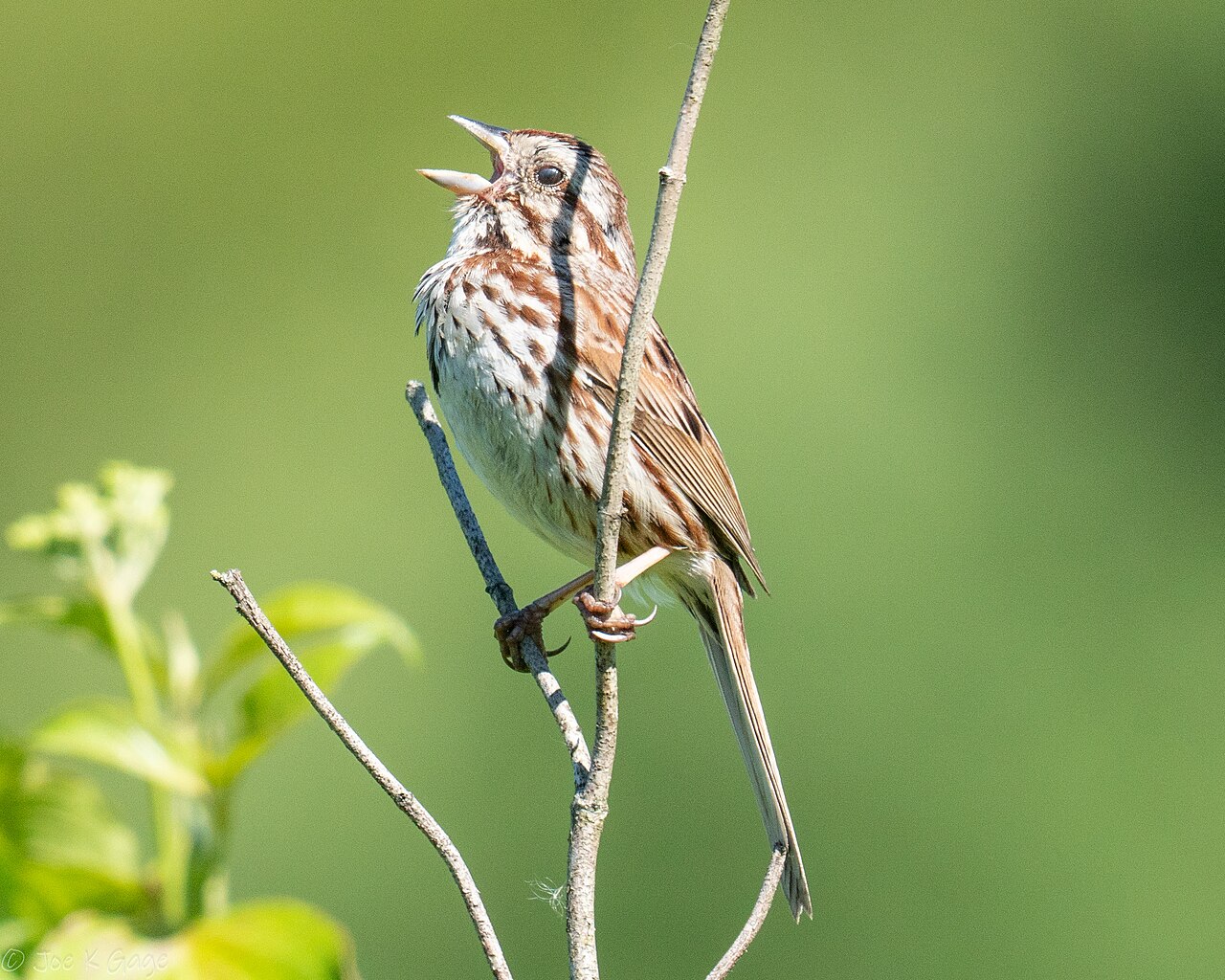
The Song Sparrow is one of the most widespread songbirds in North America: a streaked sparrow with a dark smudge in the middle of its breast, delivering its name from an open twig. Few songbirds on the continent vary so much from region to region — more than thirty subspecies have been described, from slight desert birds to heavily built birds of the Aleutians.
Voice
The song opens with two or three clear, repeated introductory notes followed by a short trill and a somewhat jumbled ending — sweet sweet sweet, tea-kettle-tea, zzzzr — delivered from a low branch, post or shrub top. Each male commands a repertoire of several song variants which it alternates through the season, and neighbours learn each other's phrases. The call is a short, dry chimp, repeated quickly when alarmed.
Recording: Ryan Douglas — CC BY-SA 4.0 · Damascus, Montgomery County, Maryland, United States · xeno-canto
Identification
A medium-sized, thickset sparrow with a long, rounded tail it pumps up and down in flight. The breast and flanks are heavily streaked on a white or buffy ground, the streaks often converging at the centre of the breast into a dark blotch. Males and females look alike; juveniles are more finely and faintly streaked. No other North American songbird varies so much in appearance from place to place: Pacific coastal birds are dark and rufous, southwestern birds pale and sandy, and the Aleutian subspecies noticeably larger and darker than all the rest.
Confusion species
Other streaked sparrows — Fox Sparrow and Swamp Sparrow — show a similar pattern but lack the clear breast blotch and have a shorter tail. Lincoln's Sparrow is more finely streaked over a more evenly grey head, without the broad, dark malar stripe of the Song Sparrow. Because the Song Sparrow itself varies so much coast to coast, the local subspecies is often a better guide than any general description.
Habitat
Dense shrubs and undergrowth along water, marsh edges, gardens with a well-grown hedge, and overgrown farmland edges. It seeks above all the edge between cover and open ground, where it forages low down for seeds and insects. Along the Pacific coast it also inhabits salt marshes, where separate, darker-coloured subspecies have arisen.
Where the bird is most often found, arranged by the USNVC — the vegetation classification of the United States and Canada — and CMECS for sea and coast.





Range and movements
Breeds across almost the whole continent, from Alaska and southern Canada to central Mexico; along the Pacific coast and across much of the United States it is present year-round, while the northernmost and most continental populations move south for winter. High-latitude birds generally do not travel far, wintering already in neighbouring states. It is one of the best-studied songbirds in North America, and precisely this abundance of locally adapted populations makes it a textbook case in research on variation within a single species.
- Resident
- Breeding (summer)
- Winter
- Passage
- dark = core range, pale = thinly spread
Where and when to look
Walk along a stream or marsh edge with dense cover and wait for a male singing from an open twig — it rarely stays hidden for long. When in doubt about identification, look above all for the dark breast blotch and the long, rounded tail, more reliable than colour, which differs sharply from region to region.
Conservation
Common and stable at the continental scale, though some coastal subspecies with a small range, such as those of the San Francisco Bay salt marshes, are vulnerable to habitat loss. Across most of its range the species benefits from shrubby cover around human settlement.
Scientific name
Melospiza melodia | (Wilson, 1810)
Wilson described the species in 1810 as Fringilla melodia, among the finches; it has since been moved to another genus, so author and year stand in parentheses. The genus Melospiza is Greek for 'song sparrow' — from melos, 'song', and spiza, 'finch' — and was introduced by Baird in 1858. melodia is Latin for 'melody', for its sustained song. The type locality was first given only vaguely as the whole eastern United States, and restricted to Philadelphia in 1930.