All species › Passerines › New World sparrows › Spotted Towhee
Spotted Towhee | Pipilo maculatus
Gevlekte towie | Rascador moteado
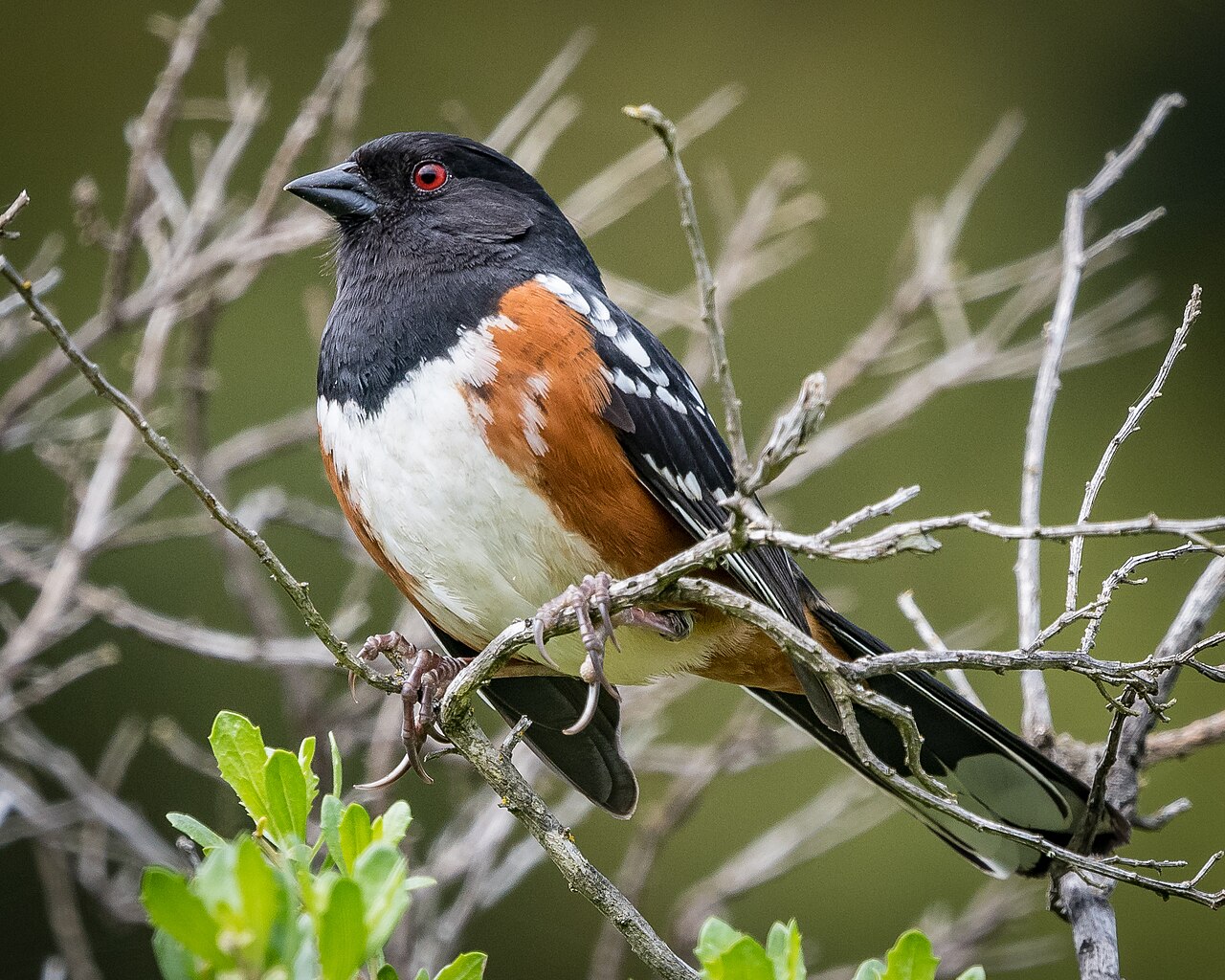
The Spotted Towhee is the western counterpart of the Eastern Towhee: a large, long-tailed sparrow with a black head, rufous flanks and rows of white spots across back and wings. It scratches in the leaf litter under dense shrubs with both feet at once, from southern British Columbia to the mountains of southern Mexico.
Voice
The song lasts about a second and a half and consists of one or two — sometimes up to eight — short introductory notes followed by a fast trill, with the sound of a taut rubber band released or a sheet of paper in a fan. Some birds leave out the introduction. The best-known call is a catlike mew of a little more than half a second, used for scolding and for keeping contact; in flight there is a high, thin note. Birds from Mexico and from Isla Socorro sing audibly differently from those of the western United States.
Recording: Ed Pandolfino — CC BY-NC-SA 4.0 · Round Tent Rd,El Dorado County, California, United States · xeno-canto
Identification
The male has a black head, throat and breast, black upperparts scattered with white spots on the scapulars and wing coverts, rufous flanks, a white belly and a long black tail with white corners. The eyes are red. The female shows the same pattern in grey-brown instead of black. In flight the white tail corners stand out. It usually stays low and forages in the litter with a double backward hop.
Confusion species
Eastern Towhee lacks the white spots on back and scapulars and has largely unmarked black upperparts; the ranges meet on the Great Plains, where intermediates occur. Green-tailed Towhee is far smaller, green above and has a rufous crown with a white throat. Canyon and California Towhees are plain brown, without any black and white pattern. In southwestern Mexico the birds have an olive-brown rather than black back, but the white spots remain.
Habitat
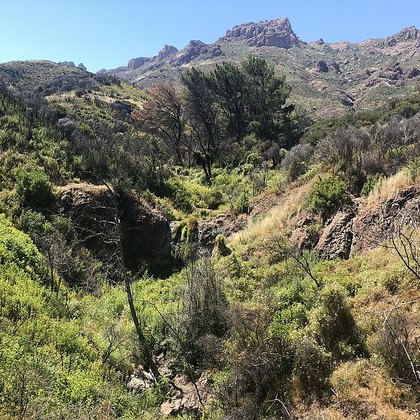
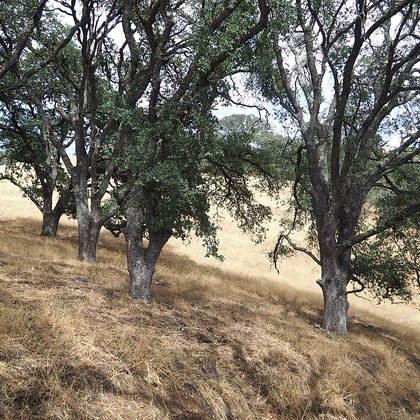
Dry thickets and forest edges: brushy tangles, old fields, chaparral (dense, hard-leaved scrub of California's Mediterranean climate), canyon bottoms and open dry upland forest, always with a dense shrub layer and a thick layer of leaf litter beneath it. It uses gardens and shrubby residential areas. In Mexico it occupies mainly montane pine-oak woodland. Unburned chaparral is preferred, but the bird returns within about fifteen years of a fire once ground cover has recovered.
Where the bird is most often found, arranged by the USNVC — the vegetation classification of the United States and Canada — and CMECS for sea and coast.





Range and movements
Resident in British Columbia, Washington, Oregon, California, Idaho, Nevada, Utah, Arizona, Colorado and New Mexico, and through the Mexican mountains to Oaxaca, with isolated populations on the Baja California peninsula. On the northern and eastern edge — Alberta, Saskatchewan, Montana, Wyoming, the Dakotas and Nebraska — it is a summer bird; those populations winter further south, into Kansas, Oklahoma and Texas. A population on Isla Guadalupe, P. m. consobrinus, is extinct.
- Resident
- Breeding (summer)
- Winter
- Passage
- dark = core range, pale = thinly spread
Where and when to look
Go by sound: the loud rustling in the litter under a shrub is often the first signal, followed by the catlike mew. The bird sits briefly on a low branch before disappearing again — that is the moment for the red eyes and the white spots. In winter along the eastern edge of the range, a feeding station with seed on the ground gives the best chance.
Conservation
Partners in Flight puts the breeding population at about 40 million birds and scores the species 8 out of 20 on the Continental Concern Score. The Breeding Bird Survey showed a stable trend between 1966 and 2019. Development often creates more shrubby ground and so does not work against the species, but it raises mortality from domestic cats. Isolated island populations off California and Mexico are more vulnerable to habitat loss and overgrazing; the IUCN has not yet assessed the species separately since the split from Eastern Towhee.
Scientific name
Pipilo maculatus | Swainson, 1827
Swainson described the species in 1827 as Pipilo maculata; because it still stands in Pipilo, author and year carry no parentheses. The genus Pipilo was introduced in 1816 by Louis Pierre Vieillot, from Latin pipilo 'to chirp'. The species name maculatus is Latin for 'spotted', after the white spots on back and wings. The specimen described came from Real del Monte in the Mexican state of Hidalgo. Until 1995 this bird and the Eastern Towhee formed one species, the Rufous-sided Towhee.