All species › Passerines › New World sparrows › Green-tailed Towhee
Green-tailed Towhee | Pipilo chlorurus
Groenstaarttowie | Rascador cola verde
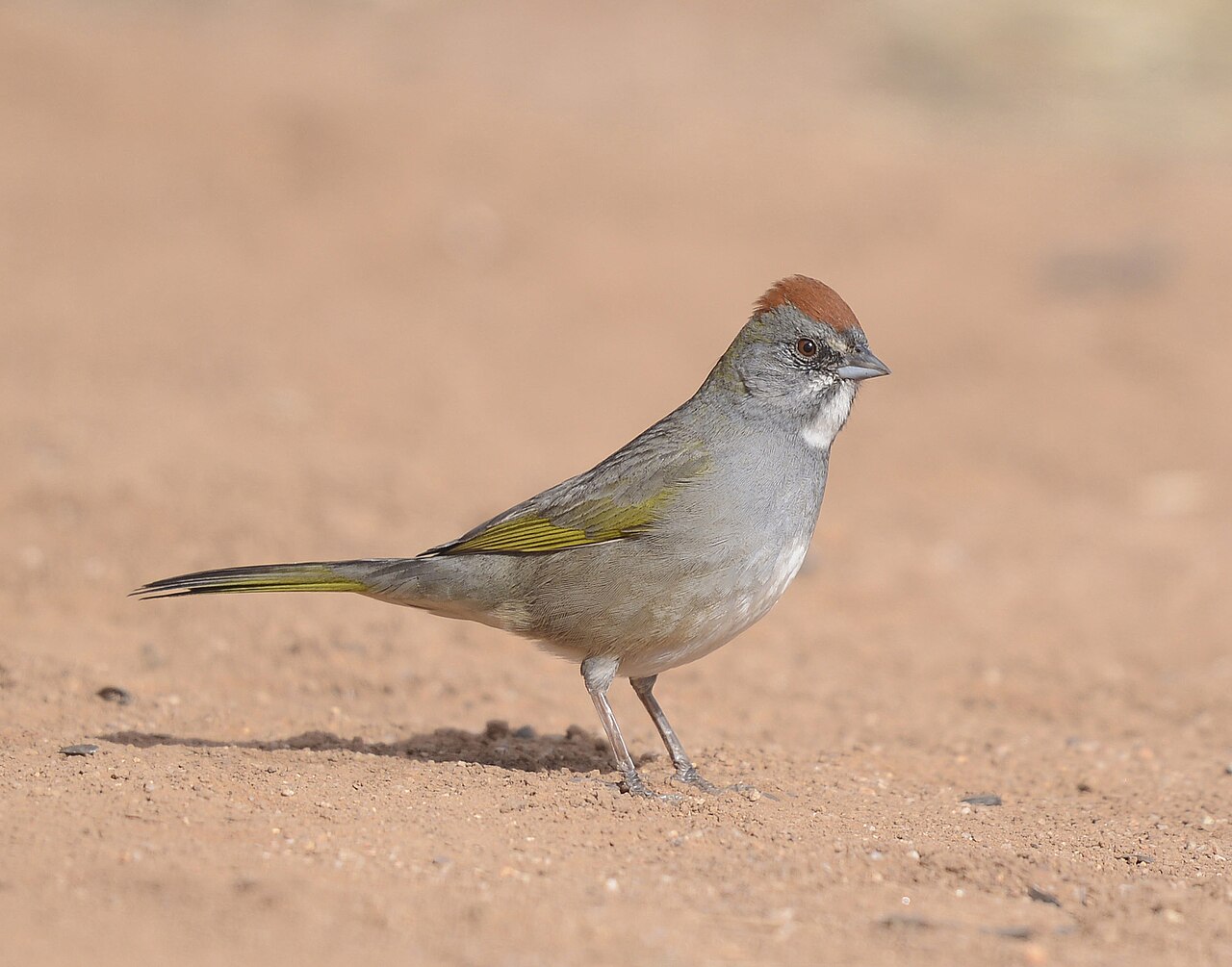
The Green-tailed Towhee is the smallest towhee in North America and the only one with green upperparts. It breeds in shrub vegetation of the western mountains and the sagebrush (grey-green scrub of the dry western interior) steppe and moves in winter to lower desert scrub in the southwestern United States and Mexico.
Voice
The male's song is a long, jumbled series of clear whistles and trills lasting about two and a half seconds; at the height of the breeding season he delivers up to twelve songs a minute. The contact call is a thin, high mew that rises in pitch, used by both sexes while foraging, on leaving the nest and in flight. When threatened the bird gives a sharp, repeated tick.
Recording: Ed Pandolfino — CC BY-NC-SA 4.0 · Upper Barker Pass Rd, Placer County, California, United States · xeno-canto
Identification
A small towhee with a rufous crown, a grey head and neck, a sharply outlined white throat with a white moustache stripe, and olive-green upperparts with yellow-green edges to wing and tail. The underparts are grey and unstreaked. The female is slightly duller than the male. The bird forages on the ground with a forward hop and a simultaneous backward scratch with both feet, and raises its crown feathers when excited.
Confusion species
No other North American sparrow combines a rufous crown with a white throat and green wings and tail. American Tree Sparrow also has a rufous crown, but is streaked brown, smaller and has a dark breast spot. Green-tailed Towhee is considerably smaller than the other towhees and, unlike them, has no brown or black upperparts. In dense scrub you hear it before you see it; the rising mew differs from the flatter mew of Spotted Towhee.
Habitat
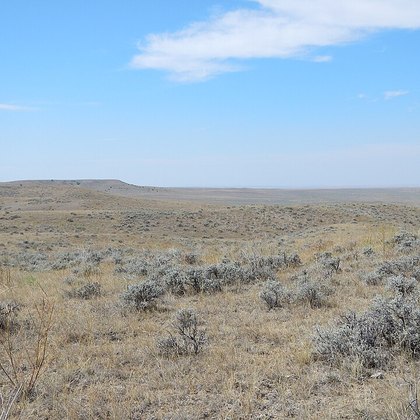
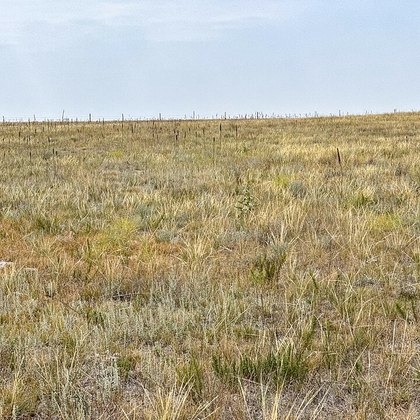
Dense, low shrub in the western mountains, often with scattered trees or cacti: sagebrush steppe with chokecherry, mountain mahogany and juniper, and shrub regrowth on ground opened up by wildfire. It breeds from the lowlands to about 3000 metres. In winter it drops below 1200 metres into dry arroyos (dry, steep-sided gullies that carry water only after rain), mesquite thickets, oak-juniper woodland and desert grassland.
Where the bird is most often found, arranged by the USNVC — the vegetation classification of the United States and Canada — and CMECS for sea and coast.



Range and movements
Breeds in the western United States, from eastern Washington and Idaho through Montana, Wyoming, Nevada, Utah and Colorado south to California, Arizona and New Mexico. All of the world population spends part of the year in the United States and 61 per cent winters in Mexico, roughly from Sonora and Chihuahua south to Jalisco, Michoacán, Hidalgo and Oaxaca, plus the Baja California peninsula. Small numbers stay in southern California, central Arizona and West Texas. Vagrants have reached Manitoba and Nova Scotia.
- Resident
- Breeding (summer)
- Winter
- Passage
- dark = core range, pale = thinly spread
Where and when to look
Look for it in May and June on a sagebrush slope or in an old burn, where males sing from the top of a shrub. Later in the season it keeps mostly to the ground; the rising mew from a bush gives it away, and waiting a moment for it to appear on the shrub top usually suffices. Then look at the crown and throat rather than the green, which reads as grey in shade.
Conservation
The species is listed as Least Concern (LC). Partners in Flight puts the breeding population at 4.1 million birds; the Breeding Bird Survey showed a stable trend between 1966 and 2014. The pressure lies in the condition of the sagebrush steppe: grazing, conversion to cropland and an altered fire regime remove the shrub layer or burn it too often. Because the species benefits from shrub regrowth in the first years after a fire, fire management largely sets how much breeding habitat exists.
Scientific name
Pipilo chlorurus | (Audubon, 1839)
John James Audubon described the species in 1839 as Fringilla chlorura; because it later moved to Pipilo, author and year stand in parentheses. The genus Pipilo was introduced in 1816 by Louis Pierre Vieillot, from Latin pipilo 'to chirp'. The species name chlorurus is from Greek khlōros 'green' and -ouros '-tailed', hence 'green-tail' — the same meaning as the English and Dutch names. The type locality was later fixed at Ross' Creek near Blackfoot, Bingham County, Idaho.