All species › Gamebirds › Partridges, pheasants, grouse and allies › Spruce Grouse
Spruce Grouse | Canachites canadensis
Bossneeuwhoen | Gallo Canadiense
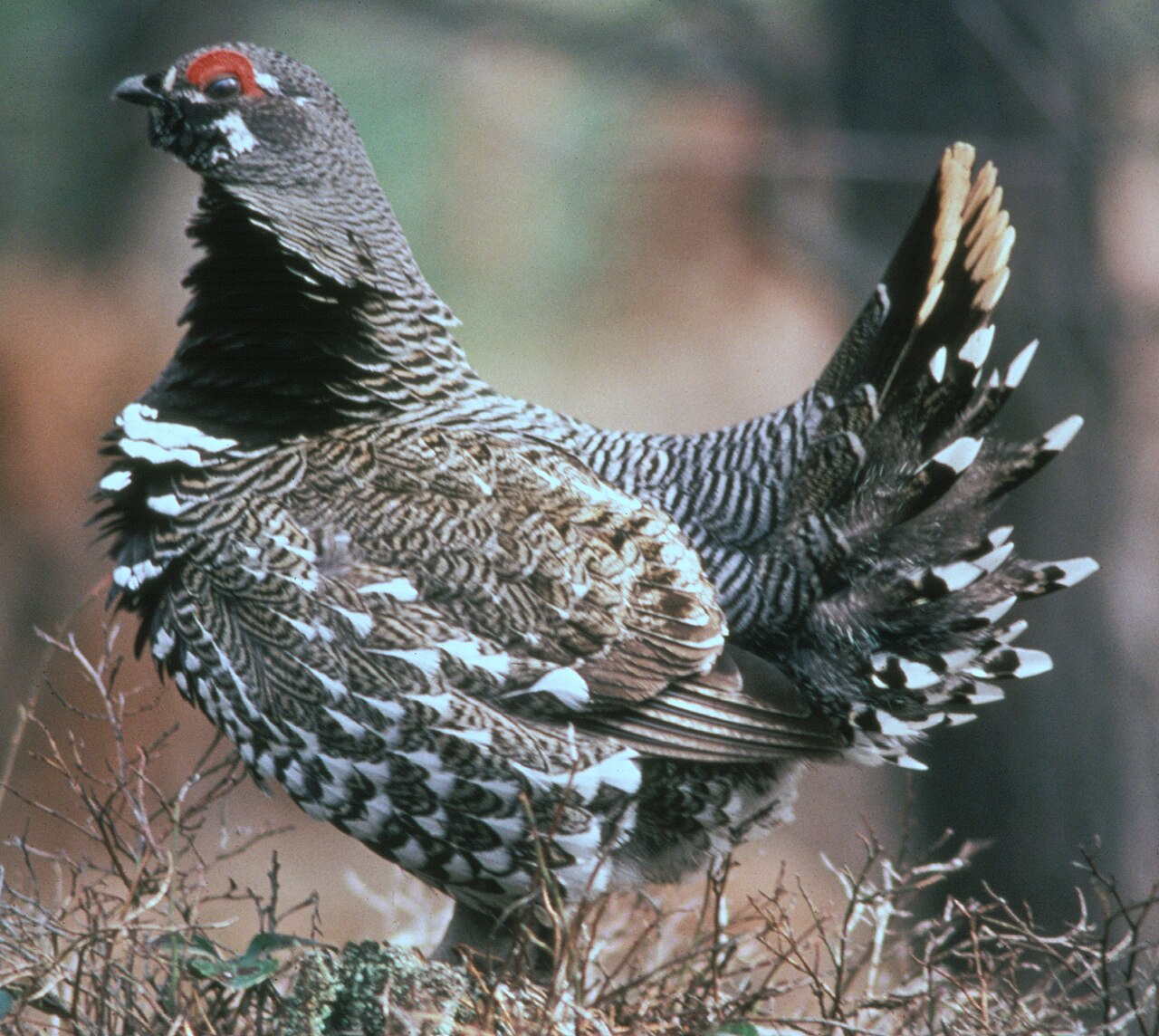
Spruce Grouse is the grouse of the dark boreal conifer forest of the far north, a study in camouflage among the spruces until the male fans his bright red eyebrow comb in display. It is unwary of people — a trait that earned it the nickname 'fool hen' — and can sometimes be approached by hand. Unlike the bare-tundra ptarmigans, it lives in closed forest all year round.
Voice
The male displays with a soft series of dull, clucking notes, often barely audible at any distance, sometimes accompanied by a short drumming clap of the wings during a short hop from branch to branch. When disturbed it makes little noise, more likely to walk off or freeze than to call. Its voice is the softest and least conspicuous of any grouse in this guide, fitting for a bird that survives by going unnoticed.
Recording: Thomas Magarian — CC BY-NC-SA 4.0 · Two Medicine, GNP, Glacier County, Montana, United States · xeno-canto
Identification
The male is mostly blackish grey with a black throat and breast edged in white, and a red, fleshy eyebrow comb above the eye that swells during display. The female is warm rusty brown to grey and variable in colour, largely lacking the red comb. Both sexes have a relatively long, rounded, dark tail, often edged with a narrow rusty band at the tip. The silhouette is compact, with a small head and short bill suited to a diet of conifer needles.
Confusion species
Dusky and Sooty Grouse (Dendragapus obscurus and Dendragapus fuliginosus) of the western mountain forests are larger and more uniformly blue-grey, without the male Spruce Grouse's sharp black-and-white breast pattern, and largely lack the red eyebrow comb outside display. Ruffed Grouse (Bonasa umbellus) of mixed woodland is more rufous, has a fan-able neck ruff rather than a red eye-comb, and a clearly banded rather than plain tail. Females of these species are the most alike and are mainly separated by habitat and range.
Habitat
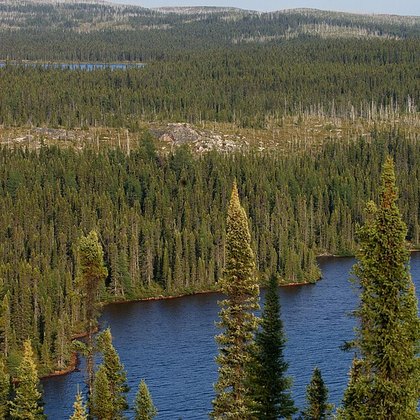
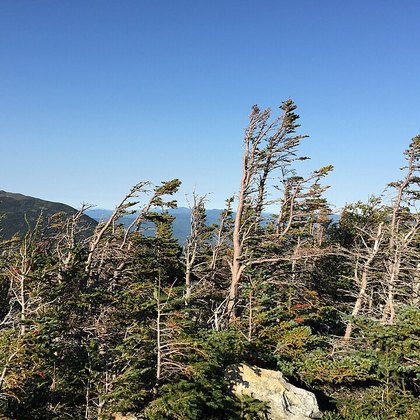
Spruce Grouse lives in boreal conifer forest, especially young to middle-aged spruce stands with a dense understorey of shrubs and moss, and in the boggy, peaty 'muskeg (boggy peatland with spruce, typical of boreal Canada)' forest that dominates much of the north. In the western mountains it also occurs in conifer forest high toward the treeline, staying close to low krummholz. It avoids open tundra and bare rock, the domain of the ptarmigans, entirely; what it needs is a closed canopy for cover from raptors.
Where the bird is most often found, arranged by the USNVC — the vegetation classification of the United States and Canada — and CMECS for sea and coast.


Range and movements
Resident across almost the entire boreal conifer belt of North America: from Alaska through all of Canada to Newfoundland and Labrador, and south in the United States into northern New England, the Adirondacks of New York, the Great Lakes states, and the conifer forests of the northern Rocky Mountains south to Oregon and Washington. The species barely moves: individual birds usually stay within a few hundred metres of their birthplace for life. On Newfoundland it was successfully introduced during the twentieth century to areas where it did not naturally occur.
- Resident
- Breeding (summer)
- Winter
- Passage
- dark = core range, pale = thinly spread
Where and when to look
Walk quietly through young spruce forest in the early morning and watch the forest floor for movement rather than listening — this is the quietest grouse on the continent. Once you find one you can often approach closer than with any other wild grouse: Spruce Grouse relies on its camouflage and will sit tight until you almost walk past it.
Conservation
Not threatened at the continental scale, but locally declining at the southern edge of the range, where logging of old conifer forest and conversion to hardwood fragments its habitat. In the core of the boreal forest, where little logging occurs, numbers remain stable.
Scientific name
Canachites canadensis | (Linnaeus, 1758)
Linnaeus described the species in 1758 as Tetrao canadensis, among the grouse of the genus Tetrao; since it was placed in another genus, author and year stand in parentheses. This species now stands in the genus Canachites, Greek for 'rustling' or 'resounding', after the drumming wing-clap of the display hop — many older sources still use the genus Falcipennis. canadensis means 'from Canada', after the type locality on Hudson Bay.