All species › Gamebirds › Partridges, pheasants, grouse and allies › Gray Partridge
Gray Partridge | Perdix perdix
Patrijs | Perdiz pardilla
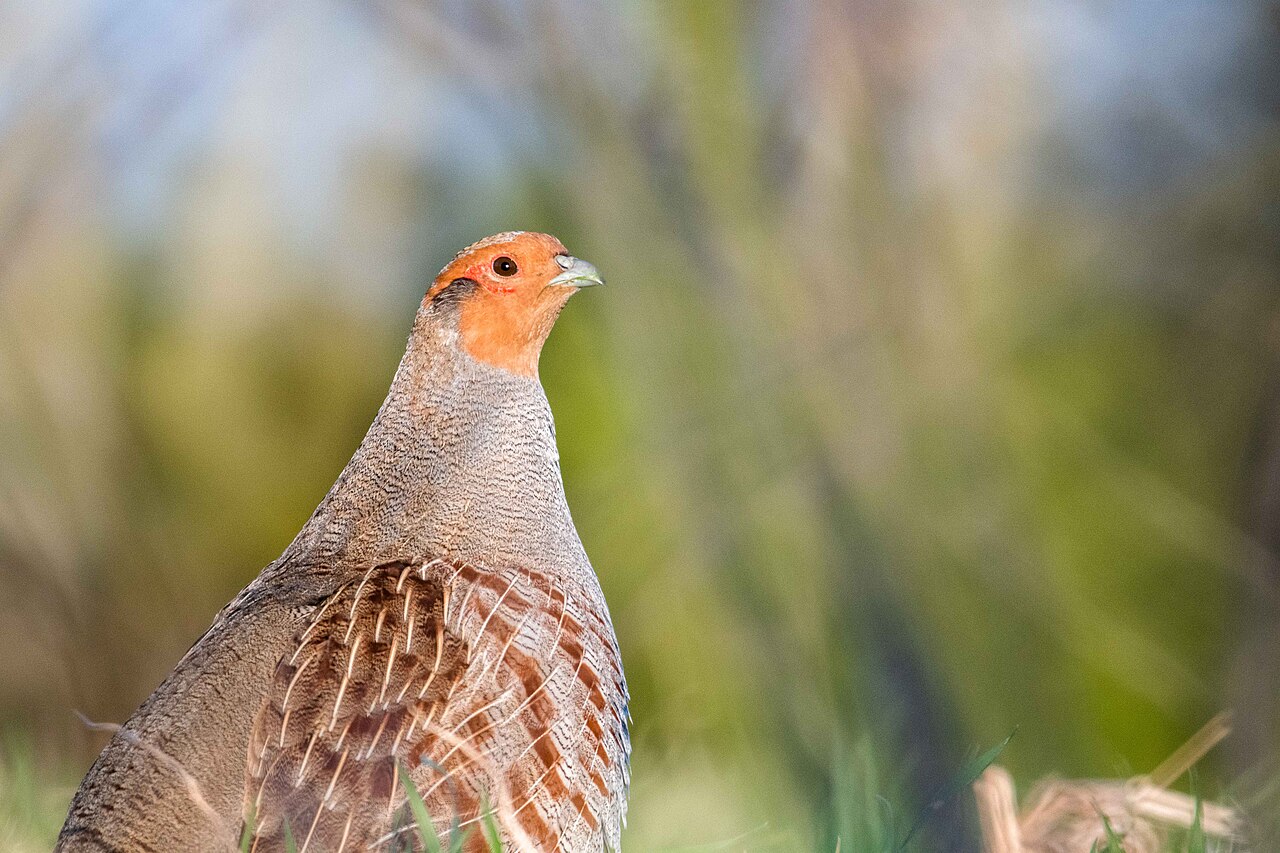
In North America the Gray Partridge is not a native bird but one brought over from Europe, which after decades of releases in the early twentieth century found a lasting foothold on the northern prairies and around the western Great Lakes. It is a stocky, short-tailed gamebird of open farmland, with an orange-brown face and, in the adult male, a dark horseshoe-shaped patch on the belly. In its new range it is usually called, as in Europe, the 'Hungarian partridge', after the country many of the released birds came from.
Voice
The call is a hoarse, grating kirr-ik or keeh-ik, usually heard at dusk and early morning and often the first sign of its presence in an otherwise quiet farmed landscape. When flushed — usually only when you are almost on top of them — the whole family group bursts up together with a fast, cackling shriek. Outside the breeding season partridges keep the covey together with short, soft contact calls.
Recording: Musse Björklund — CC BY-NC-SA 4.0 · Brumstorp, Värsås Västra Götalands län, Sweden · xeno-canto
Identification
A stocky, rounded gamebird with a short, rufous tail that shows well when it flushes. The face and throat are orange-brown, the rest of the body grey-brown with fine barred patterning and, in the adult male, a dark horseshoe-shaped patch on the belly that is smaller or absent in the female. Juveniles are more evenly brown-streaked, lack the belly patch and show a less distinct face pattern, and can be told from adults into autumn. In flight it shows short, rounded wings and a fast alternation of whirring wingbeats and glides, low over the field.
Confusion species
Across most of its North American range Gray Partridge is the only gamebird of its size in open farmland and is rarely confused; where it overlaps with Ring-necked Pheasant (Phasianus colchicus) the difference in size is immediately obvious, the pheasant being much larger and long-tailed. Young partridges without a belly patch can be mistaken at a distance for a small covey of quail, but the native quail of this region are smaller and lack the orange-brown face pattern.
Habitat
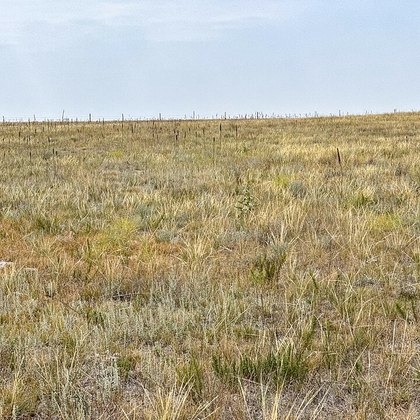
In North America Gray Partridge is entirely tied to arable farmland: grain fields, fallow strips, ditch edges and the remnants of native prairie in between. It nests in the cover of low, dense herbage along field margins and ditches and forages by day in the open fields themselves, chiefly on weed seeds and waste grain, with insects for the chicks. It avoids large-scale, uniform farmland without odd corners and rough edges; it is the small-scale patchwork of older-style farming that has kept it going longest here.
Where the bird is most often found, arranged by the USNVC — the vegetation classification of the United States and Canada — and CMECS for sea and coast.


Range and movements
Between 1900 and 1910 tens of thousands of partridges trapped in Europe were released across the United States, from California to New Jersey; only on the northern Great Plains and around the western Great Lakes did the birds take hold permanently. Today the species is resident in northern Montana, Wyoming, North and South Dakota, Nebraska, Minnesota, Iowa, Wisconsin, Idaho, Oregon and Washington, and in the adjoining Canadian prairie provinces of Alberta, Saskatchewan and Manitoba, with a smaller population in southern British Columbia. Since the 1960s the species has been declining gradually as farming has consolidated into larger fields.
- Resident
- Breeding (summer)
- Winter
- Passage
- dark = core range, pale = thinly spread
Where and when to look
Look for it along gravel roads through farmland in early morning, when family coveys — sometimes twenty birds strong — forage along the verges and, at the approach of a car, tend to run rather than fly. In winter, after fresh snow, a covey on a ploughed field with waste grain can be spotted from a considerable distance.
Conservation
Least Concern (LC) globally, but slowly declining in North America since the mid-twentieth century, mainly because farming has shifted to larger, more uniform fields with fewer odd corners, hedgerows and fallow strips. Locally, especially in parts of the northern Great Plains, it remains a valued game bird with managed populations; elsewhere, such as across much of Wisconsin, it has now largely disappeared.
Scientific name
Perdix perdix | (Linnaeus, 1758)
Linnaeus described the species in 1758 as Tetrao Perdix, among the grouse of the genus Tetrao; since it was placed in the genus Perdix, author and year stand in parentheses. Perdix is both the Greek and the Latin word for 'partridge' — the species name simply repeats the genus name. The type locality is 'Europe', later restricted to Sweden, well outside the North American range this page describes.