All species › Waders, gulls and terns › Sandpipers and allies › Stilt Sandpiper
Stilt Sandpiper | Calidris himantopus
Steltstrandloper | Correlimos zancolín
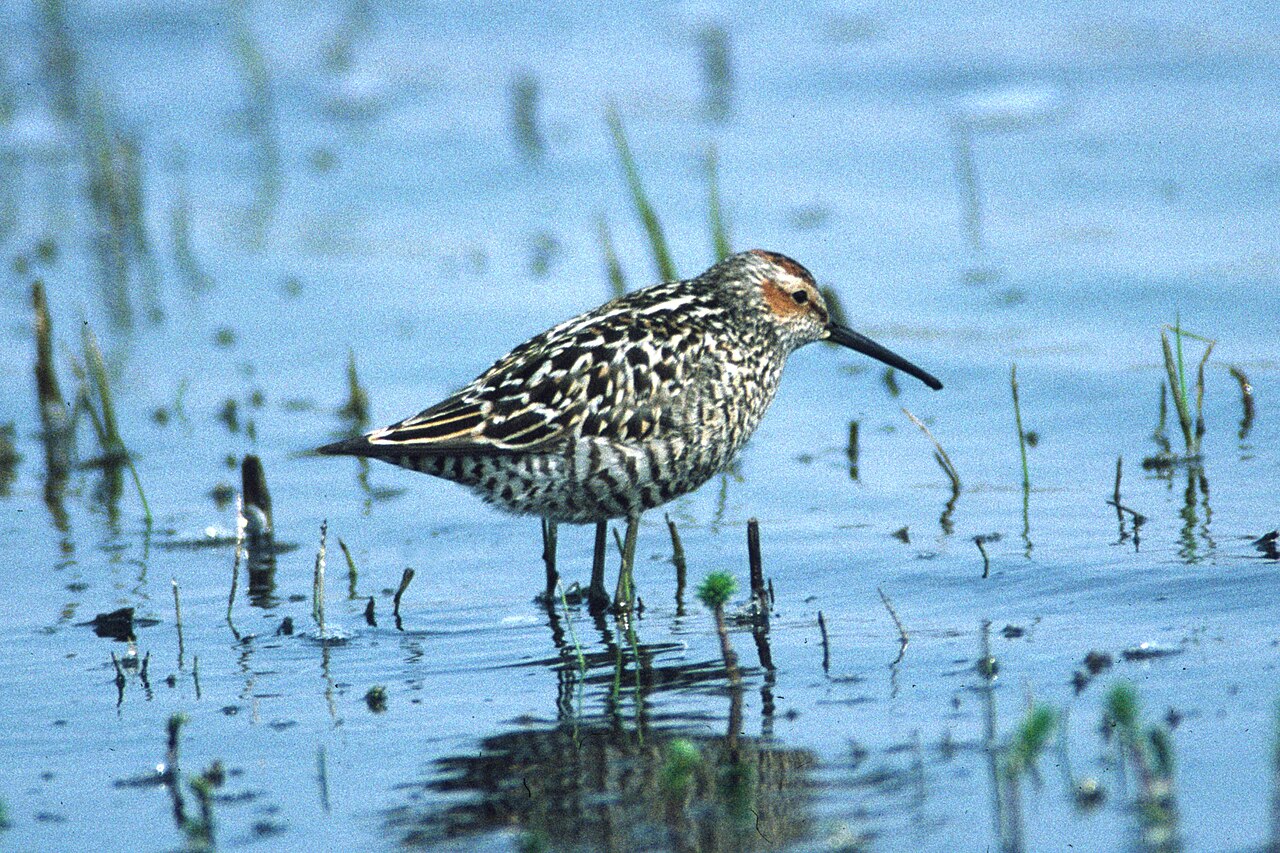
The Stilt Sandpiper is the sandpiper that behaves like a snipe: on long greenish-yellow legs it wades belly-deep into shallow fresh water and probes straight down into soft mud. It is a bird of rain pools and flooded pastures inland, not of the beach. More than half of the population has disappeared in fifty years.
Voice
Away from the breeding grounds it is a quiet bird; what you hear is a low, clipped rrit, often from a flock passing overhead. In squabbles at the water's edge it gives a buzzy bzzr that recalls a nighthawk. Over the tundra the male sings in flight: a crescendo of harsh grating trills ending in a rising, nasal errreee. On migration through the United States and Canada you will hear little more than the short call, and it is often drowned out by the noise of a mixed flock of shorebirds.
Recording: Andrew Spencer — CC BY-NC-SA 4.0 · Dalton Highway, Mile 405 Pipeline Access Road, North Slope Borough, Alaska, United States · xeno-canto
Identification
A medium-sized shorebird with long greenish-yellow legs, a long slim neck and a fairly slender bill that droops slightly at the tip. In breeding plumage the underparts are barred throughout in dark brown and white, with a chestnut cheek and crown, a pale line above the eye and a dark line in front of it. In winter plumage it is plain grey above and white below with a dusky breast and a white eyebrow; juveniles are darker and look scaly because of neat pale edges to the back feathers. In flight the white rump shows well and the feet project far beyond the tail. Male and female are alike, though the female averages slightly larger and longer-billed.
Confusion species
The likeliest confusion is with the dowitchers: Long-billed and Short-billed Dowitcher (Limnodromus scolopaceus and L. griseus) have shorter legs, a longer and straighter bill and a darker back. Lesser Yellowlegs (Tringa flavipes) is larger, has a straight bill and far brighter yellow legs. Pectoral Sandpiper (Calidris melanotos) has a shorter bill and a sharp border between the streaked breast and the white belly. In Europe the counterpart is Curlew Sandpiper (C. ferruginea), which has black legs and a more evenly curved bill.
Compare sandpipers, snipes and allies: bill, legs, wing bar and rump
Habitat
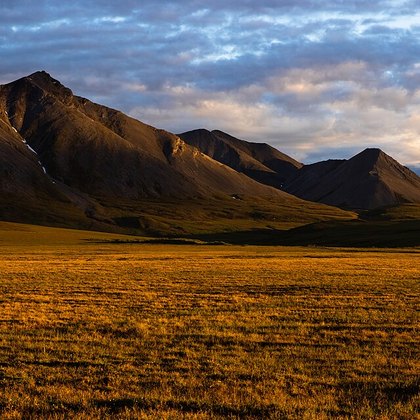
On migration and in winter this is a bird of shallow fresh water: prairie rain pools, freshwater marshes, the weedy margins of reservoirs, sewage lagoons and flooded pastures and fields. It avoids sandy beaches and surf, and is far scarcer on salt mudflats than most sandpipers. What it wants is water up to its belly over a soft bottom in which it can probe vertically, the way a snipe does. On the breeding grounds it takes moist sedge meadows and drier ridges in low arctic tundra, among dwarf birch and willow.
Where the bird is most often found, arranged by the USNVC — the vegetation classification of the United States and Canada — and CMECS for sea and coast.




Range and movements
It breeds in a narrow band of tundra from the North Slope of Alaska east through Yukon, the Northwest Territories and Nunavut to Hudson Bay. Migration runs mainly over the Great Plains: in August the largest flocks stand on the prairie pools of the Dakotas, Nebraska and Kansas. On the Atlantic coast it is regular in autumn but in small numbers, on the Pacific coast it is rare. Most of the population winters in South America, from Peru and Brazil south to the Argentine pampas — beyond the guide area; smaller numbers stay in Florida, along the Gulf Coast, in Mexico and in the Caribbean.
- Resident
- Breeding (summer)
- Winter
- Passage
- dark = core range, pale = thinly spread
Where and when to look
Look for it in August and early September on a shallow freshwater pool holding dowitchers: among those short-legged birds it stands out by its long greenish-yellow legs and clean white eyebrow. Watch the way it feeds — it wades deeper than the rest and probes with head and neck under water and the tail tipped up. In spring, in May, the best chance is in the midwestern states, and then it wears its distinctive barred breeding plumage.
Conservation
The world population is put at about 1.2 million birds, but more than half has been lost in fifty years and the decline has accelerated over the past decade. In northern Canada, where Snow Geese graze the tundra bare, breeding numbers fell by some ninety per cent in thirty years. Oil and gas development on the breeding grounds, the loss of inland wetlands along the migration route and hunting in the Caribbean and South America all add to the pressure. The IUCN therefore lists it as Near Threatened (NT).
Scientific name
Calidris himantopus | (Bonaparte, 1826)
Charles Lucien Bonaparte described the species in 1826 as Tringa himantopus; because it was later moved to Calidris, author and year stand in parentheses. For a long time it even had a genus of its own, Micropalama. himantopus is Greek for 'strap-foot', from himas (strap) and pous (foot) — the same word as the genus name of the stilts, and a reference to the long, thin legs. The genus name Calidris goes back to kalidris, the word Aristotle used for a grey waterside bird. The described specimen came from Long Branch, New Jersey.