All species › Waders, gulls and terns › Sandpipers and allies › Curlew Sandpiper
Curlew Sandpiper | Calidris ferruginea
Krombekstrandloper | Correlimos zarapitín
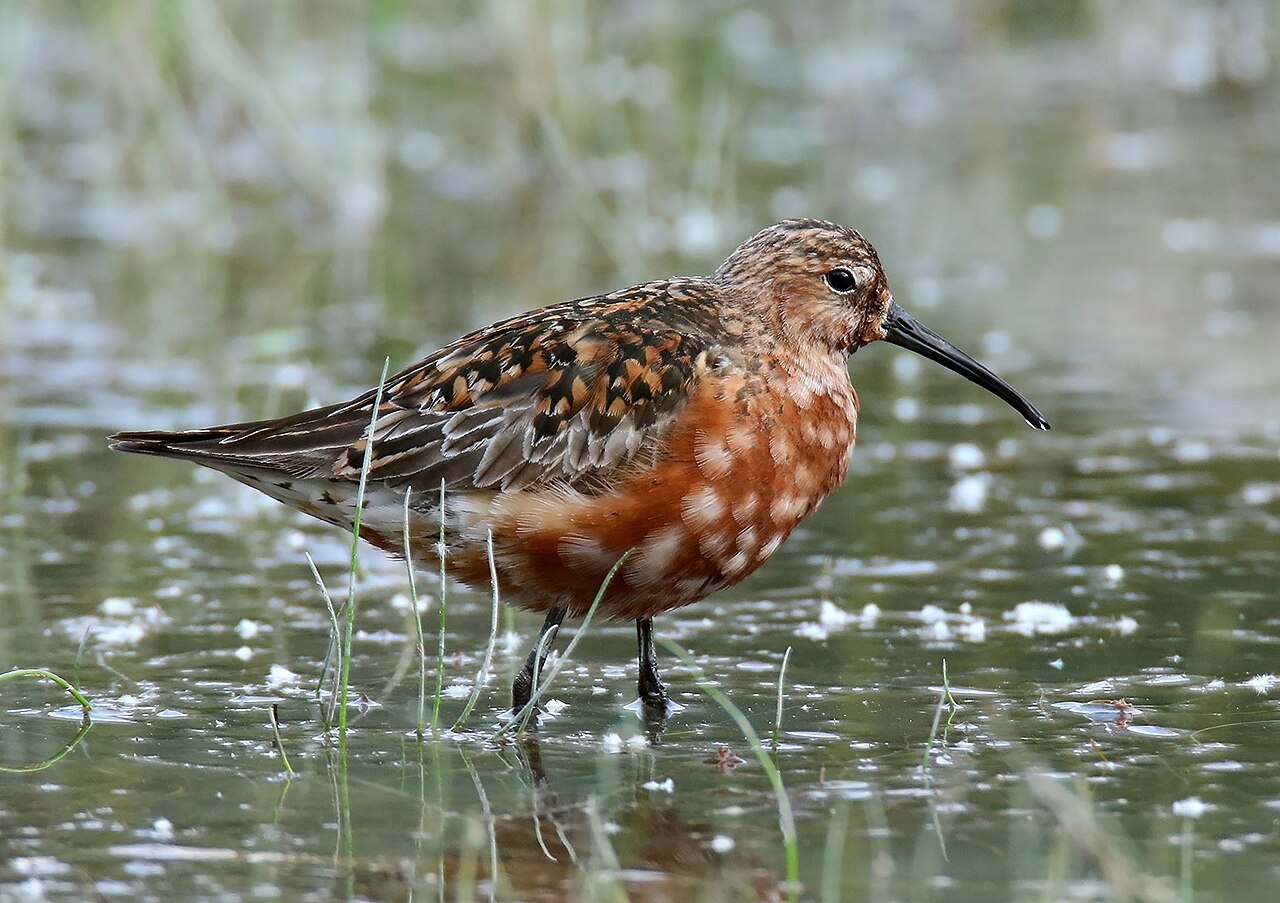
Curlew Sandpiper is a slim wader with long legs and an evenly downcurved bill, brick red over head, neck and belly in spring. It breeds on the drier tundra of northern Siberia and winters from Africa to Australia. It very rarely breeds in North America: a few birds turn up each year, nearly all of them on the Atlantic coast.
Voice
The flight call is a short, slightly burry chirrup, softer and fuller than the rasping kree of Dunlin, and usually all you hear from a stray bird. In alarm both sexes give a hard, carrying whik whik whik. On the breeding grounds the male sings a series in parts: short introductory notes first, then a high twittering that runs up and down, and finally low, plaintive whistles. Single pieces of that song are used as calls away from the display flight as well. Outside the breeding season the species is not loud, but in a flock of Dunlin the different call sometimes betrays it before the eye does.
Recording: Xavier Riera — CC BY-NC-SA 4.0 · Baix Ebre (near L'Ampolla), Tarragona, Catalunya, Spain · xeno-canto
Identification
In breeding plumage head, neck, breast and belly are deep brick red, with white feather tips that fade the red by the end of the season; the upperparts are a coarse pattern of black, rufous and grey. The female is usually duller and shows more white on the belly than the male. In winter plumage the bird is plain grey above and white below, with a long, clear white eyebrow. Juveniles have neat, pale-edged feathers that give the back a scaly look, and a peach-buff wash across the breast. The bill is black, long and evenly downcurved along its whole length; the legs are black and longer than in most sandpipers, so the bird stands taller. In flight a broad white band across the rump is the quickest mark.
Confusion species
Dunlin (Calidris alpina) is always the species at issue: shorter in the leg, with a thicker bill that kinks only at the tip, a dark line down the centre of the rump and, in breeding plumage, a black belly patch instead of a red one. Stilt Sandpiper (C. himantopus) also shows a white rump but has greenish-yellow legs, a straighter bill and barred underparts in breeding plumage. Red Knot (C. canutus) is larger and heavier, with a short straight bill. Given a flock of Dunlin, look for the bird that stands taller and longer and keeps half a step ahead; when it flies, the white rump band settles it.
Habitat
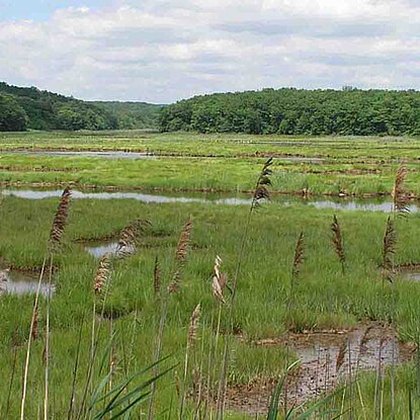
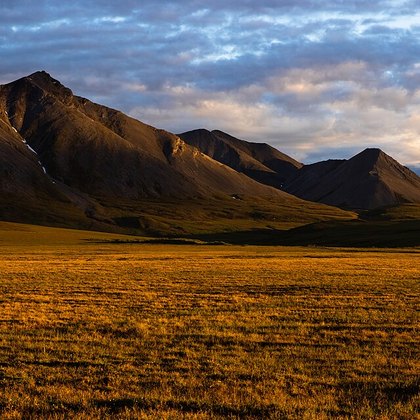
Outside the breeding season this is a bird of shallow salt and brackish water: tidal flats and the muddy edges of estuaries, salt marsh pools, salt pans, coastal impoundments and lagoons. It wades deeper than Dunlin while doing so, up to the belly, and probes fast and repeatedly with the long bill in soft mud. Inland it uses lake shores, rice fields and sewage ponds. Away from the breeding grounds it is almost always in flocks, in Africa and Asia in hundreds or thousands and often among Dunlin. It breeds on the drier tundra of northern Siberia, on ridges with lichen and dwarf willow close to wet hollows.
Where the bird is most often found, arranged by the USNVC — the vegetation classification of the United States and Canada — and CMECS for sea and coast.



Range and movements
The breeding range runs from the Yamal Peninsula eastward to northwestern Chukotka, the New Siberian Islands included. It winters from southern Europe and the whole of Africa eastward across southern Asia to Taiwan and the Philippines and south to Australia and Melanesia. Of all the Siberian sandpipers it strays furthest: a few birds reach the Atlantic coast of North America every year, from New England to the mid-Atlantic states, and further off there are scattered records as far as Florida, California and western Alaska. Most of those birds are adults still in breeding plumage; they appear in May and again from July to September. A nest has been found once at Point Barrow in Alaska, but in most years the species is absent there altogether.
Where and when to look
The best chance runs from late July into early September at a coastal impoundment or a salt pan on the east coast, in a flock of Dunlin on a rising tide. Work along the flock for a bird that stands a little taller, is longer in the bill and wades deeper than the rest. Then let the flock get up, or wait until it does of its own accord: the broad white rump band shows at a distance and leaves no doubt.
Conservation
The Red List holds the species as Vulnerable (VU). The world population is put at 420,000 to 960,000 birds and fell by 30 to 49 per cent between 2010 and 2024. The loss of tidal flats at the stopovers, from the Yellow Sea to the coasts of West Africa, counts as the heaviest cause, with hunting and the warming of the breeding range beside it. Breeding success depends strongly on the lemming cycle in Siberia: in years with few lemmings, Arctic foxes and jaegers turn to the nests and hardly any young birds come through, which shows directly on the Atlantic coast of North America in the number of juveniles that appear.
Scientific name
Calidris ferruginea | (Pontoppidan, 1763)
Erik Pontoppidan described the species in 1763 as Tringa Ferrugineus, in the first volume of Den Danske Atlas; since it was placed in the genus Calidris, author and year stand in parentheses. ferruginea is Latin for 'rust-coloured', from ferrugo, 'iron rust', after the brick-red breeding plumage. The original name still carried the masculine ending ferrugineus; that was adjusted on the move to the feminine genus name Calidris. No type locality was fixed with this description. The genus Calidris goes back to the Greek kalidris, in Aristotle the name of a grey speckled bird of the waterside.