All species › Waterfowl › Ducks, swans and geese › Surf Scoter
Surf Scoter | Melanitta perspicillata
Brilzee-eend | Negrón careto
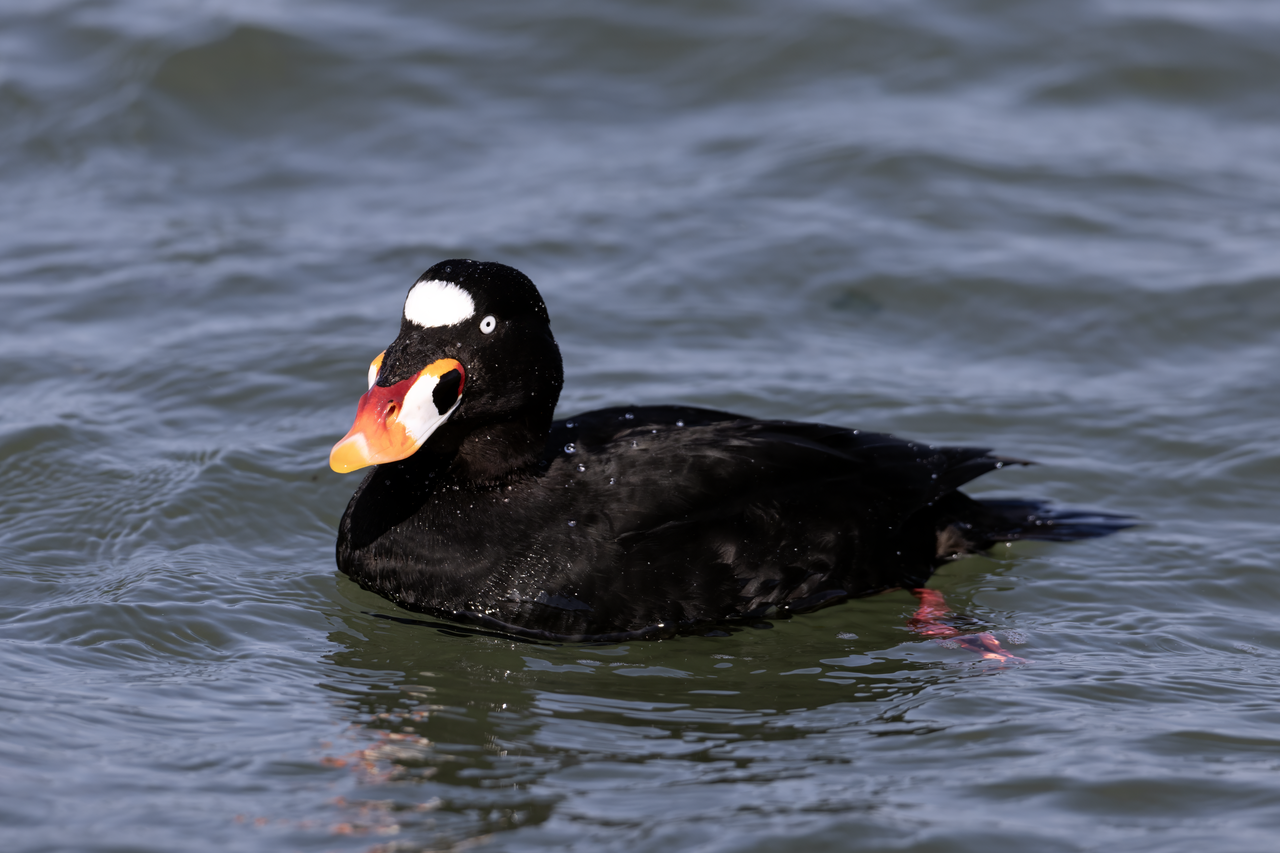
The Surf Scoter is the most colourful of the three scoters: the male carries a large, black-white-and-orange blocked bill and two sharply defined white patches on an otherwise jet-black head. It owes its English name to its preference for exactly the zone where the waves break, closer to the surf than most other sea ducks venture. The species breeds only in Canada and Alaska and does not occur anywhere outside North America.
Voice
In courtship males make a low, gurgling sound followed by an explosive puk-puk, while females defending young give a hoarse, crow-like call. Alarmed birds give a short, guttural guk, somewhere between a cluck and a knock. Large flocks at sea are mostly silent, and the most noticeable sound is then the clatter of a flock taking flight.
Recording: Stanislas Wroza — CC BY-NC-SA 4.0 · La Haute-Côte-Nord Regional County Municipality (near Les Escoumins), Côte-Nord, Quebec, Canada · xeno-canto
Identification
The male is glossy black with a white patch on the forehead and a triangular white patch on the nape, and a heavy, square-looking bill patterned in orange, yellow, white and red. The female is browner with vague pale patches on the cheeks and sometimes a pale nape patch, and lacks the male's colourful bill. Juveniles resemble the female but are paler and browner, with a dull whitish belly. In all plumages the heavy bill with its squarish base at the forehead stands out, distinctive for the species and different from the other two scoters in this chapter.
Confusion species
White-winged Scoter (Melanitta deglandi) has a white wing patch visible in flight and sometimes on the water, which Surf Scoter never shows; that species' female also has a rounder head and a slimmer bill. Black Scoter (Melanitta americana) lacks any white on the head or wing of the male and has a distinctly smaller, plain yellow rather than multicoloured bill knob. Females of the three species are the biggest challenge and are most reliably told apart by bill shape and head profile, not colour alone.
Habitat
Breeds at the edge of the boreal forest belt, on shallow lakes and pools in open conifer forest and tundra transition zones. Outside the breeding season it is the scoter of the surf zone par excellence: it feeds just behind the breaking waves along rocky and sandy coasts, diving for mussels and other shellfish, and on migration it also occurs on large inland lakes and reservoirs. It uses sheltered, fully calm water less than the other two scoters; the turbulence of the surf seems to draw it in.
Where the bird is most often found, arranged by the USNVC — the vegetation classification of the United States and Canada — and CMECS for sea and coast.



Range and movements
Breeds from mainland Alaska through subarctic Canada eastward to Labrador. Winters along the Pacific coast from the eastern Aleutians to deep into Mexico, as far as Baja California, and along the Atlantic coast from Prince Edward Island to North Carolina. Some immature birds skip the northward migration to the breeding grounds entirely and remain year-round in bays and estuaries as far south as Baja California or New Jersey.
- Resident
- Breeding (summer)
- Winter
- Passage
- dark = core range, pale = thinly spread
Where and when to look
Look for it just behind the breaking waves on a beach with moderate surf, closer to shore than the other scoters usually sit. The combination of the black-white-orange bill and the two white head patches is visible in good light at a considerable distance, even without a scope.
Conservation
Not threatened, with a world population estimated between a quarter million and just over a million birds, although it has declined by tens of per cent over recent decades. Oil spills in the wintering areas, parasites and starvation are the main direct causes of death, and eagles and mustelids prey on the birds on the water and along the coast. Because most of the year is spent at sea, the precise cause of the decline remains hard to pin down.
Scientific name
Melanitta perspicillata | (Linnaeus, 1758)
Linnaeus described the species in 1758 as Anas perspicillata, among the ducks; because it was later placed in another genus, author and year stand in parentheses. The genus Melanitta was introduced in 1822 by Friedrich Boie, from the Greek melas, 'black', and netta, 'duck'. The species name perspicillata is modern Latin for 'spectacled', from perspicere, 'to see through', and refers to the white patches on the forehead and nape that seem to frame the black of the head like a pair of spectacles. The type locality is Hudson Bay, based on an eighteenth-century plate by George Edwards.