All species › Waterfowl › Ducks, swans and geese › Black Scoter
Black Scoter | Melanitta americana
Amerikaanse zwarte zee-eend | Negrón americano
The Black Scoter is the plainest of the three scoters in this chapter: the male is entirely black from head to tail, broken only by a bright yellow, swollen bill knob. It breeds in small numbers on remote tundra pools in the far north and spends the rest of the year in dense, noisy flocks at sea. Until recently it was treated as the same species as the Eurasian Common Scoter (Melanitta nigra), from which it differs mainly in its courtship call and the shape of the bill knob.
Voice
The male courts with a melodious, whistled pyoo-pyoo-oo, unusually musical for a scoter and clearly different from the shorter, harsher call of the Eurasian Common Scoter. Groups of displaying males often call together, so that a whistling chorus carries across the water and can be heard from a considerable distance. The female is far quieter and mainly gives a low, hoarse croak when startled.
Recording: Stanislas Wroza — CC BY-NC-SA 4.0 · Stationnement des dunes (near Tadoussac), Côte-Nord, Québec, Canada · xeno-canto
Identification
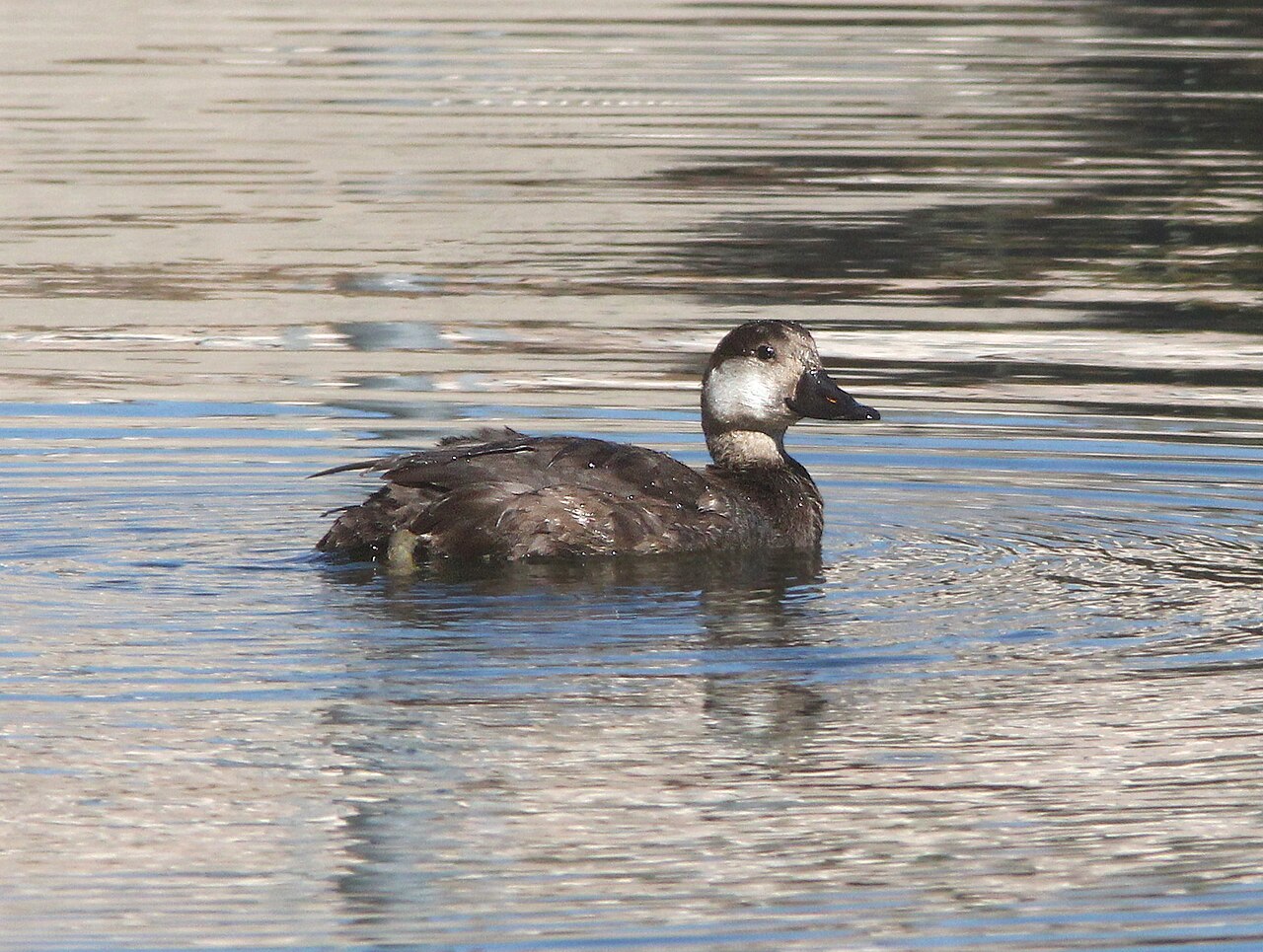
The male is the only scoter with a wholly glossy black plumage, broken by a large, bright yellow, swollen knob at the base of the bill. The female is dark brown with a sharply contrasting pale cheek and throat against a dark cap, lacks the male's knob, and has an evenly dark bill. Juveniles resemble the female but are generally paler below. In flight the species shows no white in the wing at all, unlike the other two scoters in this chapter, and flies in long, undulating lines low over the water.
Confusion species
Surf Scoter (Melanitta perspicillata) and White-winged Scoter (Melanitta deglandi) are the obvious confusion species: both show white on the head or in the wing of the male, while Black Scoter is the only one that is wholly black. Females of the three species are harder to separate; focus on head shape and the sharpness of the pale cheek patch — in Black Scoter it is fairly large and clearly bordered. In Europe and Asia the closely related and similar Common Scoter (Melanitta nigra) occurs, with a smaller, less swollen bill knob on the male; the two species do not overlap in North America during the breeding season.
Habitat
Breeds on isolated pools and small lakes in open tundra and subarctic conifer forest, usually not far from the coast and without dense shoreline vegetation. Outside the breeding season it is a true sea duck of sheltered bays, reefs and shallow coastal waters with a sandy or gravelly bottom, where it dives for mussels and other shellfish. It makes little use of deep open water without shellfish beds, and almost never uses fresh water outside the breeding season.
Where the bird is most often found, arranged by the USNVC — the vegetation classification of the United States and Canada — and CMECS for sea and coast.


Range and movements
Breeds scattered and in small numbers from western Alaska across northern Canada to Newfoundland, with the highest densities around Hudson Bay and on the tundra of the Northwest Territories. Winters in two separate areas: along the Pacific coast from the Aleutians to central California, and along the Atlantic coast from Newfoundland to Florida. Relatively little is known about its breeding biology, because the nests lie scattered and are hard to reach; most knowledge of the species comes from the large winter flocks along the coast.
- Resident
- Breeding (summer)
- Winter
- Passage
- dark = core range, pale = thinly spread
Where and when to look
Look for it in winter among mixed flocks of scoters offshore and watch for birds that are entirely black from head to tail — the male's yellow bill knob shows up as a pale spot even at a fair distance. The whistled courtship call, heard in early spring just before the birds leave for the north, is the clearest giveaway of the species.
Conservation
Its global status is Near Threatened (NT): numbers are declining, and because of the remote breeding grounds there is relatively little certainty about the exact size of the population. Oil pollution in the wintering areas and changes in the quality of coastal shellfish beds are seen as the main risks. Because the species breeds largely beyond the reach of regular surveys, the trend is harder to track than for most other ducks in this chapter.
Scientific name
Melanitta americana | (Swainson, 1832)
William Swainson described the species in 1832 as Oidemia americana; because it was later placed in another genus, author and year stand in parentheses. The genus Melanitta was introduced in 1822 by the German naturalist Friedrich Boie, combining the Greek melas, 'black', and netta, 'duck'. The species name americana is Latin for 'of America' and distinguishes the species from its Eurasian counterpart, the Common Scoter Melanitta nigra. Swainson described the type material from the coast of Hudson Bay.