All species › Waterfowl › Ducks, swans and geese › Harlequin Duck
Harlequin Duck | Histrionicus histrionicus
Harlekijneend | Pato arlequín
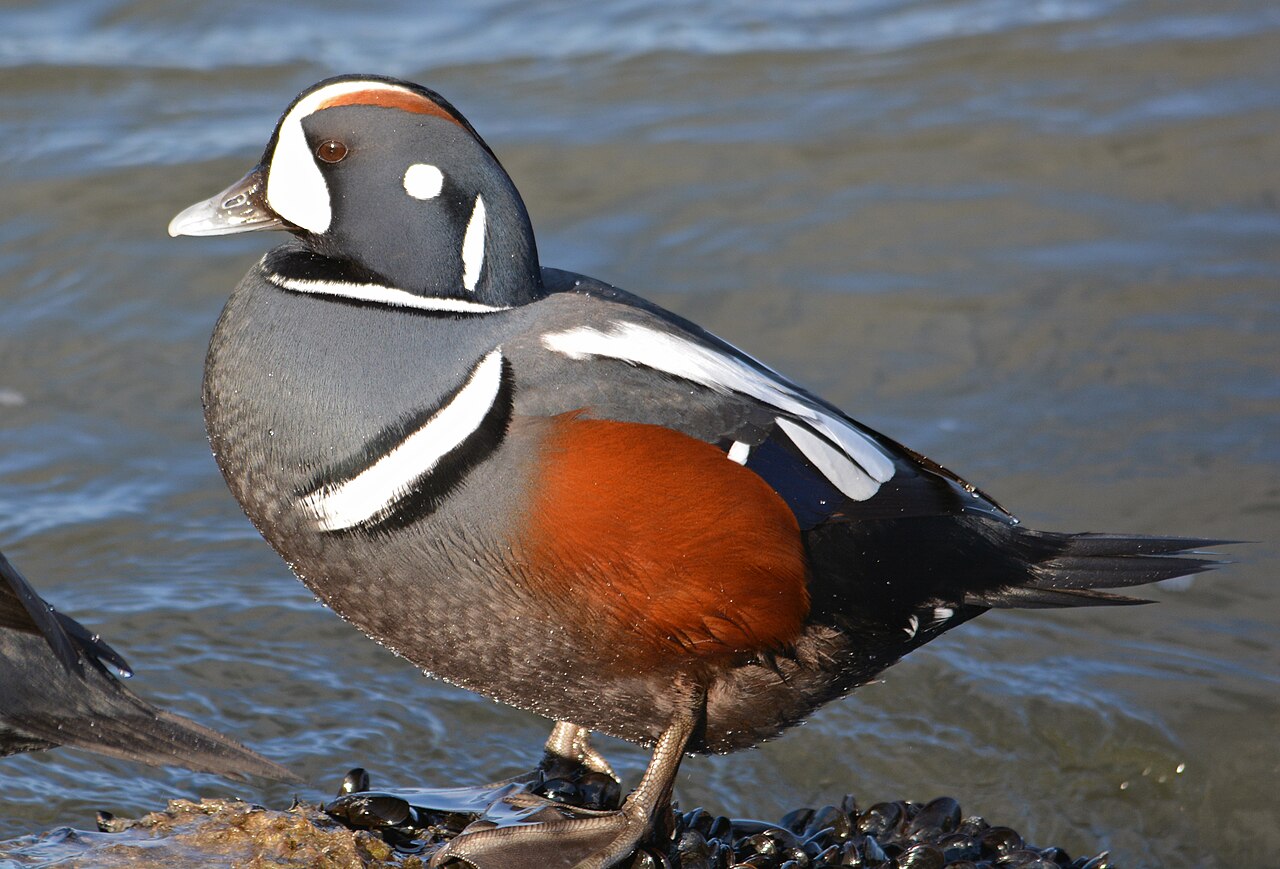
The Harlequin Duck takes its name from the male's bold plumage: blue-grey with chestnut patches and sharply defined white bands and spots, like the costume of the harlequin from Italian comedy. It breeds on fast-flowing mountain water and winters on the roughest rocky coasts of the continent, diving between the breakers for barnacles and snails. In no other North American duck is the biology so tightly bound to turbulent water, in both summer and winter.
Voice
Its call is so high and squeaky that birders sometimes mistake it for a mouse rather than a duck, which has earned it the nickname 'sea mouse'. On the breeding river the male gives a soft, nasal ee-ee-ee, barely audible over the roar of the rapids; the female answers with a rasping, repeated quack. On the winter rocky coast the species is far quieter and gives itself away more by its plumage than by sound.
Recording: Stanislas Wroza — CC BY-NC-SA 4.0 · Northeastern Region, Iceland · xeno-canto
Identification
The male is blue-grey with chestnut flanks, a white band across the breast, a white crescent-shaped patch in front of the eye, and fine white lines and spots on the head and neck, with a small black bill. The female is uniform dark brown with three white patches on the head: a round spot behind the eye, a larger patch from the eye to the bill, and a small spot above the eye. Juveniles closely resemble the female, with the same head patches but a slightly duller plumage overall. Both on the water and in flight, the compact, rounded body with a short neck and a relatively short, raised tail stands out, smaller than most other sea ducks.
Confusion species
From a distance the female is confused with the females of other sea ducks, but the Harlequin Duck's three white head patches, against the vague pale cheek patch of, for instance, Surf Scoter, are readily told apart with binoculars at moderate range. The male in breeding plumage cannot be mistaken for any other North American duck; only at great distance in poor light might the combination of blue-grey and white suggest a male Long-tailed Duck (Clangula hyemalis), which has a much paler head and a long, pointed tail. The setting also helps: the Harlequin Duck almost always sits in the roughest, most turbulent spots on the coast, while the species mentioned above are just as likely to be found on calm open water.
Habitat
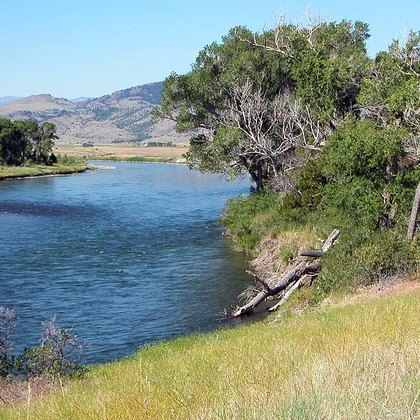
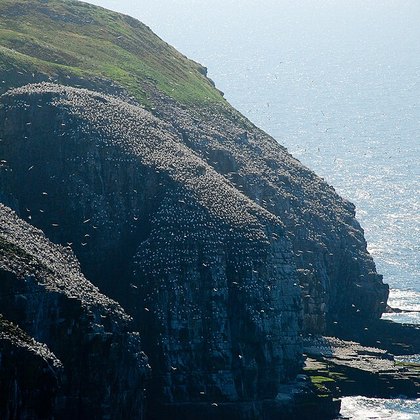
In summer it breeds along cold, oxygen-rich rapids in mountain rivers, diving to the bottom among the boulders for caddisfly and stonefly larvae; banks with dense shrubs or rock crevices close to the water serve as nest sites. Outside the breeding season it trades the river entirely for the roughest rocky coast available: breakwaters, reefs and seaweed-covered boulders in the surf zone, where it hunts just below the surface for barnacles, limpets and small crustaceans. In both seasons it avoids calm, sheltered water and sandy beaches; what it seeks out is precisely the place where the water moves hardest.
Where the bird is most often found, arranged by the USNVC — the vegetation classification of the United States and Canada — and CMECS for sea and coast.


Range and movements
Two strongly separated populations: a western one, breeding from Alaska and the Yukon through British Columbia into the northwestern states, and a smaller eastern population breeding in northeastern Quebec, Labrador and on Baffin Island. Western birds winter along the entire Pacific coast from the Aleutians to California; the eastern population concentrates almost entirely off the coast of Maine, where an estimated more than half of all eastern birds spend the winter. The eastern population shrank sharply during the twentieth century through hunting and was only recognised as a separately protected unit in the 1990s, after which numbers partly recovered.
- Resident
- Breeding (summer)
- Winter
- Passage
- dark = core range, pale = thinly spread
Where and when to look
Look for it in winter on the rockiest, most exposed stretch of coast you can find — a calm-water harbour breakwater is the wrong place. On the Atlantic coast, Penobscot Bay in Maine is the most reliable site on the continent; on the west coast you can find it on almost any rocky headland from Washington to Alaska. Watch closely between the waves: it often dives for a long time and resurfaces close to the breakers.
Conservation
Least Concern (LC) worldwide, but the eastern North American population is small — a few thousand birds — and vulnerable, with oil pollution along the winter mainland coast and hydroelectric development on breeding rivers as the main risks. The western population is considerably larger and more stable. Because the species is tied to a narrow, specific habitat in both summer and winter, it is more sensitive to local disturbance than most other ducks in this guide.
Scientific name
Histrionicus histrionicus | (Linnaeus, 1758)
Linnaeus described the species in 1758 as Anas histrionica, among the ducks; because it was later placed in another genus, author and year stand in parentheses. The genus Histrionicus was introduced in 1828 by the French naturalist René Lesson. The name comes from the Latin histrio, 'actor' or 'player', and, like the Dutch, English and Spanish common names, refers to the colourful, theatrical costumes of the harlequin from Italian comedy. The type locality was later restricted to Newfoundland, based on a description tied to a plate by the naturalist George Edwards.