All species › Tubenoses › Northern storm petrels › Tristram's Storm-Petrel
Tristram's Storm-Petrel | Hydrobates tristrami
Tristrams stormvogeltje | Paíño de Tristram
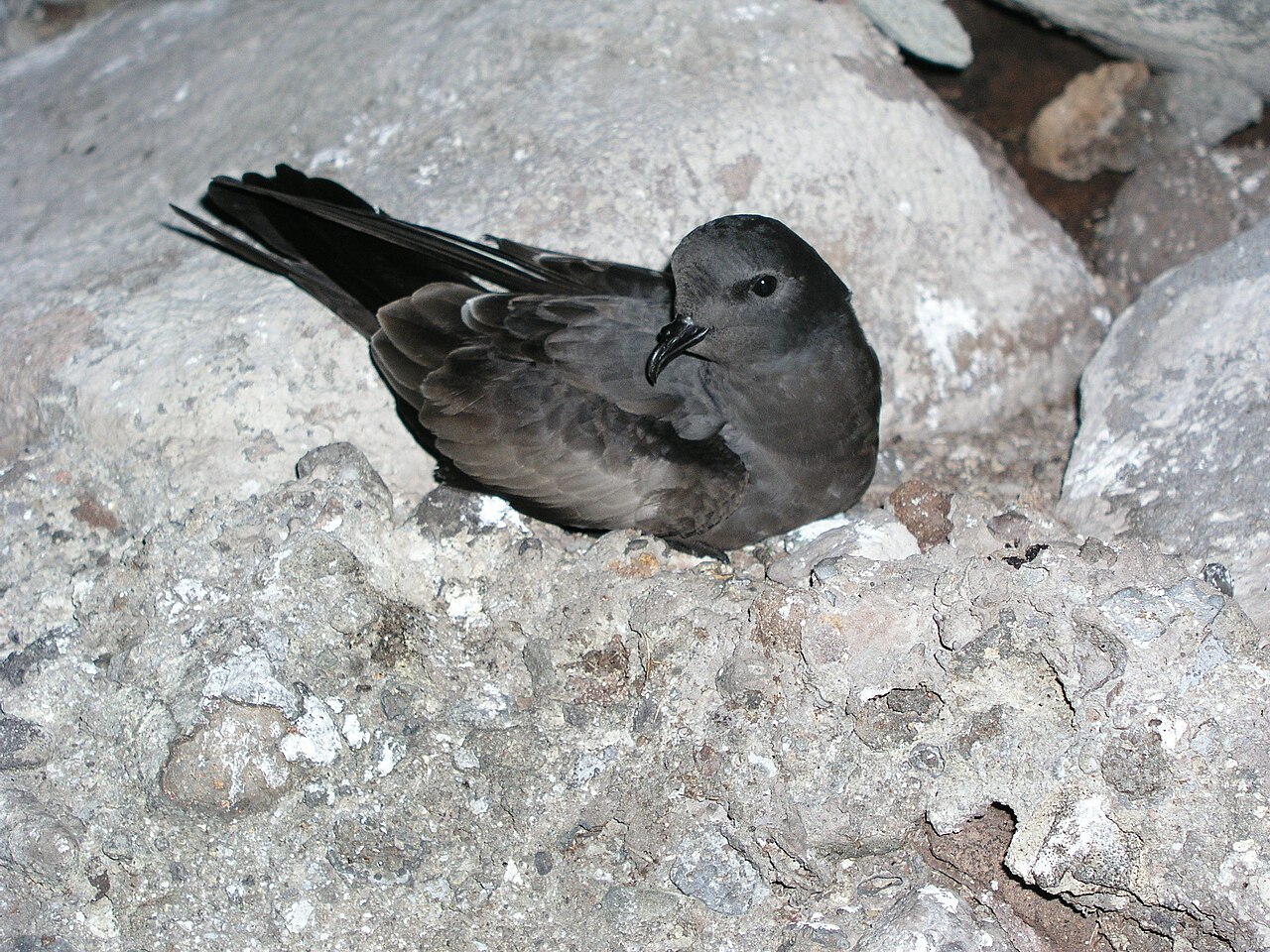
Tristram's Storm-Petrel is the largest storm-petrel in the world and the only member of its family in this guide to breed within the United States: on the small islands and atolls of the Northwestern Hawaiian Islands. Unlike most relatives it breeds in winter, laying eggs in December and January with chicks fledging by early summer.
Voice
At the colony, which like all storm-petrels it visits only in darkness, moaning and purring sounds come from the nesting burrows under shrubs and among the rocky rubble. At sea, where it spends most of the year, it is silent.
No freely licensed recording has been found for this species yet; what to listen for is described below.
Identification
With its long, angular wings, this is the largest of all storm-petrels. The plumage is mostly dark brown, with a paler, greyish rump and a striking pale grey bar across the upperwing. The flight is stronger and broader-winged than that of the much smaller storm-petrels of the American west coast, gliding more between beats. Male and female look alike.
Confusion species
The most useful feature is size: no other storm-petrel in the Pacific is as large, and the pale wing bar and rump are far less pronounced or absent in smaller species. Bulwer's Petrel, which occurs in the same waters and is likewise mostly dark, can cause confusion, but it has a longer, wedge-shaped tail and a stiffer, more gliding flight with high arcs, rather than the fluttering, direct flight of a storm-petrel.
Habitat
It spends most of the year over open tropical and subtropical waters of the North Pacific, catching squid and small fish. For breeding it uses short burrows under shrub vegetation or rock crevices on low, uninhabited islands and atolls. At the main colonies the ground is sandy to rocky, with little tall vegetation.
Where the bird is most often found, arranged by the USNVC — the vegetation classification of the United States and Canada — and CMECS for sea and coast.
Range and movements
It breeds on Nihoa and on most atolls of the Northwestern Hawaiian Islands, and on a few islands south of Japan; on Midway Atoll, where it once bred, birds have been returning since introduced rats were removed in 1996, though breeding has not yet resumed there. It does not breed on the main, inhabited Hawaiian Islands. Outside the breeding season it disperses widely over the tropical and northern Pacific.
- Breeding (summer)
Where and when to look
The Northwestern Hawaiian Islands are essentially inaccessible to visitors; look for this species instead on pelagic boat trips from the main Hawaiian Islands, especially during the winter months around the breeding season, and watch for its striking size and pale wing bar.
Conservation
The IUCN lists the world population of Tristram's Storm-Petrel as of least concern. Introduced rats and cats have wiped out entire colonies in the past, as at Midway; on islands where these predators have been eradicated, the species is slowly recovering. Invasive plants that choke the ground under shrubs remain an ongoing problem, as they make burrows inaccessible.
Scientific name
Hydrobates tristrami | (Salvin, 1896)
Salvin described the species in 1896 as Oceanodroma tristrami, in a genus later merged into Hydrobates, hence the parentheses around author and year. The species name honours Henry Baker Tristram, a nineteenth-century English clergyman and naturalist. The type locality is Sendai Bay, Japan.