All species › Waterfowl › Ducks, swans and geese › Tundra Swan
Tundra Swan | Cygnus columbianus
Fluitzwaan | Cisne chico
Tundra Swan is the smallest and most numerous of North America's three native swans, and breeds farther north than the other two: only on the flat, open tundra along the Arctic coast. In winter it gathers in dense flocks on the shallow bays of the Chesapeake and the grain fields of California, hundreds or thousands together on open water. The North American birds form their own subspecies, Cygnus columbianus columbianus, distinct from the Eurasian Bewick's Swan (C. c. bewickii), which does not occur in this guide.
Voice
The old name Whistling Swan points to the call: a high, ringing woo-ho or koo-hoo, repeated and in a large flock woven into a continuous chorus. Against the deep, blaring bugle of Trumpeter Swan, Tundra Swan sounds thinner and more musical, with more melody running through successive notes. Flocks in flight call almost without pause, even at night, so an autumn movement is sometimes heard before it is seen. On the water, feeding birds keep up a soft, chattering contact call that switches at once into the loud alarm calling of the whole flock if something is amiss.
Recording: steve — CC BY-SA 4.0 · Sixth Siding, Beaufort County, North Carolina, United States · xeno-canto
Identification
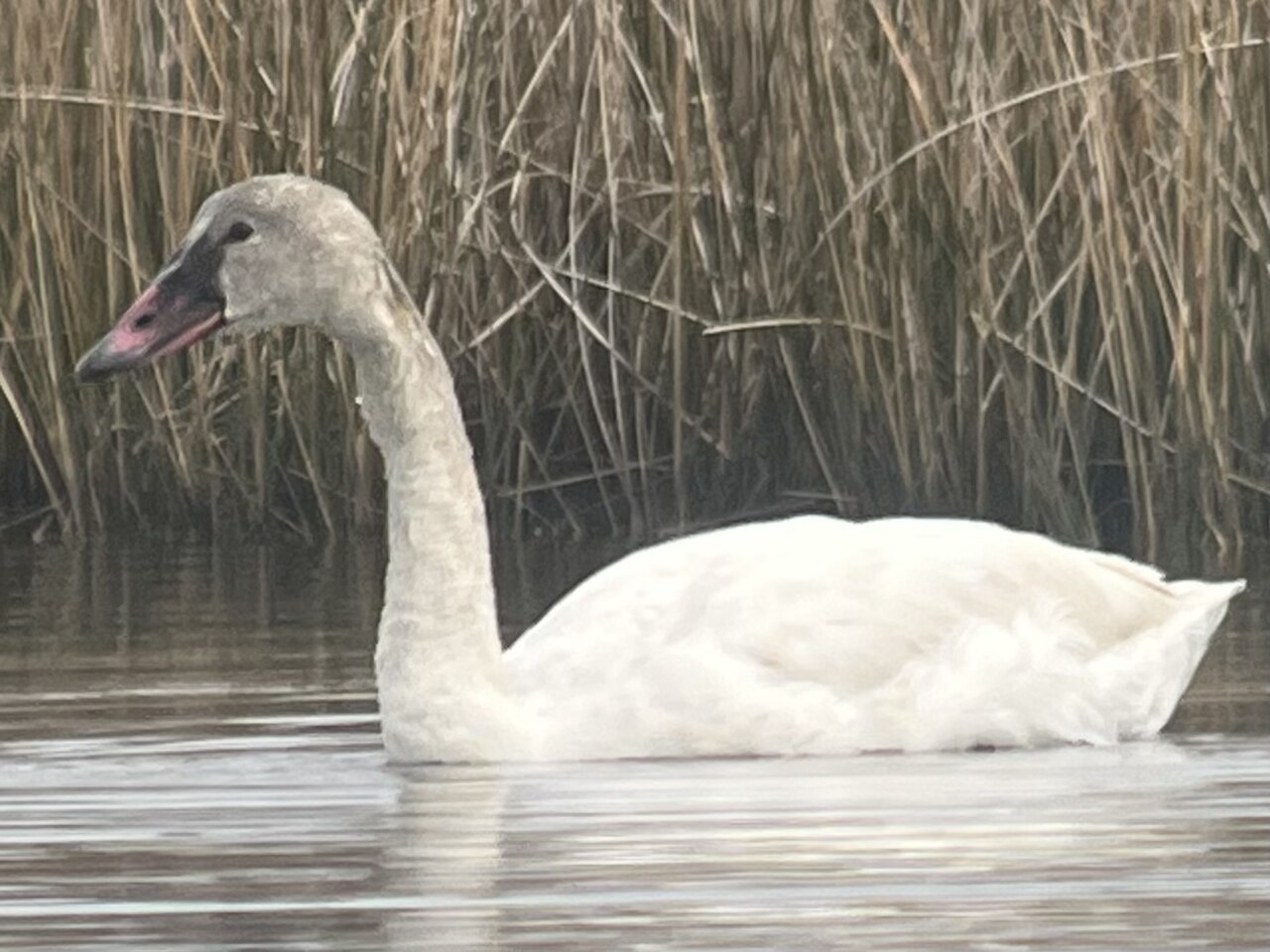
An adult Tundra Swan is entirely white with a black bill and black legs; most, though not all, birds carry a small yellow spot in front of the eye, against the base of the bill. The head is rounded with a slightly concave forehead, the bill relatively short and narrow, and the neck is held straight, without Mute Swan's curve. The cygnet is dingy white to pale grey with a pink bill that darkens gradually from the base, and does not reach adult plumage until its second year. In flight the fast, even wingbeat stands out, and flocks often form a diagonal line or V, with the longest necks of any North American waterbird.
Confusion species
Trumpeter Swan is larger, with an entirely black bill lacking any yellow spot and a straight, gradually rising forehead line that makes the bill look proportionally longer; the call is the quickest clue, deeper and less musical. Whooper Swan, a rare vagrant in North America, instead carries far more yellow on the bill, forming a wedge that reaches past the nostril. Mute Swan has an orange bill with a black knob and swims with the neck curved. From the Eurasian Bewick's Swan, which does not occur in this region, Tundra Swan differs in having less extensive yellow on the bill; the two were long treated as one species and are still regarded as closely related subspecies of Cygnus columbianus.
Habitat
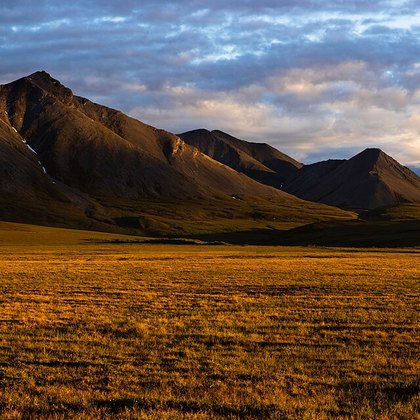
Breeds on wet, flat arctic tundra with shallow pools and slow-moving creeks, above the treeline along the coasts of Alaska and northern Canada. On migration and in winter it seeks shallow water rich in food: sheltered bays and estuaries, shallow lakes and flooded farmland, where it pulls aquatic plants from the bottom or gleans spilled grain. It roosts in dense flocks on open water and flies out by day to nearby feeding areas. It does not use fast-flowing rivers, closed forest or the open sea.
Where the bird is most often found, arranged by the USNVC — the vegetation classification of the United States and Canada — and CMECS for sea and coast.


Range and movements
Breeds from western and northern Alaska east through northern Canada to Nunavut. Two separate populations migrate to different wintering areas: the eastern group flies to the coastal waters of Chesapeake Bay, from Maryland to North Carolina, with stopovers on the Susquehanna Flats in Pennsylvania; the western group heads to California's Central Valley and the coastal lowlands of Washington, with the Great Salt Lake in Utah and the area around Madison, Wisconsin as important staging grounds along the way. Combined numbers exceed two hundred thousand and have been rising since the 1980s, after decades of hunting pressure in the first half of the twentieth century.
- Resident
- Breeding (summer)
- Winter
- Passage
- dark = core range, pale = thinly spread
Where and when to look
Look for it in autumn and winter on open water: Chesapeake Bay and the Central Valley are the most reliable places, but staging grounds such as the Great Salt Lake or around Madison sometimes hold thousands of birds too. Scan a flock for the yellow spot on the bill to separate it from Trumpeter Swan, but when in doubt trust the call over that spot, since not every Tundra Swan carries it.
Conservation
Not threatened, with a growing population of well over two hundred thousand birds. Heavy hunting in the early twentieth century cut numbers sharply, after which protection and the recovery of staging areas let the species increase again. Lead poisoning from ingested shot and collisions with overhead power lines remain local causes of death.
Scientific name
Cygnus columbianus | (Ord, 1815)
Ord described the species in 1815 as Anas columbianus, among the ducks, based on notes from the Lewis and Clark Expedition; because it was later placed in another genus, author and year stand in parentheses. The genus Cygnus was introduced by Bechstein in 1803. The species name columbianus refers to the Columbia River: the type locality is The Dalles, Oregon, on that river. The subspecies name columbianus repeats the species name, since the nominate form is the North American bird; the Eurasian form is named bewickii, after the engraver Thomas Bewick.