All species › New World vultures › New World vultures › Turkey Vulture
Turkey Vulture | Cathartes aura
Kalkoengier | Aura gallipavo
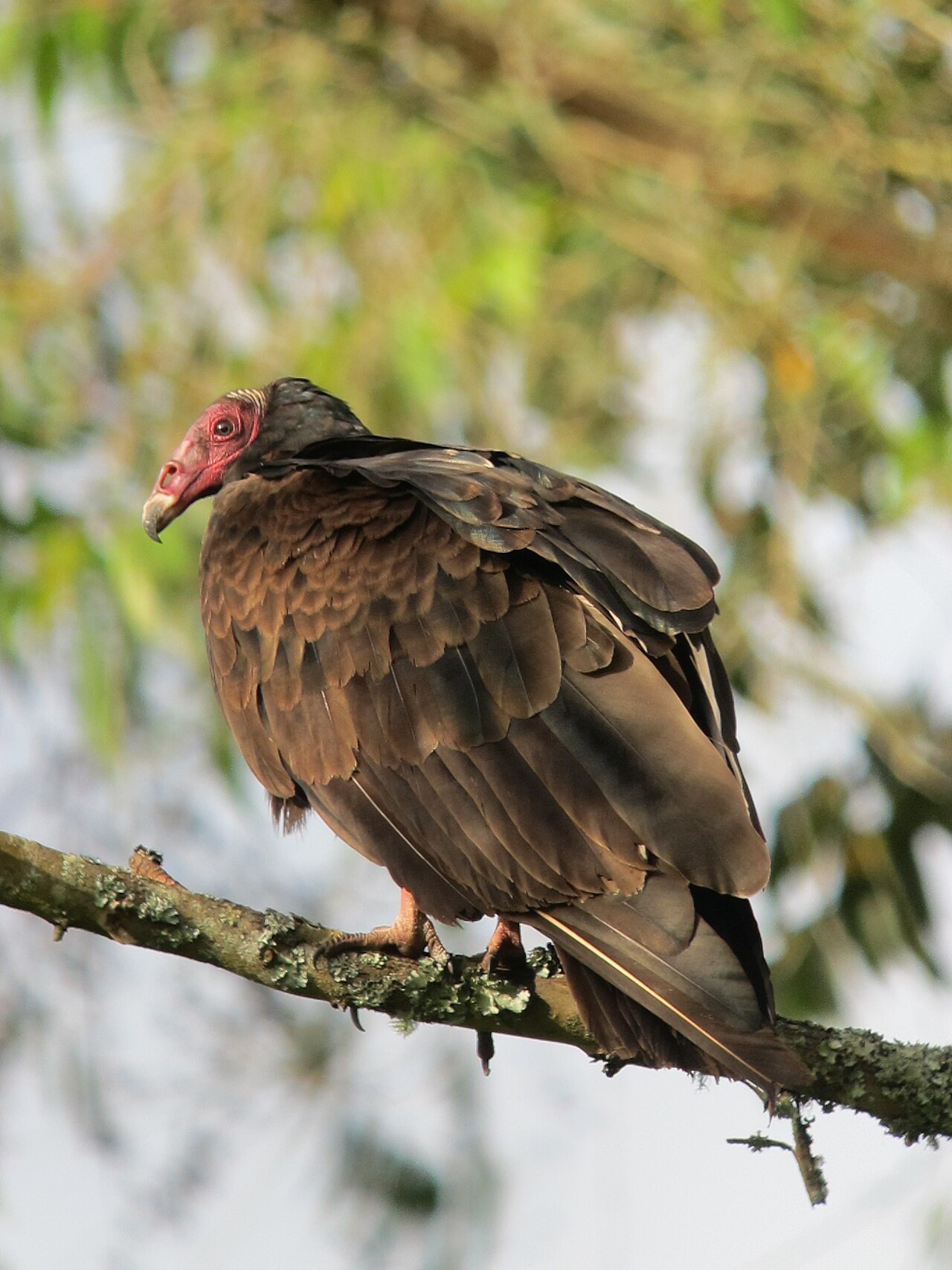
Turkey Vulture is the vulture that circles almost any open landscape on the continent on wide, shallow V-shaped wings, teetering and rocking as it scans for the scent of carrion. Its bare, red-skinned head — dull grey-black in young birds — is an adaptation to a life spent feeding on carcasses, and gives the species its English name. No other North American raptor migrates in such large flocks.
Voice
Turkey Vulture lacks a syrinx, the vocal organ of most birds, and is consequently almost silent. The only sounds it makes are low hisses and grunts, usually at a carcass where several birds are competing for access, or at the nest when it feels threatened. For the rest of its life — circling, gliding, feeding — the bird is entirely silent.
Recording: Ed Pandolfino — CC BY-NC-SA 4.0 · Deer Creek Hills Preserve, Sacramento County, California, United States · xeno-canto
Identification
A large, dark brown-black vulture with a bare red head and a pale, ivory-coloured bill tip. In flight it holds its long wings in a clear, shallow V and rocks continuously from side to side, quite unlike the steady, flat soaring of eagles. From below, the silvery-grey flight feathers contrast sharply with the black wing coverts, giving the bird a distinctly two-toned underwing pattern. Young birds have a grey-black rather than red head, not gaining adult colour until around two years old.
Confusion species
Black Vulture has a much shorter tail, white patches confined to the wingtips rather than fully silvery flight feathers, and soars on flat rather than V-shaped wings, with more frequent flapping between glides. At a distance the species is confused with eagles or buteos, but those soar steadily and flat, whereas Turkey Vulture visibly rocks and teeters on the thermals. On migration it forms large mixed 'kettles' with other raptors; the two-toned underwing pattern and rocking flight remain the best distinguishing features.
Habitat
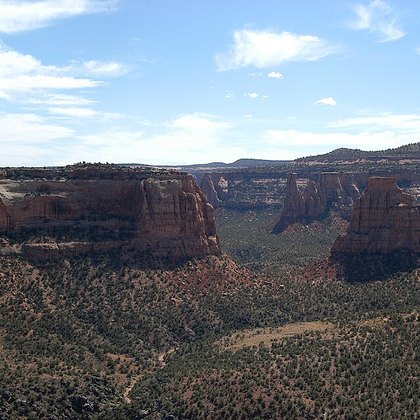
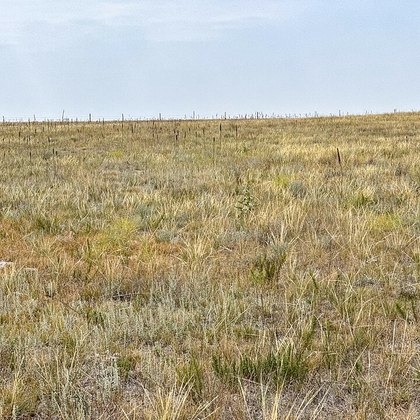
Open country of almost every kind: farmland, pasture, prairie, desert and hilly or mountainous terrain, as long as there is enough thermal lift to soar on and carrion to find. It nests in rock crevices, hollow logs, abandoned buildings or dense scrub, without building a nest, and often roosts communally in dead trees or on radio towers. It avoids closed dense rainforest and the bleakest polar regions.
Where the bird is most often found, arranged by the USNVC — the vegetation classification of the United States and Canada — and CMECS for sea and coast.



Range and movements
Breeds from southern Canada to the southern tip of South America, giving it the largest range of any New World vulture. Birds from the northern and western part of the range are strongly migratory, wintering as far south as Central America, while birds in the southern and eastern United States are largely resident. Migration moves in large kettles along fixed corridors, including over Veracruz, Mexico, where tens of thousands of birds pass daily.
- Resident
- Breeding (summer)
- Winter
- Passage
- dark = core range, pale = thinly spread
Where and when to look
Look around midday, once thermals start to build, along highways and over open farmland for the rocking V-shaped flight; in autumn, ridgelines and coastal points produce the largest kettles, sometimes hundreds of birds at once. Early in the morning the birds can often still be seen warming up with wings spread in the sun before the first thermals form.
Conservation
Least Concern (LC): widespread, numerous and still increasing in parts of its range; the species benefits from roadside carrion and from open land created by farming. Lead poisoning from feeding on carcasses containing lead shot fragments, and secondary poisoning from rodenticides, remain localised risks.
Scientific name
Cathartes aura | (Linnaeus, 1758)
Linnaeus described the species in 1758 as Vultur Aura; since moved to another genus, author and year stand in parentheses. The genus Cathartes was introduced by Illiger in 1811. aura is not classical Latin but derives from a native Mexican name for the vulture, which Linnaeus adopted. The type locality was only fixed in 1905, in the state of Veracruz, Mexico.