All species › Passerines › Thrushes and allies › Varied Thrush
Varied Thrush | Ixoreus naevius
Bonte lijster | Zorzal pinto
The Varied Thrush is a heavy thrush of the dark, wet conifer forest on the Pacific side of North America. The pattern of orange and black on head, breast and wing is matched by no other North American thrush; in winter the species drops to lower elevations and turns up in gardens and orchards, sometimes far to the east.
Voice
The song consists of single long-held notes on one pitch, each a few seconds long, with several seconds of silence between them. Each note sounds slightly burry and quavering, as though two pitches were sounding at once, and the next note usually lies above or below the last. The male sings from a high branch in the canopy, mainly early and late in the day. The call is a short, low chuk and a thin rising whistle.
No freely licensed recording has been found for this species yet; what to listen for is described below.
Identification
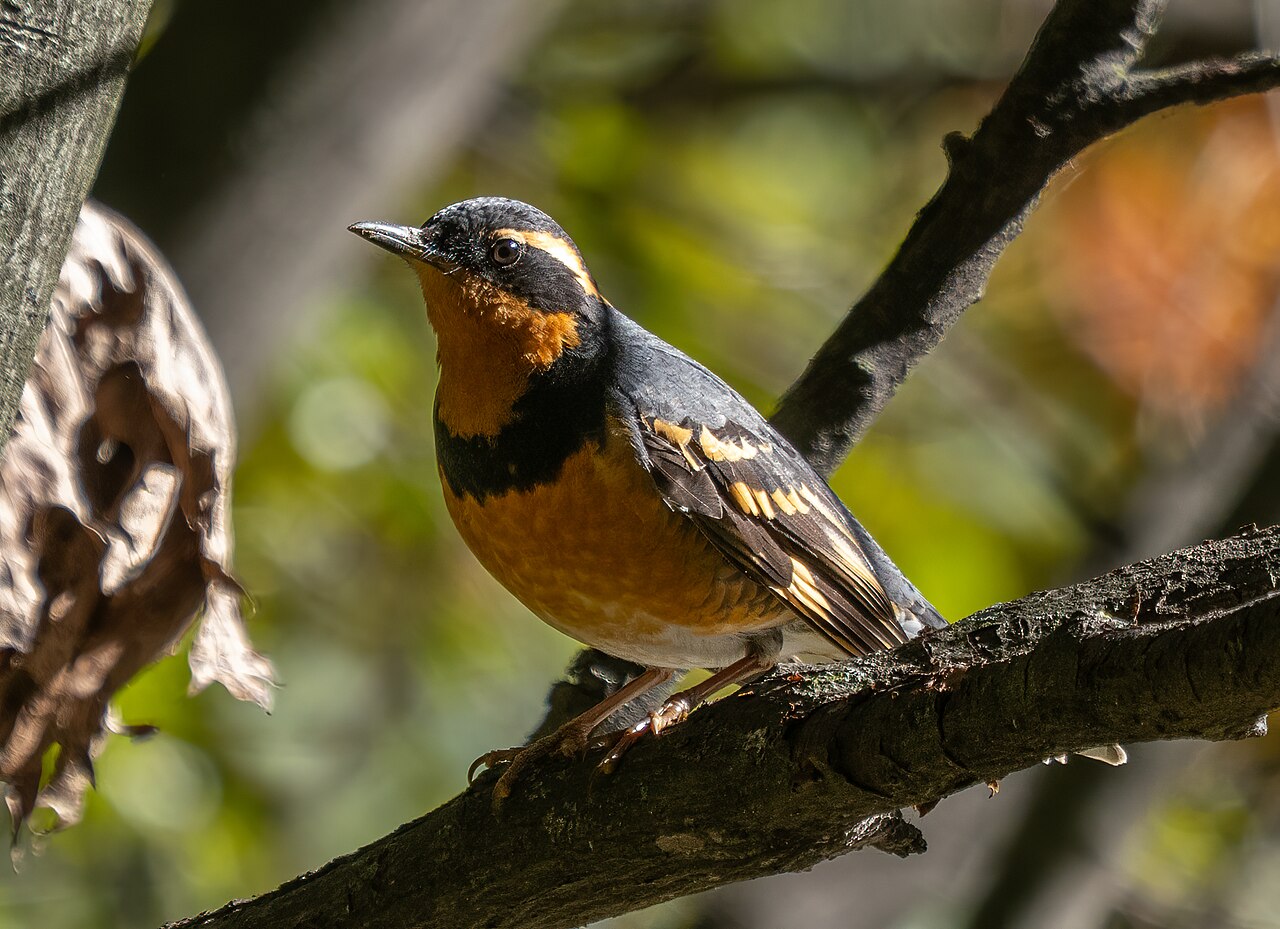
The male has slate-blue upperparts, an orange throat and breast crossed by a black breastband, an orange eyebrow through a black mask, and two orange wingbars with an orange patch at the base of the wing. The flanks are orange and the belly white. The female shows the same pattern in olive-brown and grey, with a faint greyish breastband. The head is round, the bill straight, the tail rather short.
Confusion species
American Robin has an equally orange breast, but lacks the breastband, the wingbars and the eyebrow, and has plain grey-brown upperparts with a yellow bill. On a female or a young bird the breastband may almost disappear; then watch for the two orange wingbars and the orange eyebrow, which remain visible even on the palest individuals. A stray Varied Thrush in the east is often found among American Robins under a feeder.
Habitat
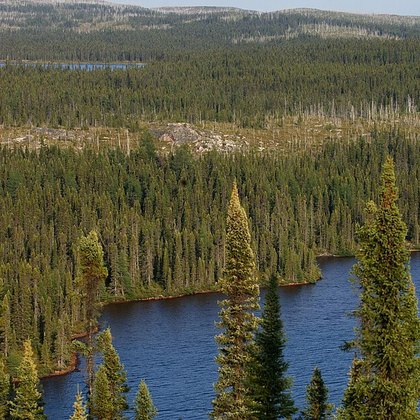
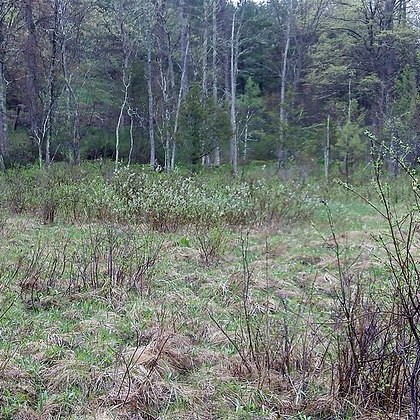
Closed, moist conifer forest with a dense canopy and a shaded, mossy floor: Sitka spruce, Douglas-fir, western hemlock and, in the north, white spruce. Old forest with fallen trunks is preferred; woodlots smaller than a few tens of hectares are generally avoided. In winter the species moves down into valley woodland, riparian scrub, orchards, parks and gardens with berry-bearing shrubs.
Where the bird is most often found, arranged by the USNVC — the vegetation classification of the United States and Canada — and CMECS for sea and coast.




Range and movements
The breeding range runs from southern and central Alaska through Yukon and the Northwest Territories into British Columbia, and south along the Cascades and the coast ranges to northern California, with an arm into the northern Rocky Mountains of Alberta, Montana and Idaho. Along the coast of British Columbia, Washington and Oregon part of the population stays all year. Northern birds move to California and the Great Basin. Every winter tens to hundreds of birds reach the Midwest and the Northeast, and there are two accepted European records.
- Resident
- Breeding (summer)
- Winter
- Passage
- dark = core range, pale = thinly spread
Where and when to look
Look for it in May and June by ear: the held, quavering note carries far through wet forest and almost always comes from high in the canopy, while the bird itself is barely visible. Outside the breeding season it pays to check under berry bushes and on paths with wet leaves, where it shuffles through the litter much as an American Robin does, but lower down and more quietly.
Conservation
Partners in Flight puts the breeding population at about 35 million birds. The Breeding Bird Survey shows a decline of about 0.7 percent a year between 1966 and 2019, roughly a third in total, placing the species on the Common Birds in Steep Decline list. The main pressure is the loss and fragmentation of old, wet conifer forest through logging; wintering birds are also killed by window collisions, cats and traffic. Reserves set aside for the Northern Spotted Owl protect this species' forest as well.
Scientific name
Ixoreus naevius | (Gmelin, 1789)
Gmelin described the species in 1789 as Turdus naevius, from a specimen taken at Nootka Sound on Vancouver Island; because it was later moved to another genus, author and year stand in parentheses. The species name naevius is Latin for 'spotted', from naevus 'spot, birthmark'. The genus Ixoreus combines Greek ixos 'mistletoe, mistletoe berry' with oros 'mountain'. Both the English and the Dutch names refer to the many-coloured pattern of head, breast and wing.