All species › Passerines › Thrushes and allies › Wood Thrush
Wood Thrush | Hylocichla mustelina
Amerikaanse boslijster | Zorzal maculado
The Wood Thrush is the thrush of mature deciduous forest in eastern North America: warm rufous on head and back, with large round spots on white underparts. It breeds from southern Canada to the Gulf Coast and winters in the lowlands of Central America. Since the 1960s its numbers have roughly halved, and the species serves as a yardstick for the state of the eastern forest.
Voice
The song consists of short three-part phrases. The first part is a series of soft, low bup-bup-bup notes audible only at close range; then comes a loud fluting middle phrase, usually three to five notes, often rendered ee-oh-lay; then a fast, high trill that seems to come from two directions at once. That last effect arises because the bird uses the two sides of its syrinx independently and can therefore produce two notes at the same time. The alarm call is a rapid staccato pit-pit-pit.
Recording: Daniel Parker — CC BY-NC-SA 4.0 · Watertown, Litchfield County, Connecticut, United States · xeno-canto
Identification
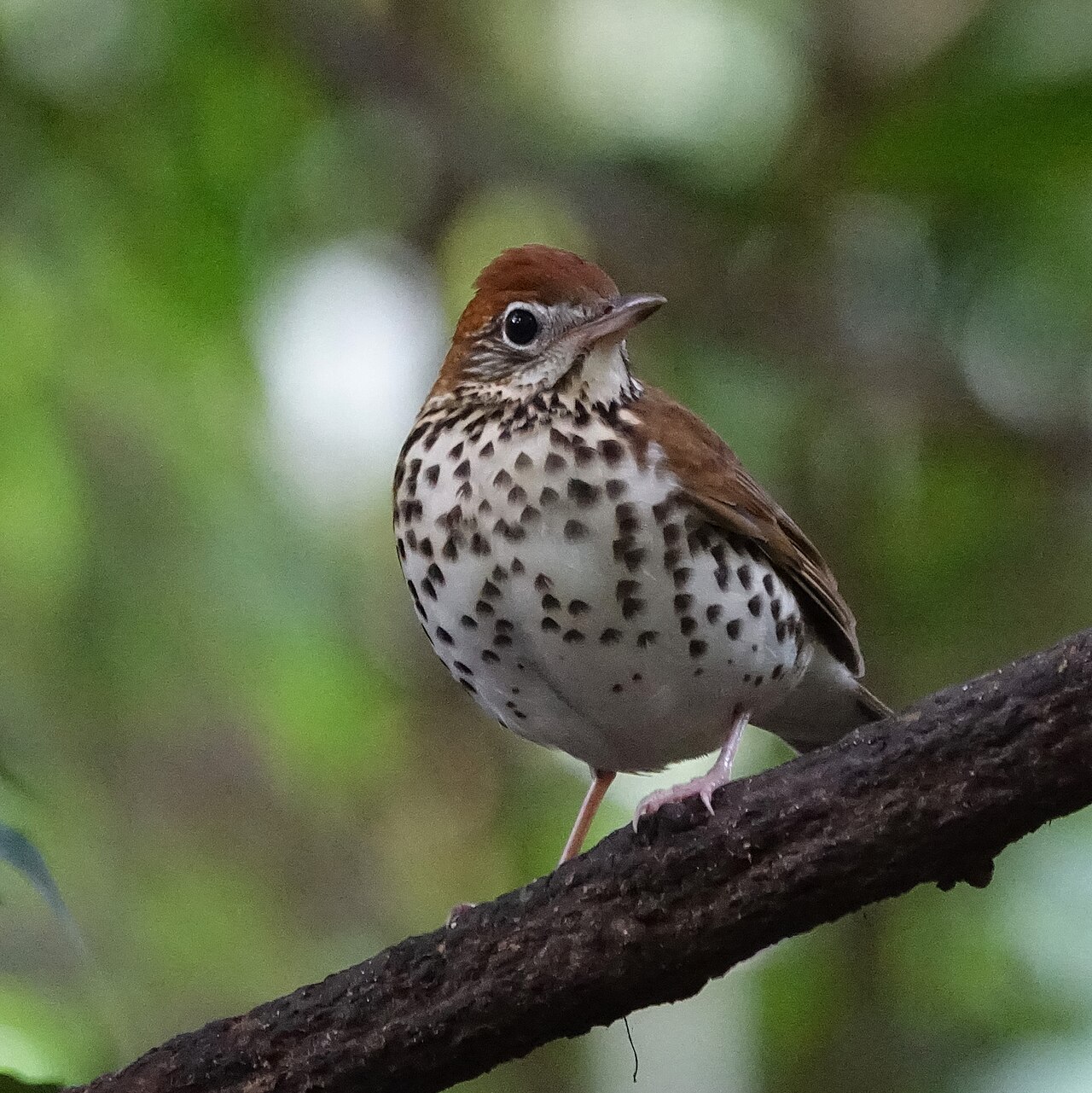
Head, nape and upper back are bright rusty brown, shading to olive-brown towards the tail — a gradient other thrushes of this size lack. The underparts are white with large, sharply edged, round blackish-brown spots that continue onto the flanks and the sides of the belly. A white eyering sits in a white-streaked cheek. The legs are pink, the bird stocky and short-tailed. Male and female cannot be told apart.
Confusion species
Swainson's Thrush and Veery are smaller, slimmer and far more faintly spotted: on a Veery the spots are no more than a wash on the upper breast, on a Swainson's they are smaller and greyer. Hermit Thrush has a rufous tail set against a brown back, exactly the reverse of the Wood Thrush's gradient, and cocks its tail on landing. American Robin is larger and has plain orange underparts without spots. The gradient from rusty head to brown rump, the large round spots and the white eyering are together the safest combination.
Habitat
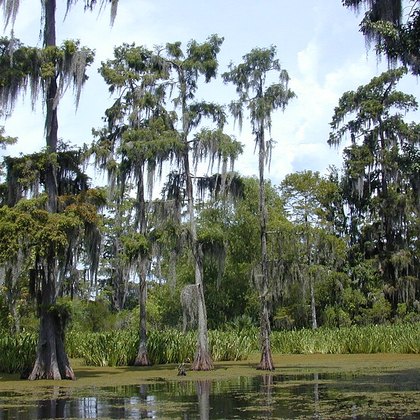
Moist, mature deciduous and mixed forest with a closed canopy above about sixteen metres, an open floor with deep leaf litter, and a dense shrub layer beneath. Large unbroken tracts produce markedly more young than small fragments in farmland. Well-watered gardens and suburban woodland with heavy undergrowth are used as well. In winter it occupies lowland tropical forest and forest edge, from the lowlands to middle slopes.
Where the bird is most often found, arranged by the USNVC — the vegetation classification of the United States and Canada — and CMECS for sea and coast.




Range and movements
The breeding range runs from southern Manitoba, southern Ontario, Quebec and Nova Scotia south to northern Florida and the Gulf Coast, and west roughly to the Missouri River. Migration crosses the Gulf of Mexico in a single night flight; migrants appear in east Texas and northeastern Mexico in April and September. The winter range lies from southern Mexico through Belize, Guatemala and Honduras into Nicaragua and further south, centred on the Atlantic lowland side. Its division among the Mexican states can only be derived in broad terms from the literature.
- Breeding (summer)
- Winter
- Passage
- dark = core range, pale = thinly spread
Where and when to look
The best chance is first light in May and June in a large, moist deciduous wood: the fluting middle phrase carries hundreds of metres, and the bird sings from a branch at mid-height, where against the light it shows as a stocky, short-tailed thrush. Stand still at the edge of a clearing with deep leaf litter and wait for it to drop down and flick leaves aside with its bill.
Conservation
Partners in Flight puts the breeding population at about twelve million birds. The Breeding Bird Survey shows a decline of about one per cent a year between 1966 and 2023, some 45 per cent in total, steepest along the Atlantic coast and in New England; the 2025 State of the Birds report places the species on the yellow tipping-point list. The causes lie at both ends of the flyway: fragmentation of the breeding forest raises the risk of nest predation and of egg-laying by Brown-headed Cowbird, while in Central America lowland forest is converted to farmland. Acid deposition that leaches calcium from the forest floor further reduces the supply of calcium-rich invertebrates.
Scientific name
Hylocichla mustelina | (Gmelin, 1789)
Gmelin described the species in 1789 as Turdus mustelinus, from a specimen taken at New York; because it was later moved to another genus, author and year stand in parentheses. The species name mustelinus means 'weasel-coloured', from Latin mustela 'weasel', after the warm rufous of the upperparts. The genus Hylocichla, introduced in 1864 by Spencer Baird, comes from Greek hulē 'wood' and kikhlē 'thrush', and thus means 'wood thrush'; the English and Dutch names render that directly.