All species › Passerines › New World sparrows › Vesper Sparrow
Vesper Sparrow | Pooecetes gramineus
Avondgors | Gorrión cola blanca
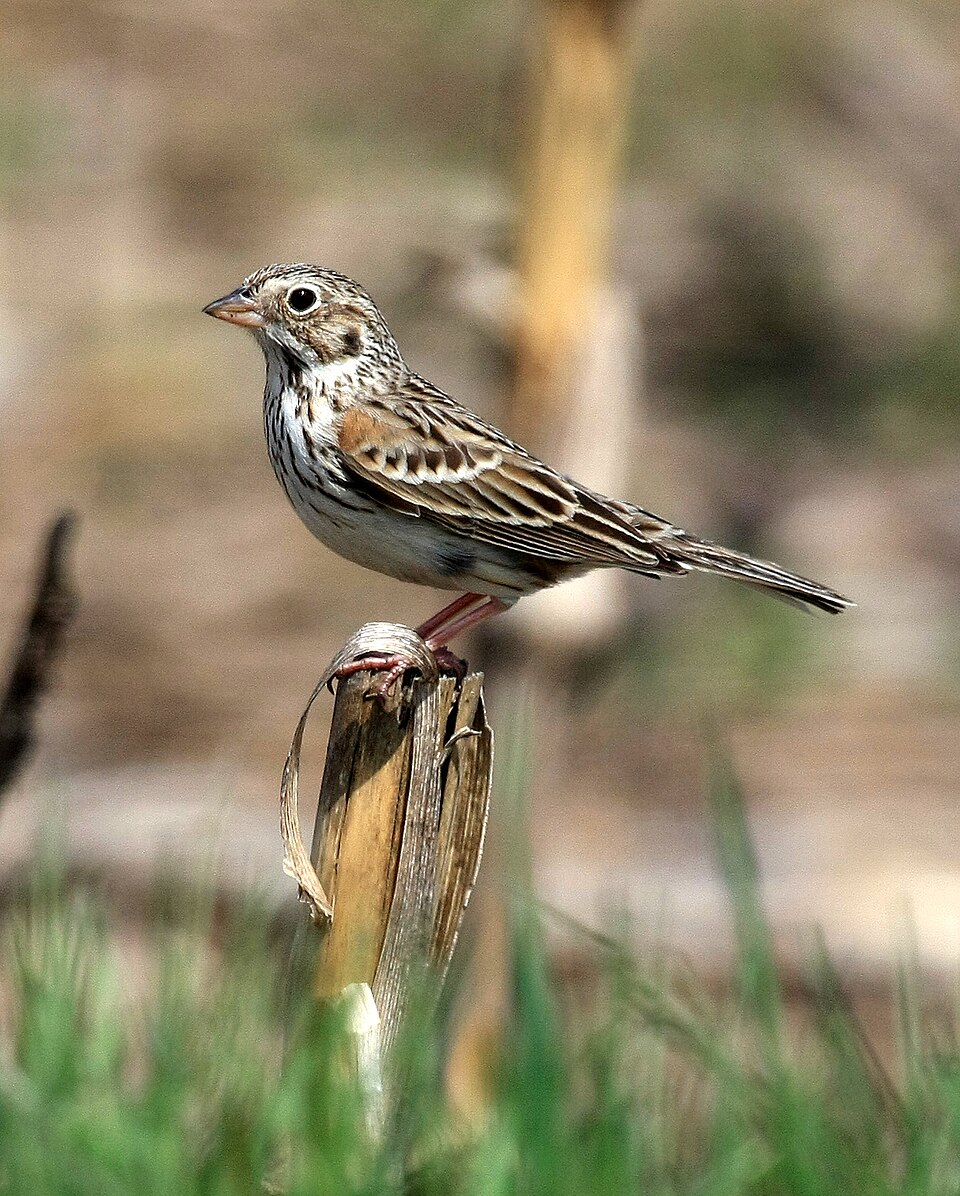
The Vesper Sparrow is the streaked sparrow of bare field edges, odd corners and dry pasture, with white outer tail feathers that show only as it flies up. It is the only North American sparrow with a chestnut shoulder patch, and it goes on singing long after sunset — the source of its name.
Voice
The song consists of two pairs of clear sustained whistles — the first pair low, the next higher — followed by a series of descending trills and slurred notes. The bird sings from a post, a wire, a clod or a low shrub, and carries on into dusk after sunset, when most grassland birds have fallen silent. The call is a short sharp chip. In display the male performs a flight with slow, high-raised wingbeats while singing.
Recording: Valerie Heemstra — CC BY-NC-SA 4.0 · Forsyth Township (near Gwinn), Marquette County, Michigan, United States · xeno-canto
Identification
A pale sparrow streaked brown over the upperparts and breast, with a fine white eyering, a pale ear-covert patch outlined in dark and a narrow dark malar stripe. The outer tail feathers are white and catch the eye on take-off and landing. On the bend of the wing sits a chestnut patch, usually hidden under the scapulars and visible only when the bird lets the wing droop slightly. The bill is conical and pale below; the legs are flesh-coloured. Western birds are paler and greyer, eastern birds warmer brown.
Confusion species
Savannah Sparrow lacks white outer tail feathers and usually shows a yellow supercilium, a shorter notched tail and finer breast streaking. Grasshopper Sparrow has a flat, orange-tinged head, a short tail and a plain buff breast. Field Sparrow has a plain breast, a pink bill and a broad white eyering without a dark-outlined ear patch. On a flushing bird the combination of white in the tail sides, a white eyering and a bulkier, longer-tailed look settles it; a streaked sparrow without white in the tail is not a Vesper.
Habitat
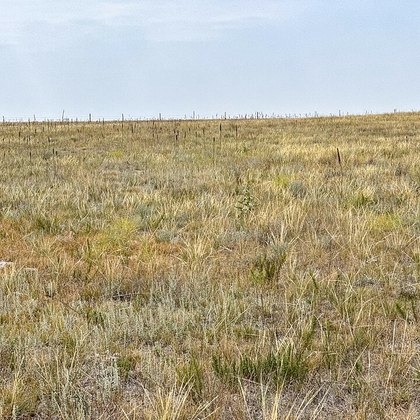
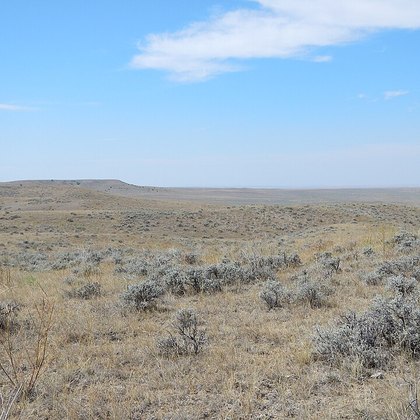
Open, dry ground with bare soil between the plants: shortgrass prairie, sagebrush (grey-green wormwood scrub of the dry western interior) steppe, heavily grazed pasture, fallow fields, roadsides and managed grain margins. It avoids tall dense vegetation and needs places where it can walk in the open. In the west it breeds up to around 3000 metres in mountain and steppe meadows. The nest is a scrape in the ground beside a grass tussock or small shrub. It is often the first songbird to settle on reclaimed mine land.
Where the bird is most often found, arranged by the USNVC — the vegetation classification of the United States and Canada — and CMECS for sea and coast.





Range and movements
The breeding range runs from British Columbia and the prairie provinces across southern Canada to the Maritimes, and in the United States through the northern half, the Rockies and the Great Basin into northern Arizona and northern New Mexico. In winter the species shifts to the southern United States, from California and Texas to Florida and the Gulf coast, and to northern and central Mexico, roughly from Baja California and Sonora to Tamaulipas and south to the plateau around Hidalgo and Puebla. Southbound migration begins in September and the return in March. The precise division among Mexican states is hard to read off the literature.
- Resident
- Breeding (summer)
- Winter
- Passage
- dark = core range, pale = thinly spread
Where and when to look
Drive a dirt road through farmland or steppe in May or June with the windows down and watch for singing birds on the wire; in the last two hours of the day the song is heard most often. If one flies, watch the tail sides: a single white flash on each side closes the case.
Conservation
The species is listed as Least Concern (LC), with an estimated breeding population of about 34 million birds, but numbers fell by roughly 30 per cent between 1970 and 2014. Loss of low-intensity grassland, earlier and more frequent mowing and the conversion of field margins to intensive cropland are the main causes. The western form affinis, of the lowlands between southwestern British Columbia, Washington and Oregon, has dropped to a few thousand birds; it is on the Washington and Oregon watch lists and has been petitioned for federal protection.
Scientific name
Pooecetes gramineus | (Gmelin, 1789)
Gmelin described the species in 1789 as Fringilla graminea, from a specimen from New York; the move to Pooecetes puts author and year in parentheses. Pooecetes is Greek, from poa 'grass' and oikētēs 'dweller': grass-dweller. Gramineus is Latin for 'of grass'. The Dutch name translates the English Vesper Sparrow, which refers to vespers, the evening prayer, after the singing at dusk; the Spanish name points instead to the white tail sides.