All species › Swifts › Hummingbirds › Violet-crowned Hummingbird
Violet-crowned Hummingbird | Ramosomyia violiceps
Violetkruinkolibrie | Colibrí corona violeta
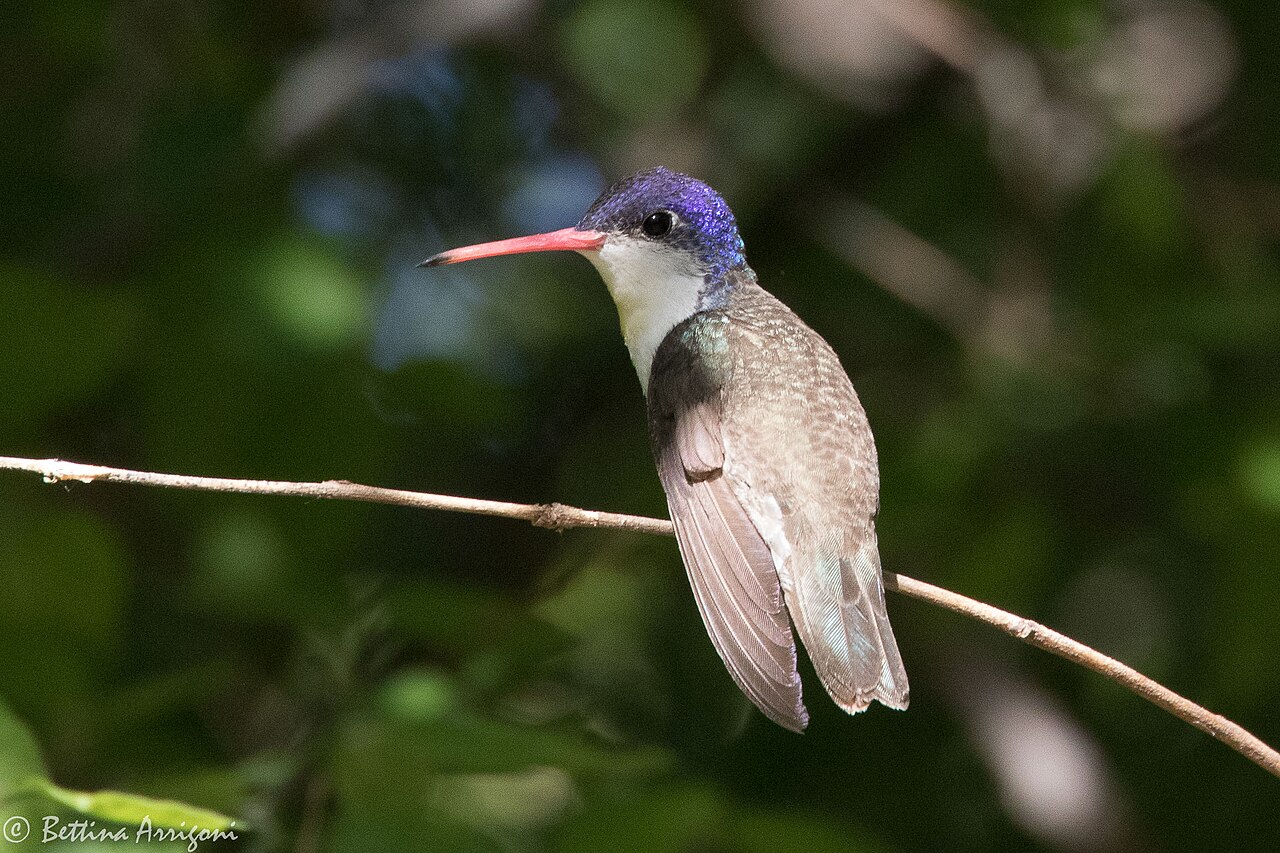
The Violet-crowned Hummingbird is the only hummingbird in the United States without a coloured gorget: it is clean white from chin to undertail, with a violet-blue crown and a long red bill. Male and female look almost identical, and in the United States it is a newcomer — the first nest there was found only in 1959.
Voice
The song is a series of four to six high, thin, descending seew notes, delivered from an open branch in the top of a sycamore. The calls are a dry chap, a hard stik sometimes repeated rapidly, a high weep and a shrill zeek. In disputes over a feeder or a patch of flowers the stik is heard most. From the wings comes only the ordinary whirring; it has no loud mechanical dive like the mountain hummingbirds of the genus Selasphorus.
No recording with a suitable Creative Commons licence has been found for this species yet; what to listen for is described below.
Identification
Bronze-green to grey-green above, with a coppery bronze tail, and unmarked white below, which is unique among North American hummingbirds. The crown is glittering violet-blue, but that is an interference colour produced by feather structure: when the light does not fall right the cap simply looks dark blue-black and the bird seems merely white with a red bill. The bill is long, straight and bright orange-red with a black tip. Females can hardly be told from males and are at most slightly duller; young birds have a subdued crown, sometimes with a cinnamon tone. At a little over five grams this is one of the largest hummingbirds north of the Mexican border, slender in build, with wingtips reaching the tail tip when perched.
Confusion species
No other hummingbird in the United States combines white underparts with a long red bill, so a good view rarely leaves any doubt. White-eared Hummingbird has a broad white ear stripe on a black face, green-spotted underparts and a shorter bill. Female Broad-billed Hummingbird is grey rather than white below and has a thin white line behind the eye. Female Black-chinned and Costa's Hummingbirds are also pale-bellied, but far smaller and with an entirely dark bill.
Habitat
Riparian woodland in canyons, with tall Arizona sycamores and cottonwoods along permanent water and the brushy understorey beneath them. It also forages in adjacent dry woodland, thorn scrub, meadows, orchards and in gardens and parks, and higher up the slope in pine-oak-juniper woodland. In the United States it is tied almost entirely to the few canyons with old sycamores; if the sycamore gallery goes, the bird goes with it.
Where the bird is most often found, arranged by the USNVC — the vegetation classification of the United States and Canada — and CMECS for sea and coast.





Range and movements
Resident across nearly all of western Mexico, from Sonora and Chihuahua south to Guerrero and Oaxaca. In the United States it is confined to a handful of canyons in southeastern Arizona and extreme southwestern New Mexico, where it is present mainly from April to September, but where birds now also stay regularly through the winter at feeders. North of the border it has only been recorded since the middle of the twentieth century, and its range and numbers there are gradually increasing.
- Resident
- Breeding (summer)
- Winter
- Passage
- dark = core range, pale = thinly spread
Where and when to look
The village of Patagonia in Arizona, on Sonoita Creek, is the classic spot: scan the crowns of the tall sycamores and the feeders in the gardens. At a shared nectar source it is the one in charge — larger hummingbirds chase smaller ones off, and this species sits at the top of that order, so watch which bird stays put when the rest scatter. Against the light the long red bill gives it away before anything of the crown can be seen.
Conservation
The population is estimated at about two million mature birds and is stable; the species is listed as Least Concern (LC) and no immediate threats have been identified. The small United States share of the population does depend on canyons with old sycamores and running water, which are sensitive to groundwater extraction. The presence of feeders has increased the number of birds wintering in southeastern Arizona.
Scientific name
Ramosomyia violiceps | (Gould, 1859)
Gould described the species in 1859 as Cyanomyia violiceps; because it has since been moved to another genus, author and year stand in parentheses. The genus Ramosomyia was introduced only in 2021, when the large genus Amazilia was divided among several genera. violiceps is Latin for 'violet-headed', from viola 'violet' and -ceps 'headed'. The type locality is Atlixco in the Mexican state of Puebla.