All species › Swifts › Hummingbirds › Berylline Hummingbird
Berylline Hummingbird | Saucerottia beryllina
Berylkolibrie | Amazilia berilina
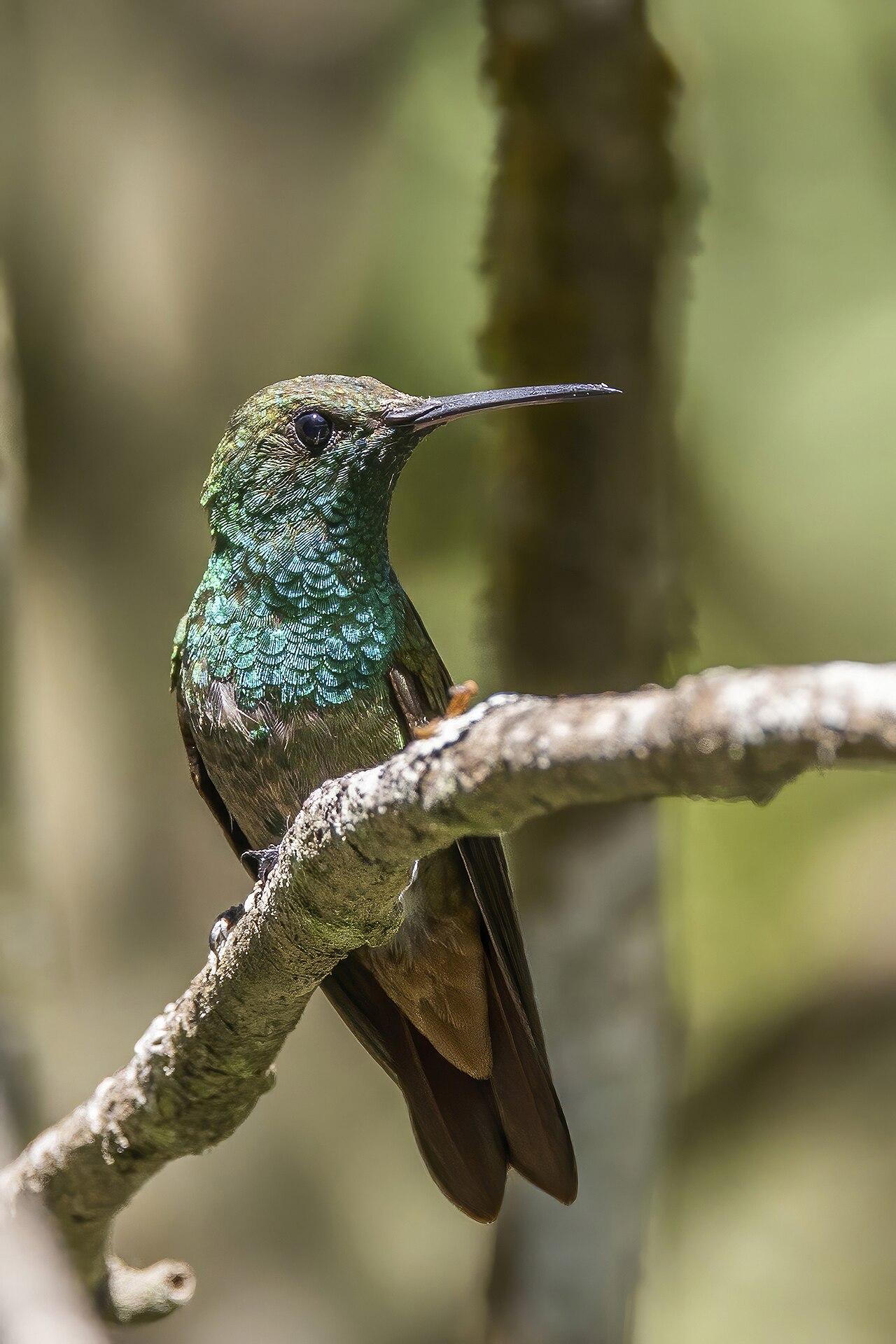
The Berylline Hummingbird is a bird of the Mexican mountain woodlands that was first recorded north of the border only in 1964, and now turns up every summer in small numbers in the canyons of southeastern Arizona. The rufous patch in wing and tail sets it apart: few hummingbirds on this continent carry that warm colour. Unusually for the family, male and female look much alike.
Voice
It has no song in the ordinary sense: from a bare twig the male repeats a series of high, slightly hoarse twittering notes that sound more like an insect than a bird. The commonest call is a hard buzzing dzzzir or drrzzt, usually given while driving another hummingbird off a flower. If the chase goes on, the call runs together into a fast low rattle of crowded notes. Over all of it lies the mechanical hum of the wings, which in this fairly heavy hummingbird is low and carrying, and often announces an approaching bird before any call does.
Recording: Pritam Baruah — CC BY-NC-SA 4.0 · Panuco Road, Sinaloa, Mexico · xeno-canto
Identification
Head, back and rump are bronze-green to coppery, the underparts glittering golden green; the tail is coppery red and the wing shows a rufous panel that flashes warm in flight. That gleam is not pigment but interference colour from thin layers in the feather barbules: the bird glows green only when lit from the front and looks dull and blackish from the side or in shade. Male and female resemble each other closely, which is unusual in a hummingbird; the female has a greyer throat and belly and an all-dark bill, the male's is pink below. Juveniles are duller, with rusty fringes to the head feathers.
Confusion species
Buff-bellied Hummingbird (Amazilia yucatanensis) is built the same way and has an equally reddish tail, but its belly is pale buff instead of green, and it lives on the Gulf coast, more than a thousand kilometres away. Violet-crowned Hummingbird has clean white underparts and an entirely coral-red bill. Broad-billed Hummingbird is darker, with a blue throat and a blue-black tail without any rufous. Among females and juveniles, which look alike across this group, the rufous wing panel is the only reliable mark: no other hummingbird north of the border has it.
Habitat
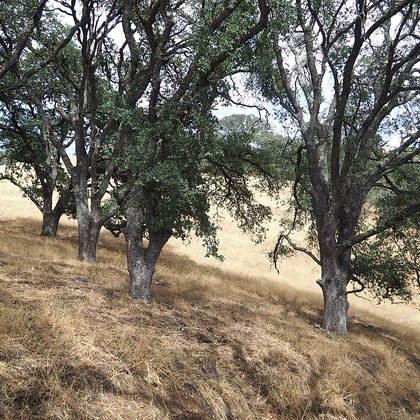
Open pine-oak and oak woodland on mountain slopes, and above all the shaded canyons of sycamore, maple and walnut that cut through them. In Mexico it goes lower, into dry thorn forest, gallery woodland, coffee plantations and village gardens with flowering shrubs. It avoids closed humid high forest and the open desert plain; what it wants is a woodland edge in flower with a stream nearby. In Arizona it is nearly always between fifteen hundred and two thousand metres.
Where the bird is most often found, arranged by the USNVC — the vegetation classification of the United States and Canada — and CMECS for sea and coast.




Range and movements
Resident in the highlands of Mexico from Sonora and western Chihuahua south to Chiapas, and in a separate block from southern Guatemala through El Salvador into central Honduras. It does not migrate, although birds from the highest zones drop to lower slopes in winter. The species was first recorded in the United States in 1964, in the mountains of southeastern Arizona; a handful of birds has appeared there every summer since, and some have nested. Single birds reach southwestern New Mexico and western Texas.
- Resident
- Breeding (summer)
- Winter
- Passage
- dark = core range, pale = thinly spread
Where and when to look
Look for it in July and August in the canyons of the Huachuca and Chiricahua mountains, at the feeders of the visitor centres or at flowering agaves along the trail. With every green hummingbird, watch the wing at the moment the bird turns away: the rufous panel holds up against the light, while the green gloss disappears.
Conservation
The world population is put at about two million mature birds and is considered stable; the species is listed as not threatened (LC). In Mexico it benefits from half-open country with flowering shrubs, including the edges of villages and plantations. The United States birds are a handful at the extreme edge of the range and count for nothing in the species' overall standing.
Scientific name
Saucerottia beryllina | (Deppe, 1830)
Wilhelm Deppe described the species in 1830 as Trochilus beryllinus, from a specimen taken in Mexico; because it was later placed in another genus, author and year stand in parentheses. beryllinus means 'like beryl', after the pale green gemstone, and refers to the gloss of the underparts. The genus Saucerottia was introduced by Bonaparte in 1850; the name goes back to the French physician and ornithologist Antoine Constant Saucerotte, honoured in 1846 in the species name of a related hummingbird. Older books still place S. beryllina in Amazilia.