All species › Swifts › Hummingbirds › White-eared Hummingbird
White-eared Hummingbird | Basilinna leucotis
Witoorsaffierkolibrie | Colibrí orejiblanco
The White-eared Hummingbird is a stocky hummingbird of pine-oak forest in the mountains of Mexico and Central America, where it is often the commonest hummingbird present. Its mark is a thick white ear stripe on a black face; the stripe is plain white and therefore shows in any light, while the rest of its colours depend on how the light falls.

Voice
It has a simple and a complex song. The simple one is a monotonous series of short, somewhat variable notes, sometimes a single note repeated endlessly, sometimes two notes alternating; the complex one runs to some fifteen seconds and mixes short ticking notes with longer rasps at speed. Calls are high ticks, up to five a second, and a lower chip that sounds like a chipmunk. From the wings comes only the ordinary whirring of hummingbird flight; there is no loud mechanical dive as in the Selasphorus species.
Recording: Manuel Grosselet — CC BY-NC-SA 4.0 · Mex, Jalisco, Volcano de Colima, Mexico · xeno-canto
Identification
The male has a metallic violet forehead and chin, a violet-blue upper throat and an emerald lower throat, a black face, and a broad white stripe running back from behind the eye; the upperparts are bright green and the bill is red with a black tip. All that violet and green is an interference colour arising from feather structure, not a pigment: in shade or against the light the whole head looks dull black and only the white stripe remains. The female has a brown crown, the same white ear stripe, whitish underparts with bronze-green spotting, and a largely dark bill with red only at the base. Young males resemble the female — note the brownish crown — but already show some red at the bill base and scattered iridescent feathers in the throat. The build is solid, with a medium-length, slightly curved bill.
Confusion species
Female Broad-billed Hummingbird has a far thinner white eye stripe, plain grey unspotted underparts and a longer bill; White-eared has a thick stripe with a dark cheek below it and clearly spotted underparts. Berylline Hummingbird is larger, rufous in wing and tail, and lacks the white ear stripe altogether. In poor light a male can look like any dark green hummingbird, but the white ear stripe is always there and makes the species immediately recognisable in Arizona. Females of the small Selasphorus hummingbirds are smaller, rufous on the flanks and without a black mask.
Habitat
Montane pine, pine-oak and pine-evergreen forest between roughly twelve hundred and three and a half thousand metres, with a preference for clearings, cut-over patches and forest edges. It forages at low to middle levels, often along flowery roadside banks and on sunlit shrubs. Lowland desert and tropical lowland forest are avoided; it is tied to cool elevations. Because it uses edges and openings, it copes better with fragmented forest than species of closed interior woodland.
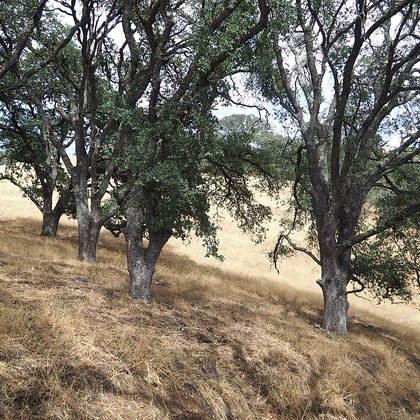
Where the bird is most often found, arranged by the USNVC — the vegetation classification of the United States and Canada — and CMECS for sea and coast.




Range and movements
Resident in the Mexican highlands, from Sonora and Chihuahua in the Sierra Madre Occidental and from Nuevo León and Tamaulipas in the Sierra Madre Oriental, south across the volcanic belt and Oaxaca to Chiapas, Guatemala, El Salvador, Honduras and northern Nicaragua. In summer small numbers reach the Huachuca and Chiricahua mountains of southeastern Arizona, where nesting has also occurred. Within the range, birds shift seasonally up and down the slopes. Strays have turned up far outside it, as far as Alabama, Michigan and Mississippi.
- Resident
- Breeding (summer)
- Winter
- Passage
- dark = core range, pale = thinly spread
Where and when to look
In Arizona, July and August are the time: leave a feeder in a mountain canyon unwatched for an hour and then check every hummingbird for a white ear stripe. In Mexico a roadside bank of flowering shrubs at two thousand metres works better than the forest itself. Go by sound: the monotonous metallic ticking carries further than the bird can be seen, and keeps going longer than you expect of a hummingbird.
Conservation
Fairly common to common across most of its range, with a stable population and a status of Least Concern (LC). Because it uses forest edges and clearings, it is less vulnerable to fragmentation than many other montane birds. Loss of pine-oak forest in the Mexican highlands to logging and conversion to farmland is the main long-term pressure.
Scientific name
Basilinna leucotis | (Vieillot, 1818)
Vieillot described the species in 1818 as Trochilus leucotis; because it was later placed in another genus, author and year stand in parentheses. leucotis is Greek for 'white-eared', from leukos 'white' and ous 'ear' — exactly the mark by which the species is known in the field. The genus name Basilinna is Greek for 'queen'. The type locality was originally given as Brazil, which was an error; Griscom later designated Orizaba in Veracruz.