All species › Swifts › Hummingbirds › Broad-billed Hummingbird
Broad-billed Hummingbird | Cynanthus latirostris
Breedsnavelkolibrie | Colibrí piquiancho común
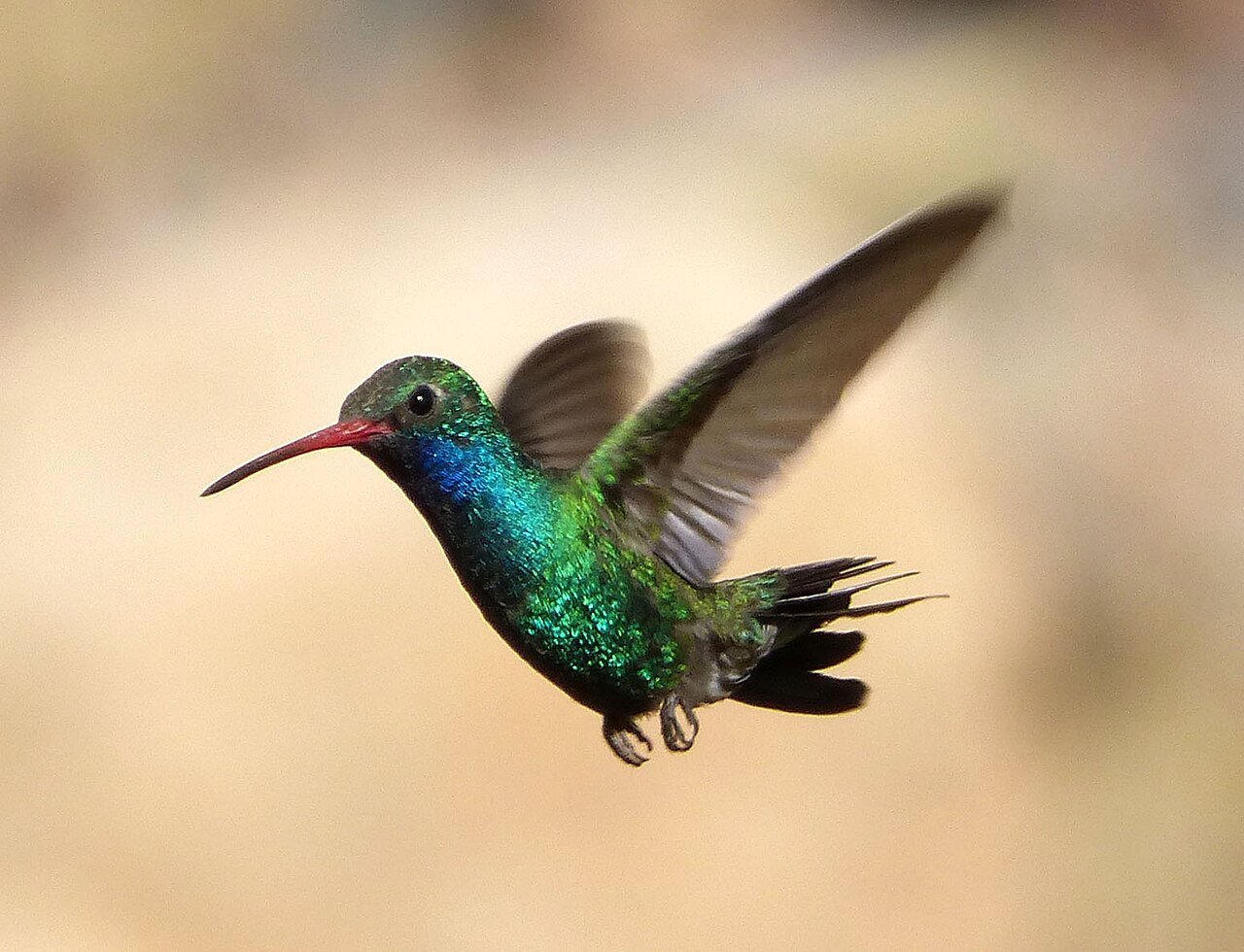
The Broad-billed Hummingbird is largely a Mexican bird that in summer reaches the creek canyons of southeastern Arizona and southwestern New Mexico. The male is emerald green with a sapphire throat and a coral-red, black-tipped bill, and performs his display like a pendulum swinging back and forth in front of the female.
Click a thumbnail to switch the photo above.
Voice
The call is a short, clipped je-dit, very like that of a Ruby-crowned Kinglet, and it is usually the first sign of the bird in dense streamside cover. Courting males deliver a series of short chip notes from a perch, monotonously repeated. During the pendulum display itself the wings vibrate hard enough to produce a high buzzing zing — a mechanical sound, not a voice. Away from courtship it is a quiet bird, heard mostly in quarrels over a patch of flowers.
No freely licensed recording has been found for this species yet; what to listen for is described below.
Identification
The male is deep green with a blue throat that merges into the green of the breast without a sharp border, so there is no clearly outlined gorget; the undertail coverts are white and the broad, centrally notched tail is blue-black. The blue and green are interference colours produced by feather structure: when the light falls wrongly the whole bird is dull black and only the red bill remains. The female is golden-green above and plain grey below, with a clean white line behind the eye and white tips to the outer tail feathers; her bill is duller and darker than the male's. Juveniles resemble the female, but young males gradually gain blue-green feathers in the throat. At a little over three grams this is a small hummingbird with a proportionately long, straight bill.
Confusion species
The female is the hardest. Female White-eared Hummingbird has a far broader, bolder white ear stripe on a black mask, spotted rather than plain underparts, and a shorter bill. Female Violet-crowned Hummingbird is pure white below, without green spotting and without a distinct eye stripe. Males in good light cannot be confused with anything else, given the combination of red bill and blue throat. Despite the similar name, there is no chance of confusion with Broad-tailed Hummingbird, a mountain bird with a rose-red throat and trilling wings.
Habitat
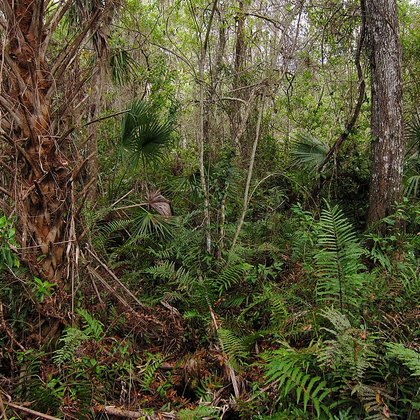
In the United States, creek canyons below about two thousand metres with Arizona sycamore, cottonwood, willow and mesquite, and with agave, desert honeysuckle and ocotillo as nectar plants. After breeding, birds move upslope to mountain meadows at nearly three thousand metres, following the bloom. In Mexico it occupies everything from dry thorn forest and tropical deciduous forest to gallery forest along rivers and on into gardens and village edges. Closed high-elevation conifer forest is avoided; it needs light, water and flowers.
Where the bird is most often found, arranged by the USNVC — the vegetation classification of the United States and Canada — and CMECS for sea and coast.




Range and movements
Resident over much of northern and central Mexico, from Sonora and Chihuahua to Tamaulipas, Veracruz and Oaxaca. In the United States only as a breeder: in southeastern Arizona and southwestern New Mexico from March to September, and rarely in extreme southwestern Texas. Only a small part of the world population nests north of the border. In autumn stray birds occasionally appear far to the east, as far as the Gulf coast.
- Resident
- Breeding (summer)
- Winter
- Passage
- dark = core range, pale = thinly spread
Where and when to look
Look for it from April to August in a canyon with tall sycamores along a permanent creek, or simply at the feeders of a visitor centre in southeastern Arizona. Watch the red bill: it stays visible when the light makes the throat look black, and on a perched bird it is the quickest mark. If you see a male swinging back and forth in a flat arc just in front of a perched female, you are watching the display.
Conservation
Partners in Flight puts the world population at 2.2 million birds, some two hundred thousand of them in the United States; the trend is unknown and the species rates as of low concern. The United States population nevertheless depends entirely on canyons with running water, and those are sensitive to groundwater extraction and drying streams. Feeders in southeastern Arizona now keep part of the population in the area longer than they used to.
Scientific name
Cynanthus latirostris | Swainson, 1827
Swainson described the species in 1827 as Cynanthus latirostris, and since it still stands in that genus, author and year remain without parentheses. latirostris is Latin for 'broad-billed', from latus 'broad' and rostrum 'bill'. The genus Cynanthus is formed from Greek kyanos 'dark blue' and anthos 'flower'. The type locality was originally given as the tableland of Mexico, but that was judged unreliable because the species probably does not occur there; Moore later designated the Valley of Mexico near Mexico City.