All species › Swifts › Hummingbirds › Broad-tailed Hummingbird
Broad-tailed Hummingbird | Selasphorus platycercus
Breedstaartkolibrie | Colibrí coliancho
The Broad-tailed Hummingbird is the hummingbird of high mountain meadows in the American West, up beyond three thousand metres where the nights freeze even in July. You hear it before you see it: the male's wings produce a shrill metallic trill that carries across a whole meadow.

Click a thumbnail to switch the photo above.
Voice
The voice consists of dry chip notes and a rattling chitter while feeding and during fights over nectar. The typical sound comes not from the throat but from the wing: the narrowed outer primaries of the male set up a sustained metallic trill in flight, as though a cricket were flying about. The sound stops the moment he perches, and it fades over the winter as those feathers wear down; they have grown back before the next breeding season. In the courtship dive the same trill swells into a shrill whine.
Recording: Sue Riffe — CC BY-NC-SA 4.0 · Lyons, Boulder County, Colorado, United States · xeno-canto
Identification
The male is glossy green on back and crown, white on the breast, with greenish-buff flanks and a gorget of rose-red to magenta. That gorget is an interference colour arising from feather structure rather than pigment: in the wrong light the throat simply looks black. Female and immature are green above and white to buff below, with green spots on throat and cheeks, a pale eyering, rufous at the tail base and white tips to the outer tail feathers. Young males acquire a few magenta feathers in the throat during their first year. The build is slender with a big head and a long straight bill, and the tail extends clearly beyond the wingtips.
Confusion species
Females and juveniles are the stumbling block. Female Rufous and Allen's Hummingbirds show far more rufous on the flanks and have a shorter tail. Calliope Hummingbird is smaller and short-tailed: its tail does not reach the wingtips, while in Broad-tailed it projects beyond them. In males the wing trill is decisive — no other North American hummingbird makes that sound. Do not confuse the species with Broad-billed Hummingbird, a green bird with a blue throat and a red bill from low canyons, not a mountain bird at all.
Habitat
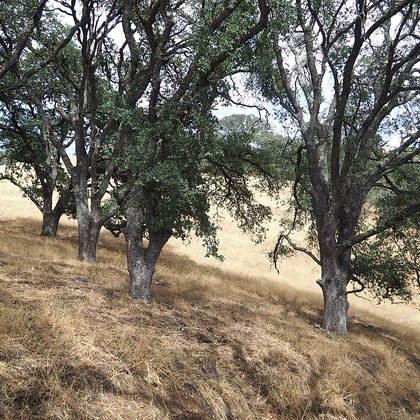
Subalpine meadows, open conifer and pine-oak forest, pinyon (a low-growing pine of the dry south-western foothills)-juniper woodland, montane scrub and willow-lined streams, between roughly fifteen hundred and three thousand metres. It looks for open, flower-rich places with a view: forest edges, clearings, slopes with larkspur, columbine and scarlet gilia. Lowlands and desert are avoided except as a corridor on migration. In Mexico it winters in pine-oak and tropical forest at two to three thousand metres.
Where the bird is most often found, arranged by the USNVC — the vegetation classification of the United States and Canada — and CMECS for sea and coast.



Range and movements
It breeds in the mountains of the interior West, from Idaho and Wyoming south across Nevada, Utah and Colorado to Arizona, New Mexico and the ranges of west Texas, plus the Sierra Madre Occidental in northern Mexico. The United States population leaves the country entirely in winter; in the Mexican highlands and in Guatemala the species is present all year. In spring the migration follows the bloom uphill, which means that a bird of three and a half grams crosses thousands of kilometres of mountain country each year. The breeding range itself has changed little over the past century; the timing of migration has.
- Resident
- Breeding (summer)
- Winter
- Passage
- dark = core range, pale = thinly spread
Where and when to look
Go to a mountain meadow above two thousand metres in July and listen: the trill of a passing male carries a hundred metres and betrays him before anything is visible. Stand still by a flowery slope and let him come to you; he inspects anything red. Early in the morning birds are still in torpor (a state of lowered metabolism, a kind of nightly hibernation) and will not move for minutes at a time — not a sick bird, but an energy-saving state.
Conservation
Partners in Flight puts the world population at 9.8 million birds, with a decline of over one per cent a year and roughly forty-five per cent between 1966 and 2019; the species is on the Yellow Watch List. Because mountain snow melts earlier, arrival and the peak of flowering match less well than they used to. Severe winters on the wintering grounds and collisions with windows, vehicles and electric fencing take a further toll.
Scientific name
Selasphorus platycercus | (Swainson, 1827)
Swainson described the species in 1827 as Trochilus platycercus; because it was later moved to another genus, author and year stand in parentheses. platycercus is Greek for 'broad-tailed', from platys 'broad' and kerkos 'tail'. The genus Selasphorus means 'flame-bearer', after the glowing throat of the males. No locality was given in the description; the type locality was later fixed simply as Mexico.