All species › Pigeons and doves › Doves and pigeons › White-tipped Dove
White-tipped Dove | Leptotila verreauxi
Verreaux' duif | Tórtola Colipinta
White-tipped Dove is a heavy, pale dove that walks alone or in pairs on the shaded floor of dense brush and rarely stays long in the open. Its song is a low, hollow note that sounds like someone blowing across the neck of a bottle, and it begins in the darkest part of the thicket before sunrise. In the United States it is found only in the far south of Texas.

Voice
The song consists of two notes on the same pitch, low, hollow and without a sharp attack: oo-wooooo, as if blown across a bottle. It carries far through dense brush and is heard mainly in the first and last hour of the day, usually from cover rather than from an open branch. The bird calls all year, with a peak in spring when the pair marks out its territory. Otherwise it is silent; anyone looking for it usually hears it before seeing it.
Recording: JAYRSON ARAUJO DE OLIVEIRA — CC BY-NC-SA 4.0 · Brejo do tricolino oliváceo - Campestre de Goiás, Brazil · xeno-canto
Identification
A large, heavy dove with a small head, a pale forehead and an olive-brown back that takes on a green or purple sheen towards the neck. The underparts are grey-white to dirty white, the breast with a faint pink wash; the wing is plain, without spots or marks. The eye is pale yellow within a ring of bare red skin, and the legs are red — features that stand out at once at close range. The tail is dark with white corners, visible only on take-off or landing; the underwing is rufous. Male and female are alike, juveniles duller with pale edges to the wing coverts.
Confusion species
White-winged Dove is the same size but carries a sharp white line along the folded wing, a black cheek streak and blue skin around a red eye. Mourning Dove is far slimmer, has a tapering tail, black spots on the wing and only narrow white tips to the outer tail feathers, not broad white corners. From the small ground doves it differs by its size and by the complete absence of any wing pattern. When it is walking on the ground, the pale eye, the red legs and the plain wing together are enough.
Habitat
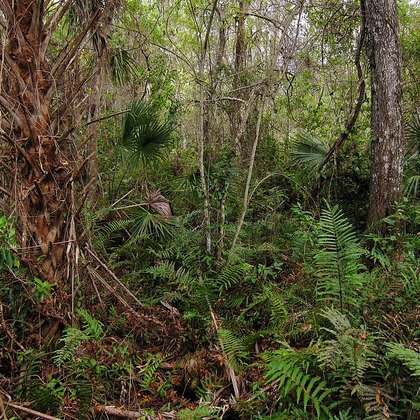
Dense thorn brush and dry woodland rich in vines, preferably near water, and along woodland edges, hedgerows and overgrown field margins. Where the original brush is gone it uses citrus groves, shaded parks and vegetated town edges. It forages on foot on the shaded floor and along paths and sand tracks, staying close to cover. It avoids open grassland without shrubs and the closed interior of humid rainforest.
Where the bird is most often found, arranged by the USNVC — the vegetation classification of the United States and Canada — and CMECS for sea and coast.




Range and movements
Resident in the far south of Texas along the lower Rio Grande, through both slopes of Mexico from Sonora and Tamaulipas, across the Yucatán Peninsula and the whole of Central America, and on through South America to Peru, Uruguay and central Argentina. It does not migrate and stays in the same area for life. In Texas it has crept slowly north over recent decades, past Corpus Christi and into the surroundings of San Antonio. Fourteen subspecies are recognised across the range, differing in tone and size.
- Resident
- Breeding (summer)
- Winter
- Passage
- dark = core range, pale = thinly spread
Where and when to look
Walk a shaded trail at first light in one of the reserves along the lower Rio Grande and listen for the low hollow note; then look at the ground, not at the branches, because this dove is seldom high up. At the feeding stations of the visitor centres there it comes to spilled seed and can be watched at a few metres. Look then for the pale eye and the red eye-ring.
Conservation
Partners in Flight estimates the world population at twenty million breeding birds, of which fewer than ten thousand breed in the United States. More than ninety-five per cent of the original brush of south Texas and northeastern Mexico has been cleared for farming and building, and that loss continues. For the species as a whole, listed as Least Concern (LC), this is no threat, but the North American edge of the range depends on the remnants kept as reserves.
Scientific name
Leptotila verreauxi | Bonaparte, 1855
Bonaparte described the species in 1855 as Leptoptila verreauxi; author and year stand without parentheses because the bird is still in the genus in which it was described — the name is now only spelled differently, as Leptotila. That name comes from Greek leptos, 'slender', and ptilon, 'feather'. The species name verreauxi honours the French collector and natural history dealer Jules Verreaux. Bonaparte gave the type locality as Colombia; the description appeared in the Comptes Rendus of the Académie des Sciences, volume 40, page 99.