All species › Pigeons and doves › Doves and pigeons › White-winged Dove
White-winged Dove | Zenaida asiatica
Witvleugeltreurduif | Paloma Alas Blancas
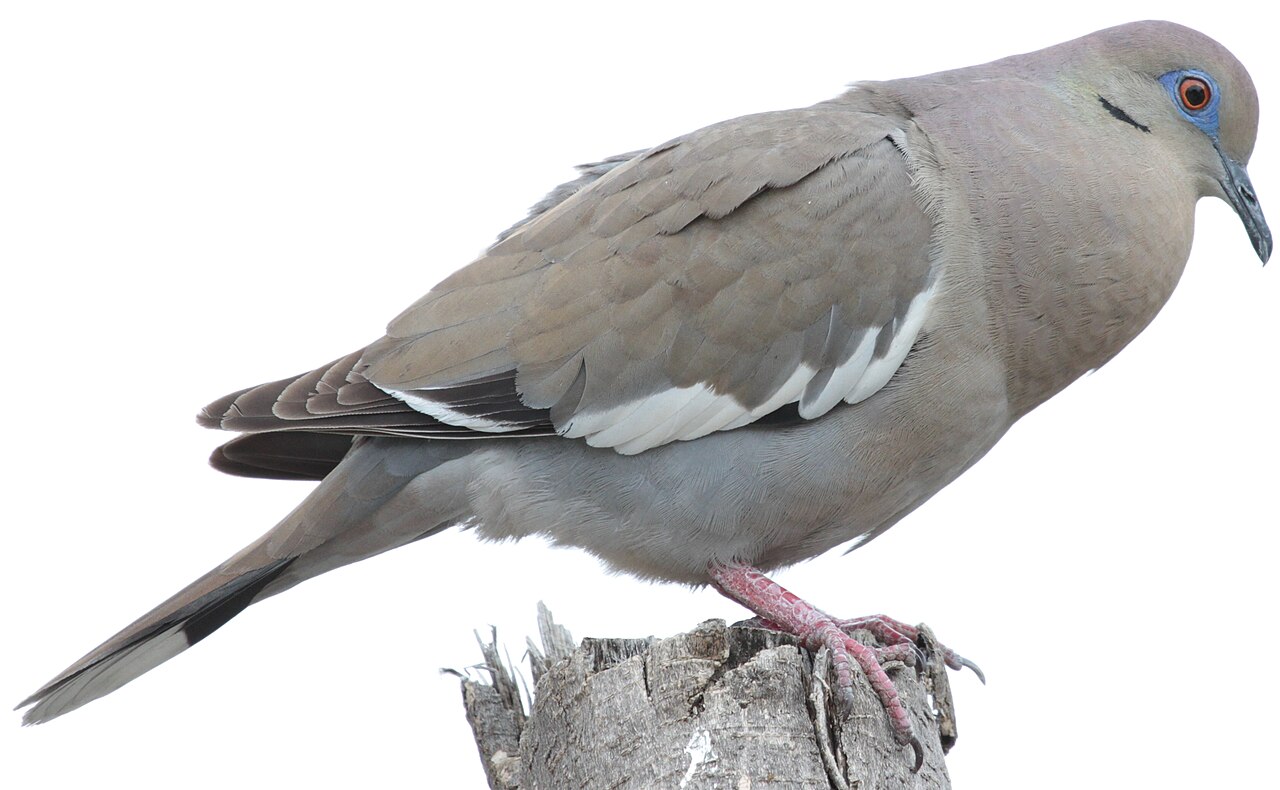
White-winged Dove is a heavy grey-brown dove with a sharp white line along the folded wing that opens on take-off into a broad white crescent. It belongs originally to the saguaro country and thorn forest of the Southwest, but now breeds in numbers in the cities of Texas and along the Gulf Coast. In San Antonio alone more than a million birds were counted around the turn of the century.
Voice
The song is a rhythmic, hooting coo rendered in field guides as who-cooks-for-you: fuller, lower and more rolling than the lament of the Mourning Dove. There is also a repeated pep-pair-poo-oo, given from a wire, a roof edge or a treetop. Where the birds nest close together, dozens of males sing across one another and the sound becomes a steady drone over the whole district. Song starts in spring and continues into late summer.
Recording: Bill Pyle — CC BY-NC-SA 4.0 · Rancho Primavera, Cabo Corrientes, Jalisco, MX, Mexico · xeno-canto
Identification
A large, solidly built dove, grey-brown above and slightly paler below, with a rounded tail carrying a black band and broad white tips. Along the edge of the folded wing runs a sharp white line, which in flight opens into a broad white field across the arm. A short black streak crosses the cheek, and the orange-red eye is set in a ring of bare blue skin. Male and female are alike; the male shows a little more purple gloss on head and neck. Juveniles are duller, with less blue around a browner eye.
Confusion species
Mourning Dove is slimmer and smaller, has a tapering tail edged white, scattered black spots on the wing and no white wing stripe anywhere. Eurasian Collared-Dove is paler, carries a black half-collar and has a square tail without a white wing panel. White-tipped Dove is the same size but has a plain wing, a pale yellow eye and white tail corners instead of a white wing band. Rock Pigeon is chunkier and shorter-tailed and shows a white rump in flight, not a white wing band.
Habitat
Originally saguaro (the giant columnar cactus of the Sonoran Desert) desert, mesquite (a thorny pod-bearing shrub of the Southwest that forms dense thickets) woodland along dry riverbeds and dense thorn scrub, where it feeds on cactus fruit, seeds and nectar. Over recent decades it has become above all a bird of towns and cities: gardens with tall trees, parks, cemeteries, citrus groves and drinking places. Unlike Mourning Dove it often feeds up in the vegetation itself, at seedheads and fruit, rather than on bare ground. Water nearby is a condition in the dry part of the range.
Where the bird is most often found, arranged by the USNVC — the vegetation classification of the United States and Canada — and CMECS for sea and coast.





Range and movements
Breeds in southern California, Nevada, Arizona, New Mexico and Oklahoma, and is resident in south Texas, Louisiana and Florida, throughout Mexico, in Central America to Nicaragua and beyond, and in the Bahamas, Cuba, Jamaica, Hispaniola, the Cayman Islands, the Turks and Caicos Islands and Puerto Rico. Northern breeders leave in September and October for Mexico and Central America and return between March and May; about a third of the Texas birds now stay through the winter. Since the middle of the twentieth century the range has moved strongly north and east, into Oklahoma, Kansas, Arkansas, Louisiana and the Gulf states, largely along the cities. After the breeding season the birds wander widely and irregularly across the continent.
- Resident
- Breeding (summer)
- Winter
- Passage
- dark = core range, pale = thinly spread
Where and when to look
Stand still at sunrise in a suburb of San Antonio, Tucson or Phoenix from March onwards and listen for the hooting coo from roofs and wires; it is then the most frequently heard bird sound of the street. When one takes off, the white wing band opens into a crescent that fixes the species at any distance. In winter look along town edges and at water troughs, where the wintering birds gather.
Conservation
The IUCN lists the species as Least Concern (LC). Partners in Flight estimates the global breeding population at fourteen million birds, with an increase between 1966 and 2019. Numbers in the United States peaked in 1968 and then fell sharply as the nesting groves along the lower Rio Grande were cleared; the recovery came from birds settling in towns. The species is hunted in several states and in Mexico without that bringing the numbers down.
Scientific name
Zenaida asiatica | (Linnaeus, 1758)
Linnaeus described the species in 1758 as Columba asiatica; Bonaparte placed it in 1838 in the genus Zenaida, which he named after his wife Zénaïde Bonaparte — hence the parentheses around author and year. The species name asiatica means 'Asian' and rests on a mistake: Linnaeus wrote the origin as 'In Indiis' and had the East Indies in mind. The bird described actually came from the West Indies, from Jamaica, and the type locality was later corrected to there. The name stands, because a species name is not changed for being misleading.