All species › Pigeons and doves › Doves and pigeons › Mourning Dove
Mourning Dove | Zenaida macroura
Treurduif | Zenaida huilota
Mourning Dove is one of the most abundant and widespread birds in North America: a slim, light brown dove with a long, tapering tail and a mournful call that gives it its name. It breeds from Canadian grainfields to the edges of Mexican deserts and is at once a common backyard bird and the continent's most heavily hunted game bird. Few other species combine such enormous abundance with such unassuming plumage.

Voice
The song is a low, mournful cooing of four to six syllables — coo-OO, coo, coo, coo — often mistaken for an owl by first-time listeners. Both sexes call, but the male sings most, especially in early morning from an open branch or wire. On take-off the wings make a sharp, whistling clatter caused by the narrow outer primaries — a sound that often gives the bird away before its call does.
Recording: Jonathon Jongsma — CC BY-SA 3.0 · Minnesota Valley NWR, Old Cedar Ave Bridge, Hennepin, Minnesota, United States · xeno-canto
Identification
A slim dove with a small round head, a long, tapering tail edged in white that shows clearly in flight, and black spots on the folded wing. The plumage is warm sandy brown with a pink flush on the breast and a blue wash around the eye; the male has an iridescent purple-green patch on the neck that the female lacks or shows only faintly. Juveniles are scaly-patterned and lack the sheen. On the ground it walks with a distinctive head-bobbing gait.
Confusion species
The introduced Eurasian Collared-Dove is larger and paler, with a black half-collar and a square rather than pointed tail. White-winged Dove of the Southwest is much bulkier, with a conspicuous white wing patch and a rounded tail. Rock Pigeon, common in cities, is far chunkier with a short tail and lacks the Mourning Dove's long, tapering lines entirely.
Habitat
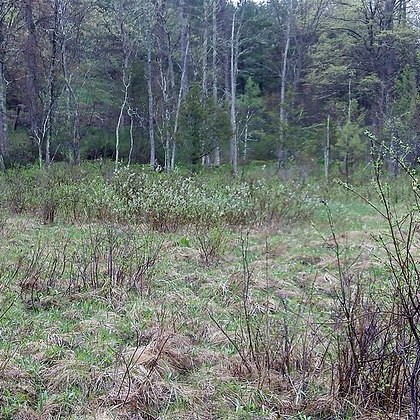
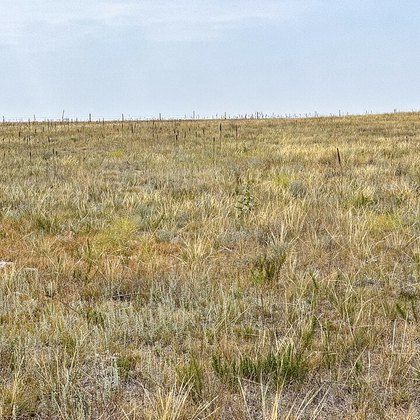
It is above all a bird of half-open country: field edges, pastures with scattered trees, desert scrub, farmyards and gardens — anywhere open ground for foraging meets trees or shrubs for nesting. It largely avoids closed forest. It tolerates drought well and reaches deep into the desert as long as occasional water and even a single tree can be found.
Where the bird is most often found, arranged by the USNVC — the vegetation classification of the United States and Canada — and CMECS for sea and coast.


Range and movements
It breeds across nearly all of the United States, southern Canada and all of Mexico, and is resident across most of that range. Only the northernmost breeders, in Canada and the northern Great Plains, migrate south in autumn and winter further south in the United States and Mexico. The range has changed little over the past century; the species is one of the few whose enormous population has stayed stable for decades despite substantial annual hunting.
- Resident
- Breeding (summer)
- Winter
- Passage
- dark = core range, pale = thinly spread
Where and when to look
Listen at sunrise or sunset along a field edge or in a suburb for the mournful cooing, then look for silhouettes on power lines or bare ground: Mourning Doves forage on foot with small, quick steps and a bobbing head. When flushed, the whistling wing sound gives the bird away before it is even seen.
Conservation
One of the most abundant native birds in North America, with a population in the hundreds of millions. It is legally hunted in most states, and the annual harvest runs into the tens of millions without noticeably denting the population. Loss of small-scale farmland with hedgerows and solitary trees is the main long-term threat.
Scientific name
Zenaida macroura | (Linnaeus, 1758)
Linnaeus described the species in 1758 as Columba macroura, in the general genus for pigeons; Bonaparte placed it in the new genus Zenaida in 1838, named after his wife Zénaïde Bonaparte — hence the parentheses around author and year. The species name macroura is Greek for 'long-tailed'. Linnaeus mistakenly gave the type locality as Canada and Carolina; later research showed the specimen described actually came from the West Indies, based on a plate by Edwards.