All species › Pigeons and doves › Doves and pigeons › Zenaida Dove
Zenaida Dove | Zenaida aurita
Antilliaanse treurduif | Zenaida Caribeña
The Zenaida Dove is the everyday dove of the Caribbean islands and a major rarity in North America: a compact, warm brown dove with a short, square-cut tail and a white border along the trailing edge of the wing. In the early nineteenth century it still bred in the Florida Keys; since then it has been recorded there only rarely, with few accepted records. A bird seen inside the area of this guide has almost certainly crossed from Cuba or the Bahamas.
Voice
The call is a mournful cooing of four syllables, coo-OO-oo coo coo, much like Mourning Dove's but delivered faster and with the first note less strongly bent. It calls mostly in the early morning and towards dusk, usually hidden in dense foliage and rarely from an open branch. On the islands a visitor therefore hears it far more often than sees it. Outside the breeding season the species is largely silent.
Recording: Garrett Yocklin — CC BY-NC-SA 4.0 · Bouton, Soufrière, St Lucia · xeno-canto
Identification
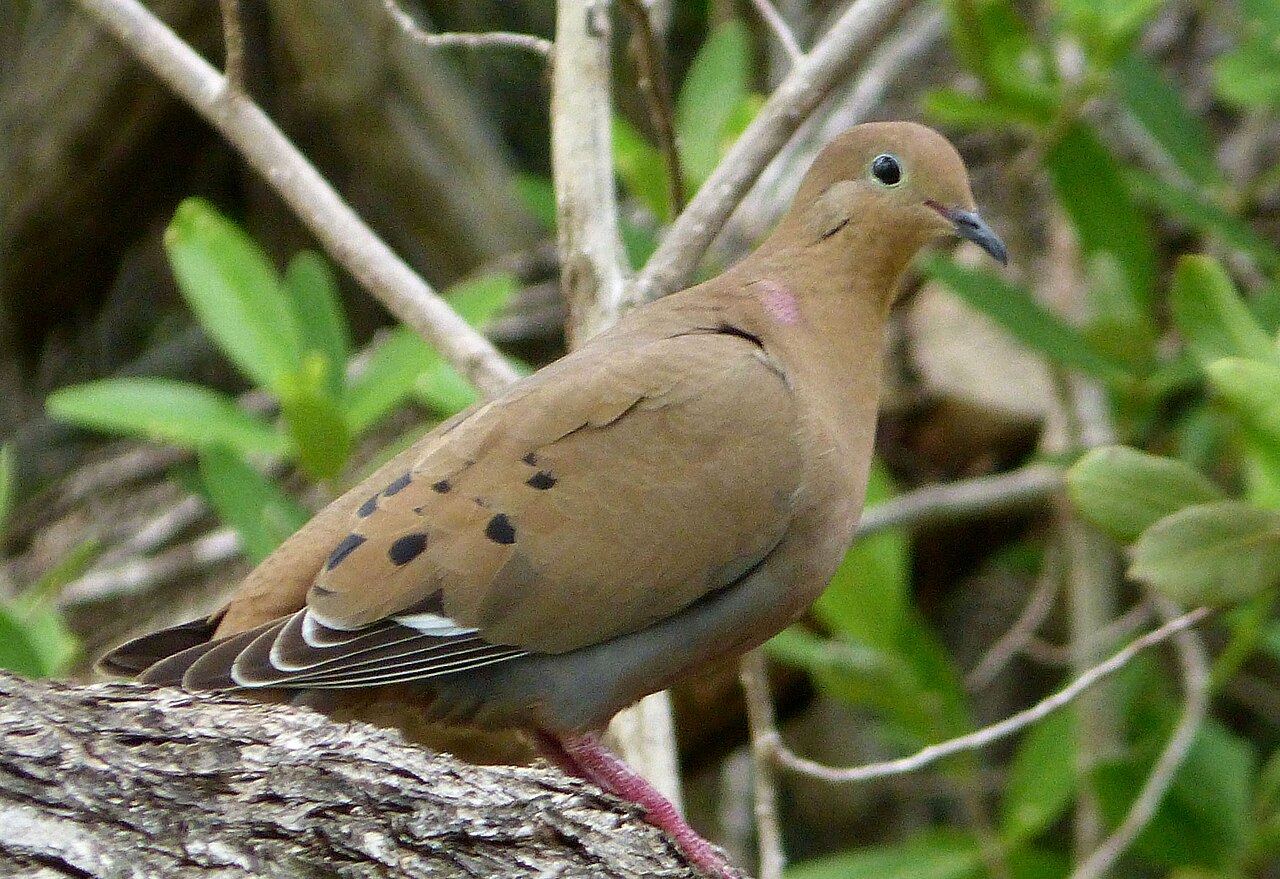
A compact, warm reddish-brown dove with a small head, short wings and a short, square-cut tail. A few black spots mark the folded wing, and along the trailing edge of the wing runs a white border that shows as a small white streak on the perched bird and lights up as a white line in flight. Two short black marks cross the cheek; in good light the neck shows a violet gloss, and bare blue skin surrounds the eye. The legs are red. Females are slightly duller than males, and juveniles are greyer and scaly-patterned, without the gloss.
Confusion species
Mourning Dove (Zenaida macroura) is slimmer, has a long tapering tail edged in white and shows no white in the wing at all. White-winged Dove (Z. asiatica) is larger and greyer and carries a broad white band across the wing coverts, not merely a narrow border along the trailing edge of the wing. Rock Pigeon is bulkier, shorter-tailed and never warm brown. On a bird in flight the white trailing edge is the quickest mark to catch.
Habitat
It likes low, half-open country: coastal dunes with scrub, dry woodland and woodland edges, plantations, and the greenery of gardens, parks and hotel grounds. The edge of mangrove belongs to its range too, and on some islands it feeds along tracks and roadsides. It avoids closed rainforest and the high interior; it is a bird of the coastal plain. It picks up its seeds on foot from the ground, and when disturbed flies low and fast into cover.
Where the bird is most often found, arranged by the USNVC — the vegetation classification of the United States and Canada — and CMECS for sea and coast.




Range and movements
Resident on nearly all the islands of the Greater and Lesser Antilles, in the Bahamas, the Cayman Islands and the Turks and Caicos, and along the Caribbean edge of the Yucatán Peninsula, including Cozumel. Within the area of this guide it is a major rarity: records come almost entirely from southern Florida and the Keys, spread through the year with an emphasis on spring and early summer. In Audubon's day the species still bred in the Keys; those breeders disappeared during the nineteenth century and have not returned. On the islands themselves the range is unchanged and the bird is common.
- Resident
- Breeding (summer)
- Winter
- Passage
- dark = core range, pale = thinly spread
Where and when to look
In the Florida Keys between April and June, search the parties of Mourning Doves feeding on open ground: a shorter, square-cut tail stands out at once among all those pointed ones. Put the bird up and watch for the white trailing edge of the wing — it is the one mark that works beyond doubt at a distance.
Conservation
On the islands the species is numerous and its numbers are steady; the Red List places it among the species of Least Concern (LC). It is hunted as game on several islands, and the loss of dry coastal woodland reduces its habitat locally. For North America there is no population to count: it is and remains a visitor from overseas.
Scientific name
Zenaida aurita | (Temminck, 1809)
Temminck described the species in 1809 as Columba aurita, in the general genus for pigeons; Bonaparte introduced the genus Zenaida in 1838, named after his wife Zénaïde — hence the parentheses around author and year. The species name aurita is Latin for 'eared' and refers to the black marks on the ear coverts. The specimen described came from Martinique. Temminck published the name in his plate work on pigeons, Les Pigeons, at plate 25.