All species › Passerines › Finches, euphonias and allies › White-winged Crossbill
White-winged Crossbill | Loxia leucoptera
Witbandkruisbek | Piquituerto franjeado
The White-winged Crossbill is the crossbill of spruce forest: a heavy finch with crossed bill tips and two broad white wingbars. It follows the cone crop of spruce and tamarack through the boreal forest and breeds wherever seed is hanging at the time, midwinter included.
Voice
The song is a long series of hard rattles and dry trills, delivered from a high perch or in a song flight above the canopy, and sounds harsh and mechanical. The flight call is a dry, rapid chet-chet-chet, higher and thinner than that of the Red Crossbill; usually it is the first sign of a flock passing overhead. Feeding groups call almost continuously as they clamber among the cones.
Recording: Stein Ø. Nilsen — CC BY-NC-SA 4.0 · Guleng, Håkøya, Tromsø, Troms, Norway · xeno-canto
Identification
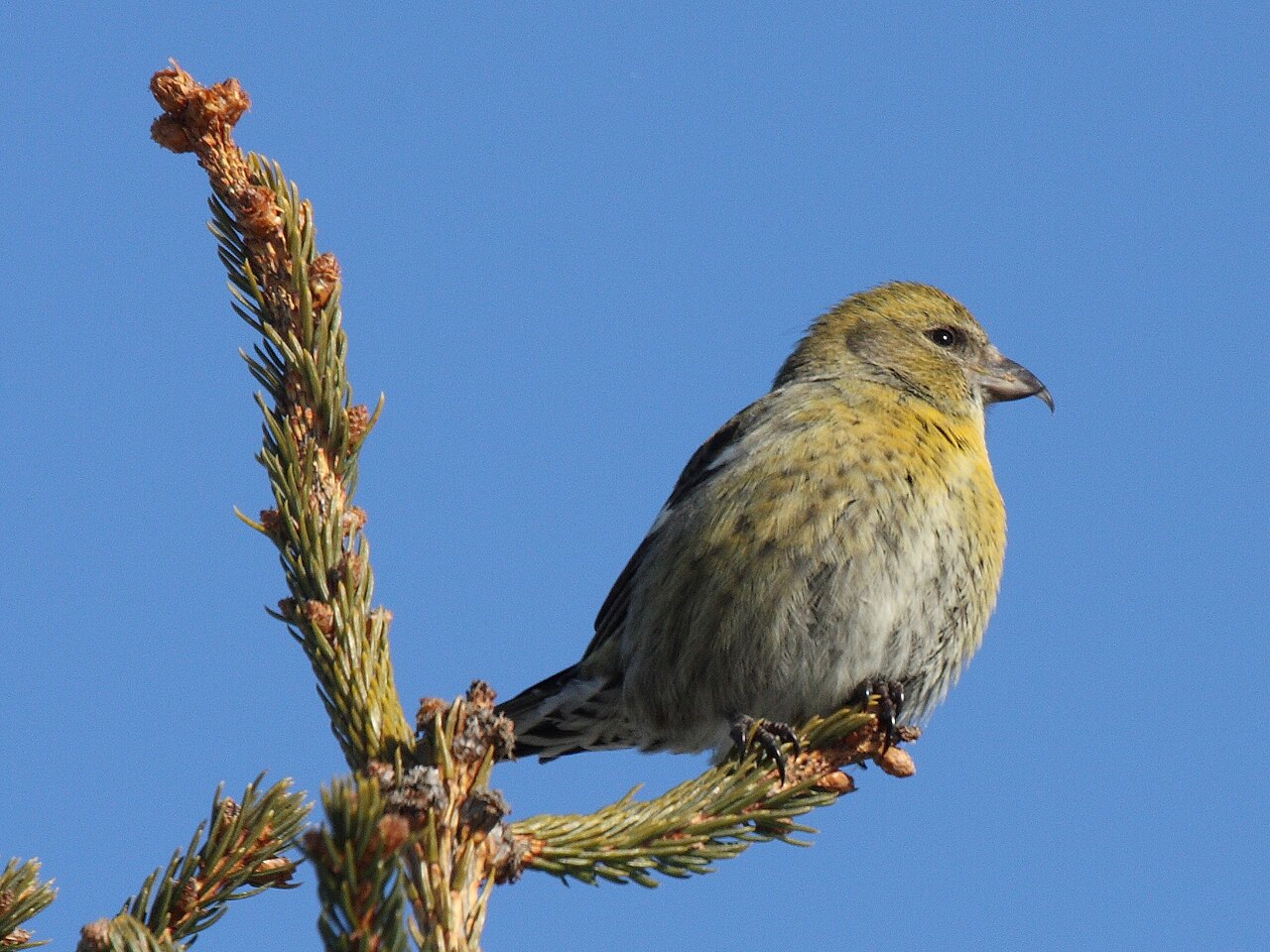
The male is rose-red to raspberry pink, with black wings and tail and two broad white wingbars; the tertials are white-tipped and can suggest a third bar. The female is olive-yellow with a greyish, streaked back and the same white wing pattern. Juveniles are greyish brown and heavily streaked, but already show the wingbars. The bill tips cross; the bill is slimmer and finer than that of the Red Crossbill.
Confusion species
Red Crossbill has no white wingbars and a heavier, blunter bill; young Red Crossbills sometimes show narrow pale wingbars, but these are buff rather than sharply white and the wing stays brown rather than black. Pine Grosbeak is larger, has a short rounded bill with no crossing and is a softer pink, with thinner white bars. On a flock high in the canopy the call settles it faster than the plumage: high and dry in White-winged, low and hard in Red.
Habitat
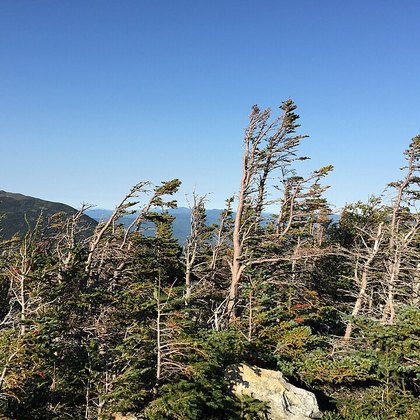
Boreal conifer forest of white, black and Engelmann spruce, balsam fir and tamarack, out into open muskeg (boggy spruce peatland typical of boreal Canada) woodland and the dwarf scrub at treeline. Spruce seed is the staple; insects are added in summer, above all spruce budworm larvae. Pine and hemlock forest it barely uses. During irruptions it appears in planted spruces in parks, gardens and cemeteries far outside the breeding range.
Where the bird is most often found, arranged by the USNVC — the vegetation classification of the United States and Canada — and CMECS for sea and coast.




Range and movements
Breeds across the whole boreal belt, from Alaska and Yukon east to Labrador and Newfoundland, and south to northern New England, the Adirondacks, northern Minnesota, northern Michigan and the mountains of Montana. There is no fixed migration: the species is nomadic and moves to wherever the cone crop is good. In years of crop failure large numbers move south to the mid-Atlantic states, the Midwest and at times to Colorado and Washington; the following year the same area may stay empty. Nesting has been recorded in nearly every month of the year.
- Resident
- Breeding (summer)
- Winter
- Passage
- dark = core range, pale = thinly spread
Where and when to look
In an irruption winter look for cone-bearing spruces and larches in parks, along roads and in cemeteries; listen first for the dry rattling overhead, then find the moving birds in the crowns. Fresh cone scales and dropped cones under a tree mark a flock that fed there shortly before. The birds are not shy and often allow an approach to within a few metres.
Conservation
Partners in Flight puts the breeding population at about 79 million birds, and the species is listed as Least Concern (LC). Because numbers in any one area can differ tenfold from year to year, survey series yield little usable trend. The pressure lies with the forest itself: fragmentation of spruce forest and shorter logging rotations reduce the share of old, heavily cone-bearing trees on which the species depends.
Scientific name
Loxia leucoptera | Gmelin, 1789
Johann Friedrich Gmelin described the species in 1789 as Loxia leucoptera, from specimens taken at Hudson Bay and New York; author and year stand without parentheses because the species is still in its original genus. Loxia comes from Greek loxos 'slanting, crosswise', after the crossed bill tips. Leucoptera is Greek for 'white-winged', from leukos 'white' and pteron 'wing', after the two wingbars. The Eurasian subspecies bifasciata is known in English as the Two-barred Crossbill.