All species › Passerines › Finches, euphonias and allies › Common Redpoll
Common Redpoll | Acanthis flammea
Grote barmsijs | Pardillo sizerín
The Common Redpoll breeds right around the Arctic in the dwarf birch and willow belt at the upper edge of the forest, and moves south in flocks in some winters. It is recognised by the crimson forehead patch above a small black chin spot. Since 2024 the former Hoary and Lesser Redpolls have been treated as the same species.

Voice
The flight call is a dry, rattling series of three to five hard notes, chet-chet-chet, given continuously by a passing flock; that sound usually gives it away before it is seen. There is also a drawn-out, plaintive swee-eet. The song consists of those rattling notes alternated with fast trills, often in an undulating song flight over the tundra.
Recording: Stanislas Wroza — CC BY-NC-SA 4.0 · Neljan Tuulen Tupa, Finland · xeno-canto
Identification
A small, short-tailed finch with a short, pointed yellow bill with a dark tip, a deeply notched tail and two narrow white wingbars. Both sexes have a glossy crimson patch on the forehead and a small black spot on chin and throat. The upperparts are grey-brown with dark streaking, the underparts white with streaking on the flanks; in spring the male has a rosy wash on breast and rump. Within the species the plumage runs from dark, heavily streaked birds to pale, nearly white individuals with an unstreaked rump.
Confusion species
The palest redpolls, formerly described as a separate Hoary Redpoll, have a shorter bill, a white unstreaked rump and much less streaking on flanks and undertail coverts; they now belong to the same species and are one end of a continuous series rather than a separate bird. Pine Siskin has a longer, thinner bill, yellow panels in wing and tail base, and no red forehead or black chin. House Finch is larger, has a heavier bill and lacks the wingbars.
Habitat
Breeds on tundra and in the open forest belt above it, with dwarf birch, willow and alder along streams and on damp slopes, and in boreal conifer forest with clearings. In winter in birch and alder stands, hedgerows, weedy ground, roadsides and gardens with nyjer feeders. Birch and alder seed is then the main food; in severe cold it burrows a tunnel in the snow to roost.
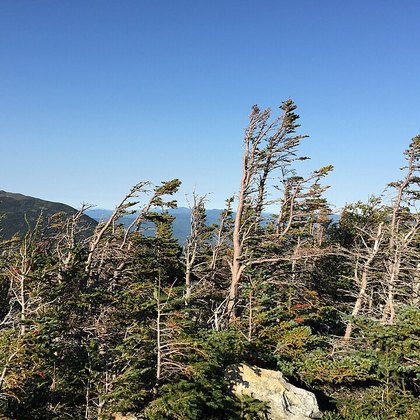
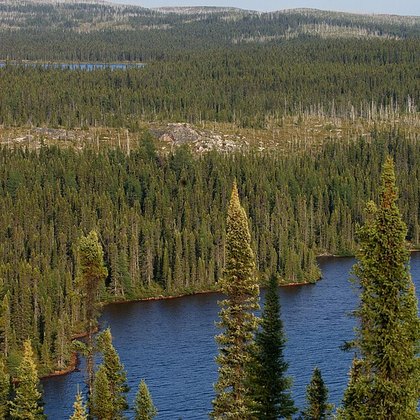
Where the bird is most often found, arranged by the USNVC — the vegetation classification of the United States and Canada — and CMECS for sea and coast.




Range and movements
Breeds in Alaska, Yukon, the Northwest Territories, Nunavut, northern Quebec and Labrador, Greenland and on around the whole Arctic. In autumn it moves to southern Canada and the northern United States; in some winters it stops there, in others large numbers reach the central states. These irruptions roughly follow a two-year rhythm tied to the birch seed crop in the breeding range: after a poor crop it comes far south, after a good one it largely stays north.
- Resident
- Breeding (summer)
- Winter
- Passage
- dark = core range, pale = thinly spread
Where and when to look
In an irruption winter look for flocks hanging, often upside down, from the drooping catkins of birches, or at a feeder with nyjer seed. Listen for the rattling chet-chet call overhead; with a flock on the ground it pays to pick out the palest birds separately, even though they are no longer a species of their own.
Conservation
The species is widespread and numerous and listed as Least Concern (LC) — before the 2024 taxonomic merger Partners in Flight arrived at about 250 million birds — but is listed as a common bird in steep decline. Numbers on the winter map swing so widely between years that the trend is hard to measure. At feeders, outbreaks of salmonellosis occur where many birds gather. In the longer term, a shift of the treeline through climate change is named as a pressure on the breeding range.
Scientific name
Acanthis flammea | (Linnaeus, 1758)
Linnaeus described the species in 1758 as Fringilla flammea, from European birds; because it later moved to another genus, author and year stand in parentheses. The genus Acanthis goes back to Greek akanthis, the name of a small seed-eating bird, derived from akantha 'thorn' or 'thistle'. The species name flammea is Latin for 'flame-coloured', after the red forehead patch. The English name refers to that same red poll, an old word for the top of the head.