All species › Passerines › New World warblers › Worm-eating Warbler
Worm-eating Warbler | Helmitheros vermivorum
Streepkopzanger | Reinita gusanera
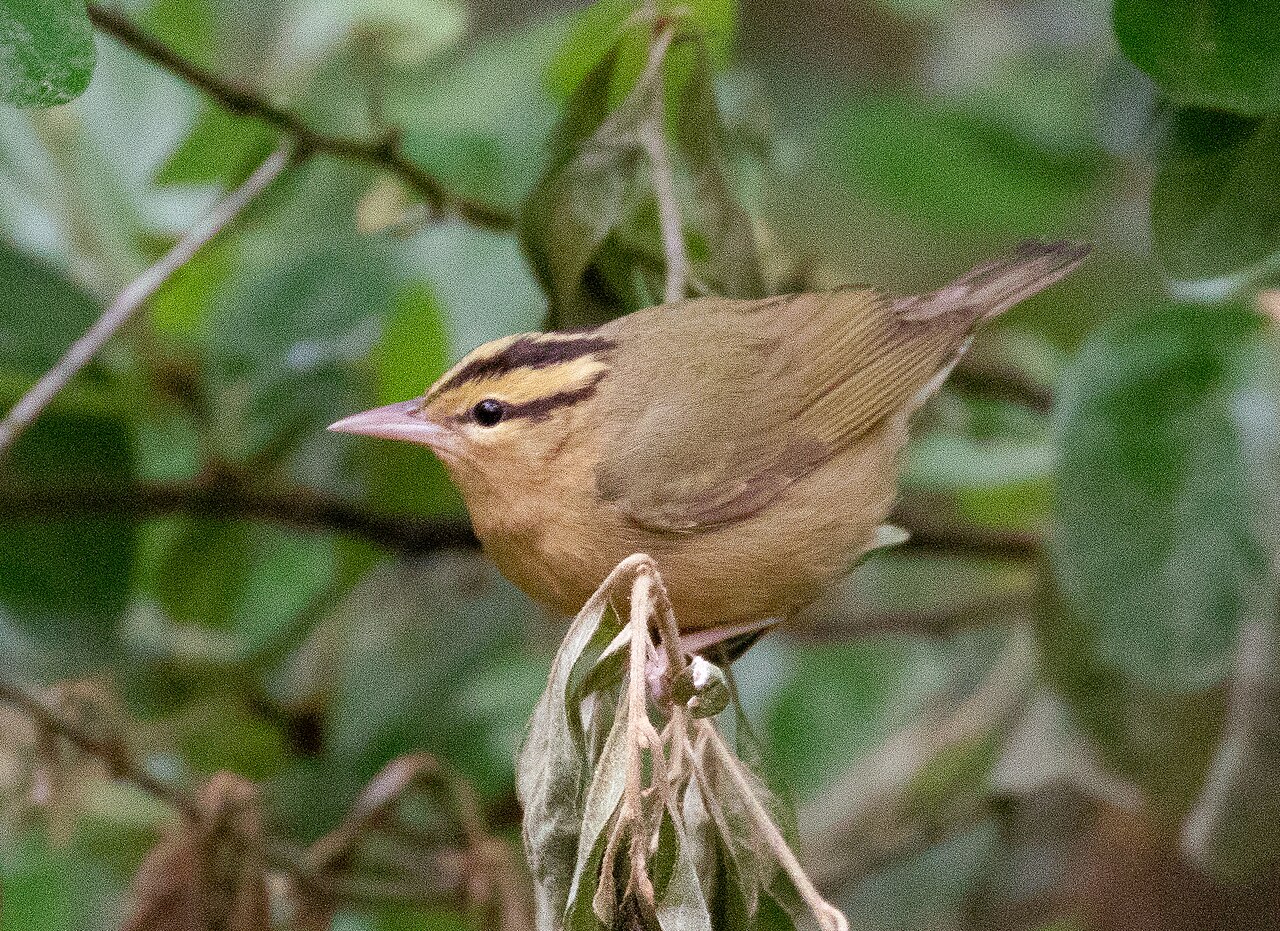
The Worm-eating Warbler is an olive-brown warbler with no yellow or blue, and its whole identification rests in the head pattern: four black stripes over a light brown head. It breeds on steep wooded slopes in the eastern United States and finds its food in hanging dead leaves.
Voice
The song is a short, dry, high trill on one pitch, about two seconds long, without an opening or closing note. It sounds harder and drier than that of Pine Warbler and flatter than the trill of Dark-eyed Junco. The call is a sharp chip, in flight a thin tseet. The male sings from a branch midway up a tree, often on a slope, and falls largely silent after early July.
Recording: Bobby Wilcox — CC BY-NC-SA 4.0 · Skinner State Park, Hampshire County, Massachusetts, United States · xeno-canto
Identification
Olive-brown above, dingy white to buff below, without streaking, wingbars or tail spots. The head is light brown with two black crown stripes and a black eye-line on each side, so that four dark lines run over the head. The bill is long, straight and pointed, the legs pink. Male and female are alike. Characteristic is the feeding method: the bird hangs at clusters of dead, curled leaves in the shrub layer and inserts its bill, then forces it open to expose the prey.
Confusion species
Swainson's Warbler has a heavier bill, a rusty crown without black stripes and only one dark eye-line; it also walks on the ground rather than hanging in dead leaves. The brown form of Blue-winged Warbler has yellow underparts and white wingbars. Ovenbird has an orange crown stripe with black borders, a white eye-ring and a streaked breast.
Habitat
Mature deciduous and mixed forest on steep slopes and in ravines, with a dense understorey of mountain laurel, rhododendron or young hardwood; also beech-maple and oak-hickory forest in hill country. Along the coastal plain it also uses pine plantation with hardwood regrowth. The species needs large unbroken forest blocks, from tens to hundreds of hectares, and drops out of fragmented woodlots. The nest sits on the ground against a slope, hidden under dead leaves. In winter it is in moist forest and scrub, often where many dead leaves hang.
Where the bird is most often found, arranged by the USNVC — the vegetation classification of the United States and Canada — and CMECS for sea and coast.



Range and movements
Breeds in the eastern United States, centred on the Appalachians and the Ohio basin: from southern New England and New York through Pennsylvania, West Virginia, Kentucky and Tennessee to northern Georgia, and west to southern Missouri, Arkansas and eastern Oklahoma and Texas. Migration crosses the Gulf of Mexico on a broad front. It winters from southeastern Mexico through Belize, Guatemala and Honduras to Panama, and in the Greater Antilles, with many birds on Jamaica, Cuba and Hispaniola.
- Breeding (summer)
- Winter
- Passage
- dark = core range, pale = thinly spread
Where and when to look
Look for it in May on a steep wooded slope with rhododendron and listen for the dry trill; then search the clusters of dead leaves in the shrub layer at eye level, because that is where it hangs, not in the canopy. The four black head lines show even in shade.
Conservation
Partners in Flight puts the breeding population at about 780,000 birds; the Breeding Bird Survey shows a largely stable trend since 1966 and the species is listed as Least Concern (LC) and rated of low conservation concern. The main constraint is its need for large unbroken forest blocks: in fragmented woodland nest predation rises and the species disappears. On the wintering grounds conversion of moist forest to farmland is the pressure.
Scientific name
Helmitheros vermivorum | (Gmelin, 1789)
Gmelin described the species in 1789 as Motacilla vermivora; because it was later moved to another genus, author and year stand in parentheses. The genus Helmitheros was introduced in 1819 by Rafinesque, from Greek helmins 'worm' and -thēras 'hunter'. The species name vermivorum comes from Latin vermis 'worm' and -vorus 'eating'. Genus name, species name and English name all point to worms, but the diet consists mainly of caterpillars and grubs, not earthworms. The Dutch name follows the four black stripes over the head.