All species › Passerines › Shrike-babblers, Erpornis and vireos › Yellow-green Vireo
Yellow-green Vireo | Vireo flavoviridis
Geelgroene vireo | Vireo verdiamarillo
The Yellow-green Vireo is the tropical counterpart of the Red-eyed Vireo: the same size, the same slow foraging, but yellower below and without the sharp black border to the crown. It breeds from Sonora and Tamaulipas southwards and touches the United States only in the lower Rio Grande valley.
Voice
The song consists of short, repeated phrases of two to four notes with brief pauses between them, and is kept up for long stretches through the morning. The phrases are shorter and follow one another faster than in Red-eyed Vireo, and sound more abrupt because the notes are packed closer together. The call is a nasal, drawn-out nyaaah. It rarely sings in the winter range, where it is noticed mainly by the call.
Recording: Noah Khanti Steinberg — CC BY-NC-SA 4.0 · Key Biscayne, Miami-Dade County, Florida, United States · xeno-canto
Identification
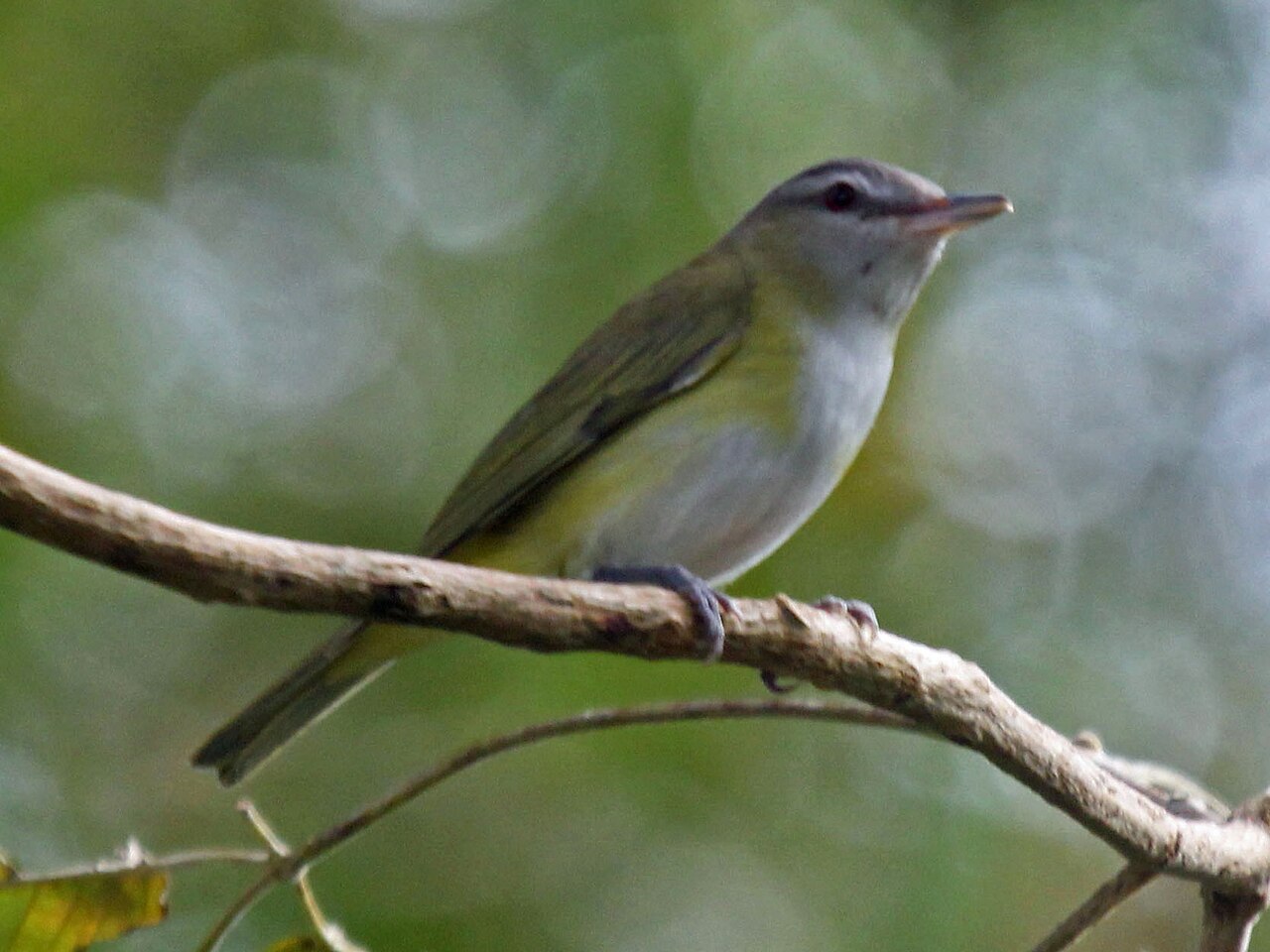
Upperparts olive-green, crown dull grey with an olive-tinged edge that is not sharply drawn. A white supercilium runs above the eye, with a dark loral line from bill to eye. The underparts are white with clear yellow on the sides of the breast, the flanks and the undertail coverts; in many birds the yellow runs across the side of the breast as a broad band. The iris is red-brown, the bill heavy and slightly hooked. Juveniles are duller, with a brown iris and less yellow.
Confusion species
Red-eyed Vireo is the only real problem. In that species the grey crown is sharply bordered by a black line above the white supercilium; in Yellow-green Vireo that black border is absent and the crown colour grades into the olive of the back. Red-eyed Vireo is clean white below, with yellow at most on the undertail coverts, while Yellow-green Vireo has yellow across breast sides and flanks. The upperparts of Yellow-green Vireo are also a yellower green. A proportion of birds cannot be identified with certainty even in the hand. Song helps: shorter phrases, faster delivery. Black-whiskered Vireo has a black malar stripe and lacks the extensive yellow; Philadelphia Vireo is much smaller, has yellow up onto the throat and a far smaller bill.
Habitat
Canopy and middle levels of light woodland, forest edge, riparian woodland, gardens and plantations, from sea level to about 1500 metres. In Texas this means riverine woodland along the Rio Grande with sycamore, cottonwood, willow, ash and hackberry, virtually at sea level. It works slowly through the foliage for caterpillars and beetles and also takes small fruit, including mistletoe and gumbo-limbo berries.
Where the bird is most often found, arranged by the USNVC — the vegetation classification of the United States and Canada — and CMECS for sea and coast.





Range and movements
The species is a summer visitor across nearly all of its range: breeding birds return from early February through March and most leave again by mid-October. The breeding range runs along both Mexican slopes — the Pacific slope from Sonora and Sinaloa, the Gulf slope from Tamaulipas — across the Neovolcanic Cordillera and south through Central America to central Panama. It winters in the western Amazon basin and along the northern and eastern Andes. In Texas it is a scarce summer resident in the lower Rio Grande valley, with breeding recorded at Laguna Atascosa among other sites, and an irregular migrant along the coast; spring records fall between 6 and 14 May, autumn records between 3 July and 13 October. It does not winter in Texas.
- Breeding (summer)
- Passage
- dark = core range, pale = thinly spread
Where and when to look
In Texas look for it between mid-May and mid-July in the riverine woodland of the Rio Grande valley, and go by voice first: short, quickly repeated phrases point to this species, longer and slower ones to Red-eyed Vireo. Then check the edge of the crown in profile — if the black line above the supercilium is missing, it is a Yellow-green Vireo.
Conservation
The IUCN places the species in the Least Concern (LC) category; the range is large and the bird is common across much of it. The northern edge of the range has shifted: Texas breeding records now lie further inland than the older specimen sites, including a 1943 nesting in Cameron County and later records further north. In the Rio Grande valley the loss of riverine woodland is the governing factor for numbers.
Scientific name
Vireo flavoviridis | (Cassin, 1851)
Cassin described the species in 1851 as Vireosylvia flavoviridis; because it was later moved to Vireo, author and year stand in parentheses. Vireo is a Latin word for a green migratory bird, from virere 'to be green'. The species name combines flavus 'yellow' and viridis 'green', after the plumage. The type locality was originally given as Panama and San Juan de Nicaragua; Zimmer restricted it in 1941 to San Juan de Nicaragua. The species was long treated as a subspecies of the Red-eyed Vireo.