All species › Passerines › Shrike-babblers, Erpornis and vireos › Warbling Vireo
Warbling Vireo | Vireo gilvus
Orpheusvireo | Vireo gorjeador
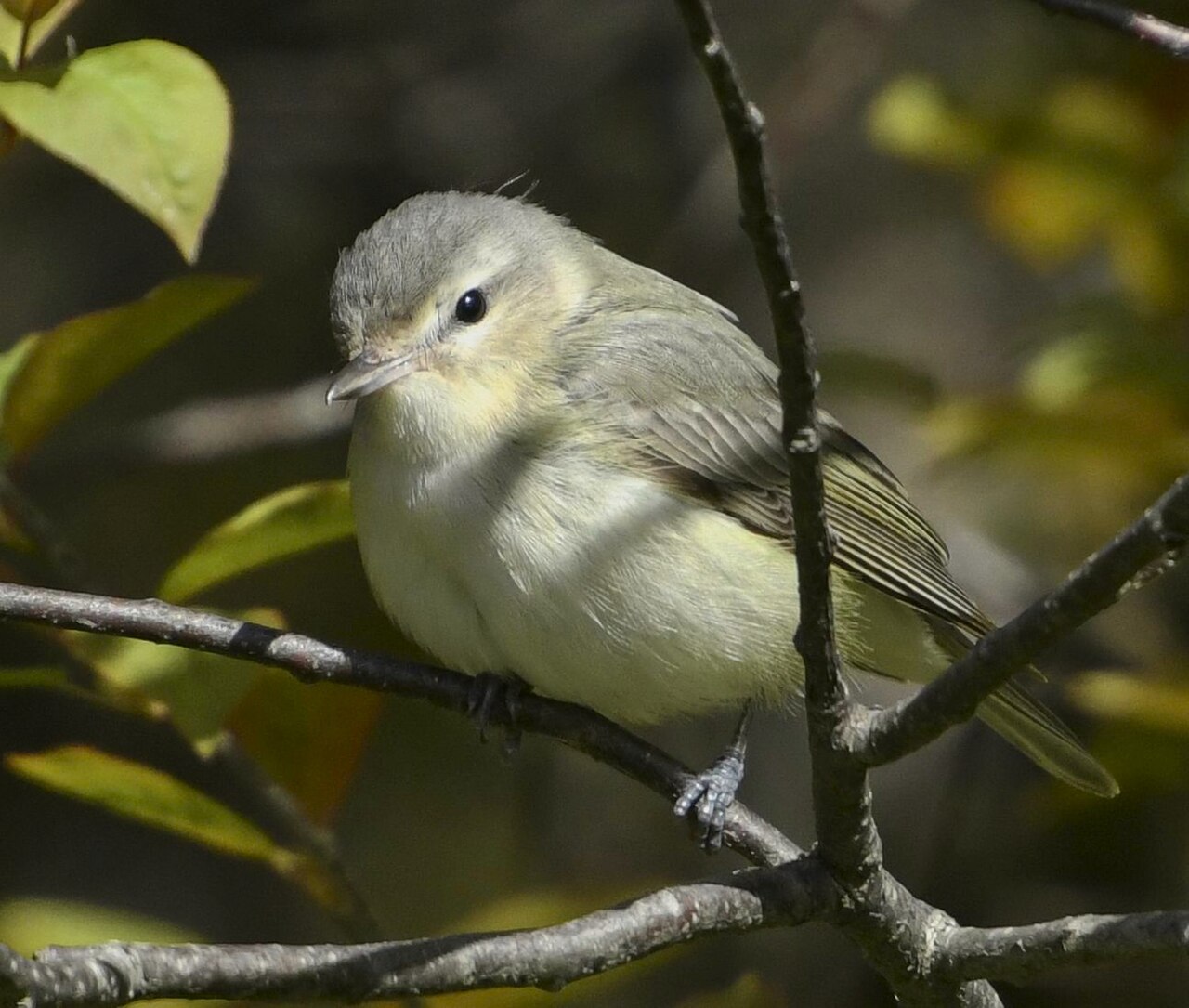
The Warbling Vireo has no sharp mark at all: grey-green above, dirty white below, with no wingbars, no eye-ring and no pattern on the head. What names it is the song, a long undulating run that ends on an upward-flicked note and that it keeps up all summer, through the middle of the day as well. It stays high in the crowns of cottonwoods and willows and is seldom seen well there.
Voice
The song is a continuous, undulating warble of three to four seconds that almost always ends on an upward-flicked note; American field guides write it as if I sees you, I will seize you, and I'll squeeze you till you squirt. It sings from its arrival in May well into August, in heat as well, when everything else falls silent. The incubating male sings too, sitting on the eggs — few songbirds do that. The call is a nasal, slightly grating tweeh, repeated as soon as anything comes too near the nest.
Recording: Scott Crabtree — CC BY-NC-SA 4.0 · Mt Bigelow, Pima County, Arizona, United States · xeno-canto
Identification
A grey-green bird of twelve to thirteen centimetres without wingbars and without an eye-ring, with a dirty white eyebrow that has no black border above it and a faint dark line through the eye. The underparts are dirty white, with a yellowish wash on the flanks in autumn. The eye is dark and the face is therefore expressionless; the bill is thick for a bird of this size, with a small hook at the tip. The sexes are alike, and young birds differ hardly at all. It moves slowly and deliberately through the crown, quite unlike the hurried business of the warblers.
Confusion species
Red-eyed Vireo is the standing comparison: it has a blue-grey crown, a sharp black border above the white eyebrow and, in adults, a red eye, and it sings in short separate phrases with pauses between them. Philadelphia Vireo (Vireo philadelphicus) is smaller and yellow on throat and breast, with a dark patch between eye and bill. Tennessee Warbler (Leiothlypis peregrina) resembles it in autumn, but has a thin, sharply pointed bill and a more restless way of moving. In doubt the song decides: only this bird keeps up one long unbroken run.
Habitat
Tall broadleaved trees near water: cottonwood, willow and alder along rivers and streams, and in the west aspen woodland higher in the mountains. Beyond that, avenues, parks, orchards and farmyards with large trees, as long as the canopy is open. It avoids conifer forest, and the dark interior of closed forest just as much; what it wants is light in the crown. It forages nearly always in the upper half of the tree, which leaves the song as the most usable thing about it.
Where the bird is most often found, arranged by the USNVC — the vegetation classification of the United States and Canada — and CMECS for sea and coast.





Range and movements
Breeds across nearly all of North America: from British Columbia and southern Yukon east to Nova Scotia, and south to California, Texas and the Appalachians. In the southeastern lowlands it does not breed and occurs only on passage. It winters from western Mexico south to Guatemala, El Salvador, Honduras and Nicaragua; a small part goes on to Costa Rica, which lies outside the guide area. The western birds, referred to as the swainsoni group, are smaller and greyer and sing more thinly; some lists, such as those of the AOS and the ABA, have treated them since 2025 as a separate species, Western Warbling-Vireo (Vireo swainsoni).
- Resident
- Breeding (summer)
- Winter
- Passage
- dark = core range, pale = thinly spread
Where and when to look
Look for it in May and June along a river with tall cottonwoods, and listen; the song nearly always comes from the top of the crown and carries on at hours when little else does. Follow the sound until you see movement and wait until the bird stands against the sky: then you see the thick hooked bill and the plain face. In autumn do not go by colour — vireos and warblers are equally drab then, and the slow clambering through the branches gets you further than the plumage.
Conservation
Least Concern (LC); numbers have been stable to slightly increasing overall since 1966. It uses the planting of towns, farmyards and roadsides, and that has gained it ground in the open middle of the continent. In the west it has lost ground where the riverside woodland has gone through grazing and the fixing of the watercourses. As a long-distance night migrant it runs, like the Red-eyed Vireo, into lit buildings and masts.
Scientific name
Vireo gilvus | (Vieillot, 1808)
Vieillot described the species in 1808 as Muscicapa gilva, among the flycatchers of the Old World; because it was later placed in another genus, author and year stand in parentheses. Vieillot introduced the genus Vireo in that same year; to the Romans vireo was the name of a green bird, and it is connected with virere, 'to be green'. gilvus is Latin for 'pale yellow' and refers to the yellowish wash on the flanks. The first specimen described came from New York State.