All species › Passerines › Shrike-babblers, Erpornis and vireos › Philadelphia Vireo
Philadelphia Vireo | Vireo philadelphicus
Philadelphiavireo | Vireo de Filadelfia
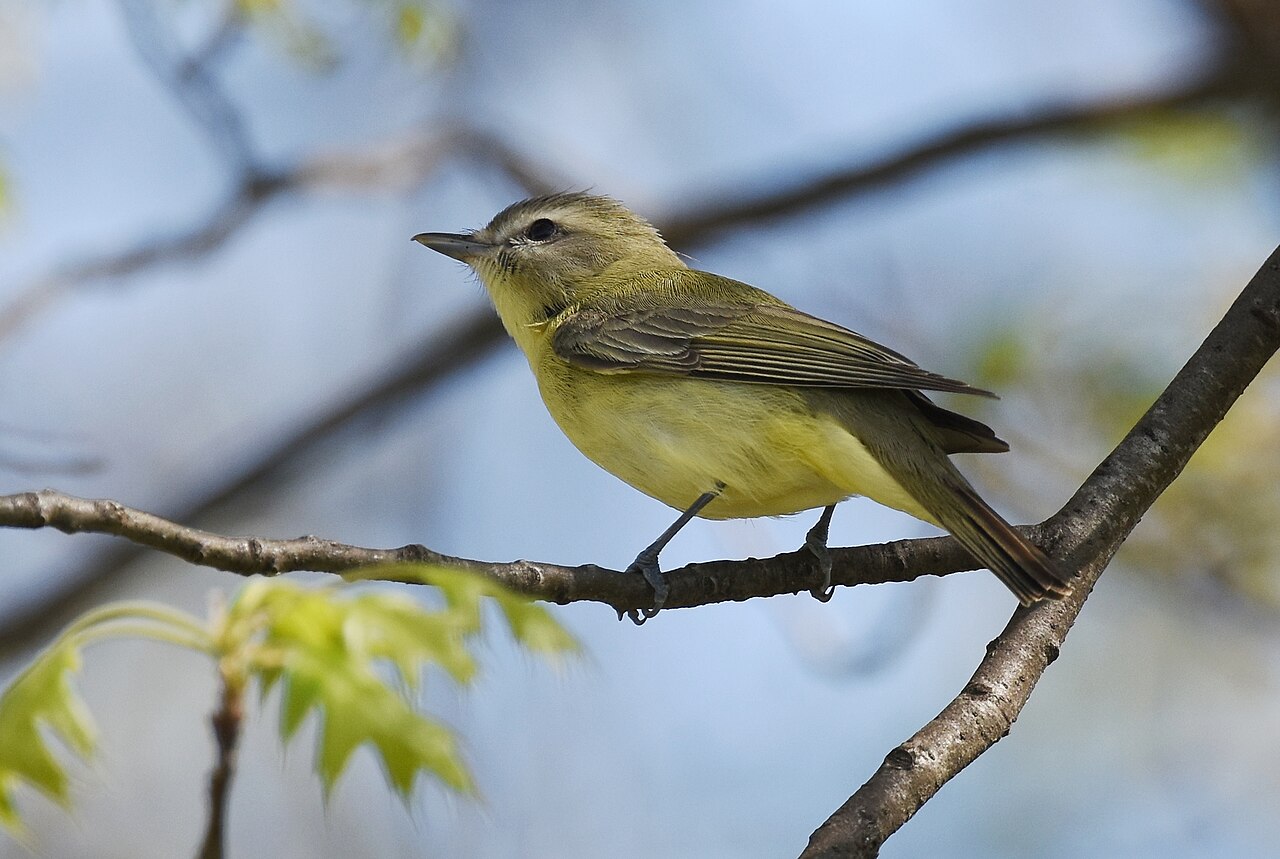
The Philadelphia Vireo is the smallest vireo of eastern North America and the only one with wholly yellow underparts and no wing bars. It breeds in young deciduous woodland along the southern edge of the boreal forest and passes through late in spring, when most warblers have already gone by.
Voice
The song consists of short phrases of two to four notes, weezh weezh weezh, each separated by a pause of about a second, and is kept up for hours at a stretch in the breeding season. It closely resembles that of the Red-eyed Vireo, but averages higher in pitch and the pauses between phrases are longer, so the delivery is slower. Written out it runs cherrie-o-witt, cheree, sissy-a-witt, tee-o. The call is a nasal, drawn-out sheee. Migrants sing too, mainly in the morning.
Recording: Stanislas Wroza — CC BY-NC-SA 4.0 · Stationnement des dunes (near Tadoussac), Côte-Nord, Québec, Canada · xeno-canto
Identification
A small, compact vireo with a grey crown, olive-brown upperparts and yellow underparts, the yellow deepest on throat and breast. Wing bars and eye-ring are absent. A white supercilium runs above the eye, and below it a dark line that continues from the eye forward to the base of the bill. The bill is short and thick with a slightly hooked tip, the legs blue-grey and stout. The bird forages slowly in the upper half of the tree and regularly hangs upside down from a twig tip.
Confusion species
Red-eyed Vireo is clearly larger and longer-billed, has a sharply drawn head pattern with a black border above and below the white supercilium, a red iris in adults and white underparts, with yellow limited to the flanks and undertail coverts. Warbling Vireo is duller and lacks yellow on the breast, and in that species the dark eye-line stops short of the bill, while in Philadelphia Vireo it reaches the bill. Tennessee Warbler is slighter, with a thin pointed bill and no hook, and in autumn plumage shows bright white undertail coverts, which are yellow on Philadelphia Vireo. In case of doubt, bill shape is the most reliable mark.
Habitat
Young, dense deciduous and mixed woodland along the southern edge of the boreal forest: regrowth of aspen, birch, alder and ash, woodland edges, recovering burns and cutovers, with 70 to 100 per cent canopy closure. On migration it uses woodland and scrub of all kinds, including city parks. In winter it occupies second growth and forest edge from the lowlands into the hills.
Where the bird is most often found, arranged by the USNVC — the vegetation classification of the United States and Canada — and CMECS for sea and coast.





Range and movements
The breeding range runs from northeastern British Columbia and Alberta through Saskatchewan, Manitoba, Ontario, Quebec and the Maritimes to Newfoundland, and reaches into the United States in northern Minnesota, northern Wisconsin, the northern Michigan peninsula, northern New York and northern New England. Birds do not arrive on the breeding grounds until late May. Migration is broad across the eastern United States and the Gulf Coast; wintering is from southern Mexico and Belize through Guatemala, Honduras, El Salvador and Nicaragua to Panama and northern Colombia.
- Breeding (summer)
- Winter
- Passage
- dark = core range, pale = thinly spread
Where and when to look
The best chance in the eastern United States falls in the last week of May and the first half of September, in the crowns of tall deciduous trees. Listen for the song: the longer pauses between phrases pick it out among the Red-eyed Vireos. Then look at the throat — yellow up onto the chin means Philadelphia, white means Red-eyed.
Conservation
The IUCN places the species in the Least Concern (LC) category. Partners in Flight puts the breeding population at about four million birds and scores it 9 out of 20 on the Continental Concern Score. The Breeding Bird Survey showed an increase of about 2.3 per cent a year between 1966 and 2015; the species benefits from young regrowth after logging and fire. Because the breeding range lies almost entirely within the boreal forest, large-scale logging and conversion of forest in the winter range are the main factors for its future.
Scientific name
Vireo philadelphicus | (Cassin, 1851)
Cassin described the species in 1851 as Vireosylvia philadelphica; because it was later moved to Vireo, author and year stand in parentheses. Vireo is a Latin word for a green migratory bird, from virere 'to be green'. The species name refers to Philadelphia: the specimen described came from Bingham's woods near that city, in Pennsylvania. The bird does not breed there; the type was a migrant.