All species › Pigeons and doves › Doves and pigeons › Zebra Dove
Zebra Dove | Geopelia striata
Zebraduif | Tortolita Estriada
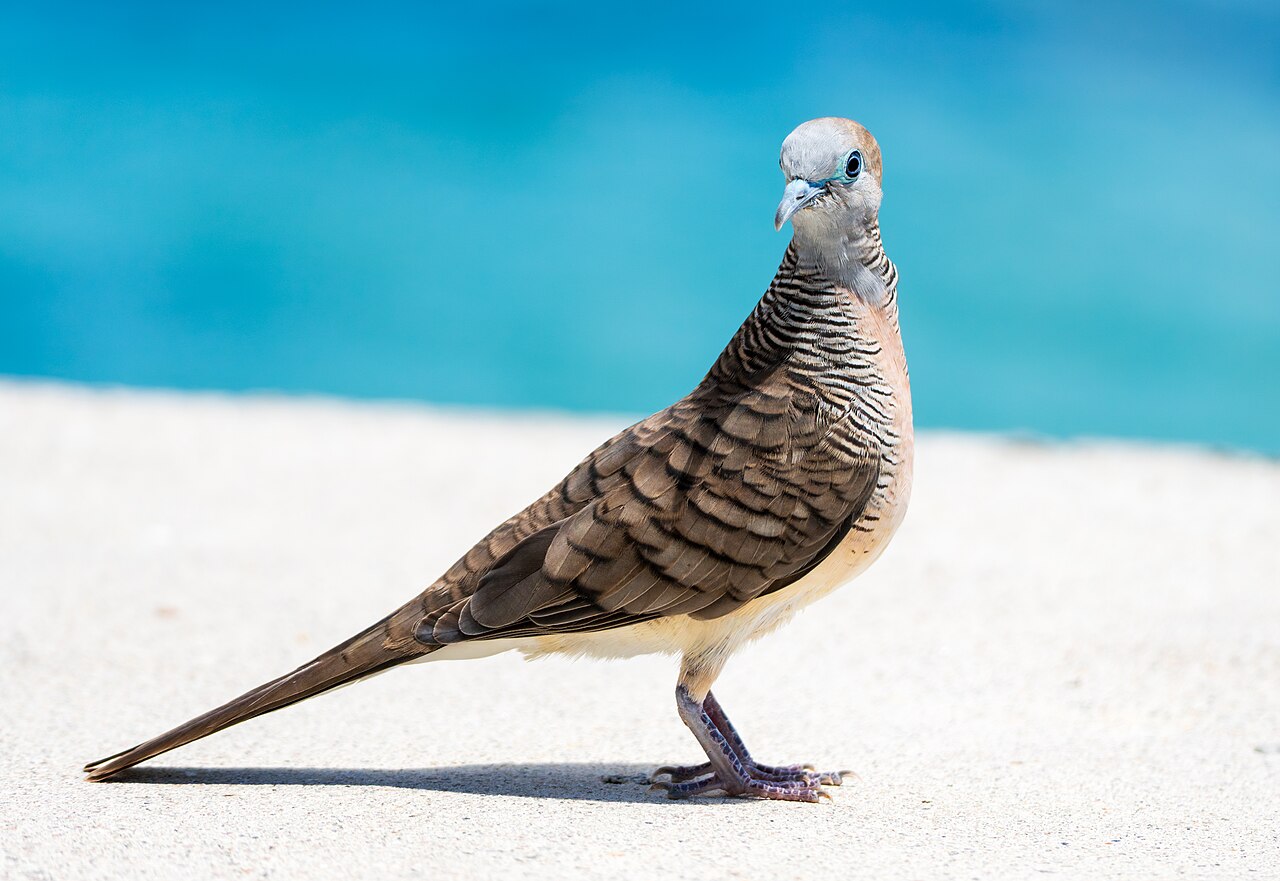
Zebra Dove is the small, finely barred dove that walks across every lawn, terrace and car park in Hawaii. It was released on four islands in 1922 and is now among the most numerous birds of the archipelago. Of all the doves in this guide it is the smallest and the least shy: it will walk right up to your feet.
Voice
The call is a rapid series of short, high coos, kroo-kroo-kroo-kroo-kroo, speeding up slightly and fading towards the end. It is higher and faster than that of Spotted Dove, with which it shares every lawn in Hawaii. The sound carries all day, even in full sun, and usually comes from a low branch, a roof edge or the ground itself. In display the male gives a longer, rolling series while bowing and spreading the tail.
Recording: Arend Wassink — CC BY-NC-SA 4.0 · Baan Maka Nature Lodge surroundings, Phetchaburi province, Thailand · xeno-canto
Identification
A small dove of just over twenty centimetres, with a long, graduated tail whose outer feathers are white. The upperparts are grey-brown with a fine, scaly pattern; breast and flanks carry crisp black-and-white bars, which give the bird its name. The centre of the breast and the face are unbarred and pinkish, and a narrow ring of bare blue skin surrounds the eye. Male and female are alike, the female slightly duller and less pink. Juveniles are paler, buffier and far more faintly barred; on take-off the white sides of the tail flash.
Confusion species
Spotted Dove, on the same lawns, is nearly twice the size, plain brown, and carries a broad black neck patch spotted with white instead of barring. Mourning Dove, present locally in Hawaii, is larger, unbarred, and has a pointed rather than graduated tail. On the mainland, Common Ground Dove and Inca Dove are as small and as patterned, but neither meets Zebra Dove anywhere. On any small dove in Hawaii the crisp black-and-white barring on breast and flanks settles it.
Habitat
Lawns, parks, gardens, hotel grounds, roadsides, field edges and dry lowland pasture make up its core range. It forages on foot on short vegetation and bare sand, and a single shrub or tree is enough for nesting. It avoids dense wet forest; the rainforests on the windward side of the islands stay almost empty. It usually keeps below a thousand metres, though it has been recorded to about 2,300.
Where the bird is most often found, arranged by the USNVC — the vegetation classification of the United States and Canada — and CMECS for sea and coast.




Range and movements
In 1922 a small consignment of birds, probably by way of a dealer in Singapore, was released on Kauaʻi, Oʻahu, Molokaʻi and Maui. By the late 1930s the species had taken all the large southeastern islands, and the island of Hawaiʻi followed. Niʻihau was reached around 1947 by birds flying over from Kauaʻi, and since 1983 it has also been reported regularly from Kahoʻolawe. Outside the archipelago it does not occur in North America.
- Resident
Where and when to look
Any lawn in Honolulu will do: sit on a bench and within minutes the birds will be walking between your feet. Separate it from Spotted Dove on size and on the barring, not on colour, since both are grey-brown. Listen in the early morning for the rapid, high series of coos, given from low branches and roof edges.
Conservation
The species is listed as Least Concern (LC) and is numerous throughout the lowlands of the archipelago; a 1946 count already reached about 237,000 birds, and thousands are still counted at single sites. As a non-native bird it has no protected status in Hawaii. What its presence means for the native birds of the lowlands has not been established.
Scientific name
Geopelia striata | (Linnaeus, 1766)
Linnaeus described the species in 1766 as Columba striata, from a bird from the East Indies; the type locality was later restricted to Java. Swainson introduced the genus Geopelia in 1837, and because the species was moved there, author and year stand in parentheses. Geopelia is built from Greek gē, 'earth', and peleia, 'dove', for a dove that lives on the ground. The species name striata is Latin for 'striped', after the bars on breast and flanks.