All species › Cranes, rails and allies › Limpkin › Limpkin
Limpkin | Aramus guarauna
Koerlan | Carrao
The Limpkin is the only species in its family on earth, and in North America the bird of the marsh at night: dark brown, long-legged, with a long curved bill and a scream that carries across the water. Around 1900 it had all but been shot out of Florida; now it is increasing so fast that within a few years it has turned up across half a continent. The reason is a snail that does not belong here.
Voice
The call is the best known thing about the species: a long drawn, piercing kree-ow that begins as a scream and slides down in complaint, usually after sunset and loudest on clear nights in early spring. Birds answer one another across the marsh, so that the screaming goes back and forth from bank to bank and at a distance sounds like something human. There is also a short, hard kwok as a contact and alarm note, by day as well. The male makes sound with his wings besides: in display flight the sickle-shaped outer primaries produce a low, buzzing hum with which he marks out his stretch of marsh.
Recording: Niels Krabbe — CC BY-SA 4.0 · Manabí: La Segua marsh (Chone lakes), Ecuador · xeno-canto
Identification
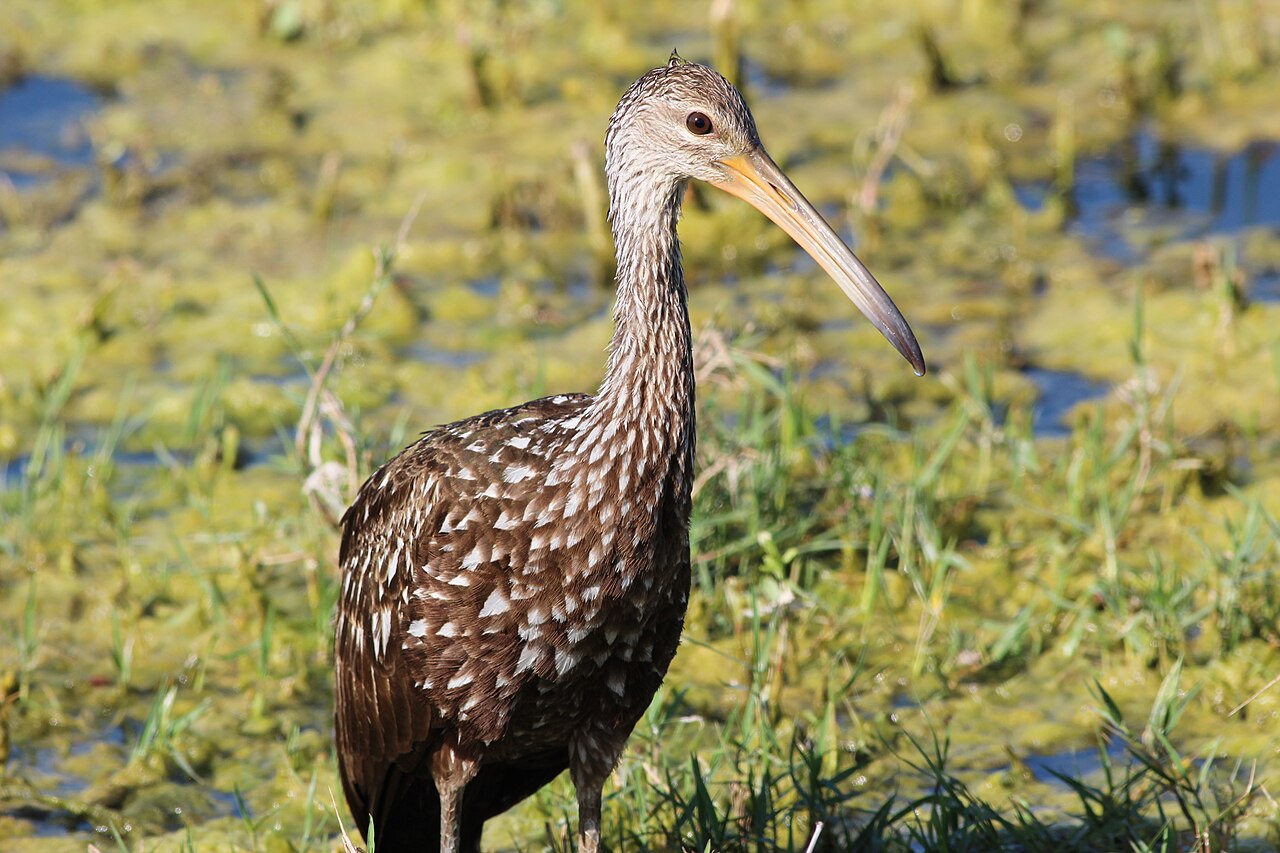
A large, angular marsh bird the size of a goose, with long grey-green legs, a long neck and a heavy bill bent down at the tip, pale horn at the base and darkening towards the front. The plumage is warm dark brown; the white sits mainly on head, neck and breast, where it forms fine drops and streaks, and thins away to almost nothing towards wing and tail. The eye is dark and small in a plain brown face, without mask or stripe. The sexes are coloured alike, though the male is somewhat larger and heavier-billed; young birds are duller and more finely marked. Anyone who watches it step through shallow water knows it by the high-lifted foot and the hesitant, limping gait that gave it its English name.
Confusion species
Young White Ibises are most often taken for it: the same size and brown, but with an evenly curved pink bill, a white belly and a white rump. Glossy Ibis is darker, shines green and purple, and its bill is curved along its whole length instead of only at the tip. Young Black-crowned Night Herons are shorter in neck and leg, sit hunched instead of upright, and have a thick, straight bill. American Bittern shares the reeds with it, but is streaked rather than spotted and keeps itself hidden; Sandhill Crane is nearly twice the size, grey, and carries a red crown.
Habitat
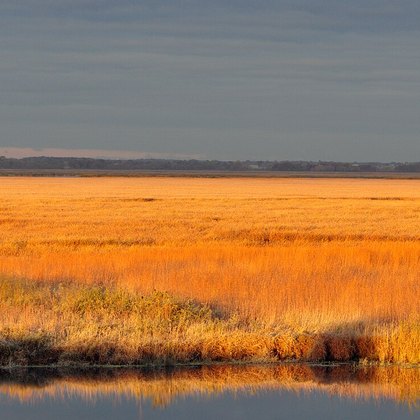
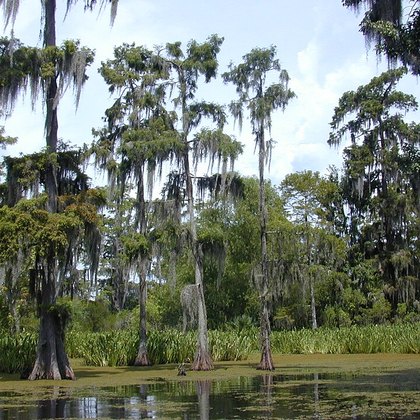
Freshwater marsh with plenty of floating and emergent vegetation, cypress swamp, the overgrown banks of slow rivers and lakes, and in Florida also artificial water: canals, retention ponds, park lakes and the ponds of golf courses. What matters is shallow water it can wade in and that holds freshwater snails; clear, lime-rich water with many water plants carries the most snails and so the most Limpkins. It avoids salt water, though in the Antilles it uses the fresh edges of mangrove. Fast rivers, bare banks and deep water it does not use.
Where the bird is most often found, arranged by the USNVC — the vegetation classification of the United States and Canada — and CMECS for sea and coast.



Range and movements
Resident in Florida and southern Georgia, in Cuba, Jamaica and Hispaniola, and from the Gulf slope of Mexico south through Central America; beyond this map window the range continues to Argentina. In Florida it was common in the nineteenth century, was greatly reduced by shooting, and recovered slowly after protection. Since 2017 things have moved fast: it appeared first in Louisiana, where it bred the following year, and then in dozens of states as far north as the top of the continent; by the estimate of the observation database the United States population rose by more than half between 2012 and 2022. Behind that wave is the introduced island apple snail, which has spread across the south-east and is far larger and more numerous than the native snail. The map shows only where it occurs regularly; the birds now turning up in Illinois or Ontario are wanderers, not a range.
- Resident
- Breeding (summer)
- Winter
- Passage
- dark = core range, pale = thinly spread
Where and when to look
Look for it in Florida at the edge of a shallow marsh pool full of water lilies — Wakulla Springs, Lake Woodruff and the retention wetlands at Gainesville and Orlando are reliable places — and watch the ground at the water's edge: a heap of empty snail shells marks a regular feeding place, and the bird is usually not far off. To hear it you have to stay until after dark; in March and April it calls most. By day it often gives itself away by the slow, hesitant way it walks through shallow water.
Conservation
The species stands as Least Concern on the Red List, but for most of the range next to nothing is known about numbers and trends. For Florida the population was put at three to six thousand pairs in 1994, after a century in which the bird went from common to local. The classic threats are still there: drainage of marsh, canalisation, and water-level management that wipes out the native apple snail. Against that stands something that rarely happens: an introduced snail that is a nuisance to the marsh turns out to be the making of this one bird.
Scientific name
Aramus guarauna | (Linnaeus, 1766)
Linnaeus described the species in 1766 as Scolopax guarauna, among the woodcocks — the long curved bill took him there. Because the bird was later moved to another genus, author and year stand in parentheses. The genus Aramus was introduced by Vieillot in 1816; what the name means is uncertain, and it is linked to a Greek bird name of which nobody now knows which bird was meant. The specific name guarauna is a Tupí name from South America, originally for the Glossy Ibis, which Linnaeus applied to this bird; as its origin he gave only 'America australi', the southern part of America. The English name limpkin comes from the limping impression its walk gives.