All species › Waders, gulls and terns › Gulls and terns › Caspian tern
Caspian tern | Hydroprogne caspia
Reuzenstern | Pagaza piquirroja
At the size of a Herring Gull the Caspian tern is the largest tern in the world, and its blood-red dagger of a bill can be seen hundreds of metres away. In the Netherlands it is a late-summer bird: Scandinavian birds pass over the IJsselmeer region in August on their way to West Africa.

Click a thumbnail to switch the photo above.
Voice
A deep, raw, heron-like scream: krey-ahk, carrying far and pitched so low that you often hear it before you see the bird. At colonies the noise is deafening. Juveniles beg with a thin, high tsee-oo as they follow their parents in flight, which over the IJsselmeer in August is a reliable clue that a family is passing.
Recording: Joost van Bruggen — CC BY-SA 4.0 · Wikimedia Commons
Identification
As big as a Herring Gull, but with the angled wrist and pointed wings of a tern. The bill is heavy and coral red with a dark tip; the legs are black. In summer a black cap with a short shaggy crest, in winter and in immatures the forehead and crown are streaked white. Upperparts pale grey, tail short and shallowly forked. The decisive flight feature is underneath: an extensive black area on the outer primaries forming a dark wedge in the otherwise white underwing. It flies heavily and purposefully with the bill angled down and dives with a solid splash.
Confusion species
Sandwich tern is barely half the weight, with a black yellow-tipped bill and a long, deeply forked tail. At distance a passing Caspian tern can be taken for a gull until the pointed wings, the down-angled bill and the black underwing wedge register. The rare Royal Tern is smaller and slimmer, with a more orange bill and without the black primary panel below. On a settled bird, gull size plus a red dagger bill is enough on its own.
Habitat
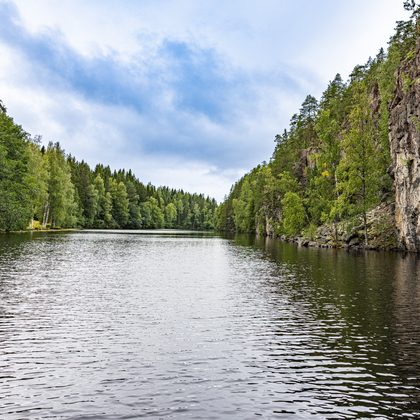
Large lakes, river mouths, lagoons, saltmarsh and harbours; breeds on bare sand and shell islets, usually in small scattered colonies or singly. It feeds almost entirely on fish taken by diving into the top layer of the water, over fresh and salt water alike. Outside the breeding season it rests on sandflats and spits among gulls and sandwich terns.
Where the bird is most at home, classified with EUNIS — the European standard for habitats.



Range and movements
European breeders are concentrated on the Swedish, Finnish and Estonian Baltic coasts, with a further population in the Black Sea and Caspian region. The Netherlands has no breeders, but records run to several hundred bird-days each August and September, concentrated in the IJsselmeer area, the Lauwersmeer and the Delta, and have increased since the late 1980s. In Spain it is a scarce passage migrant and winter visitor in Doñana, the Ebro delta and along the Andalusian coast.
- Resident
- Breeding (summer)
- Winter
- Passage
- dark = core range, pale = thinly spread
How and when to look
In August go to a large gull and tern roost on the IJsselmeer, the Lauwersmeer or in the Delta and be there for the last two hours before sunset: Caspian terns arrive late and announce themselves with their raw call. By day it pays to follow birds fishing over shallow water; they hover briefly, high above the surface, then dive at an angle. Check resting parties of sandwich terns for a single bulkier bird with a red bill; perched, it often only stands out once you look for it.
Conservation status
Not globally threatened, with a wide but strongly fragmented range. The European population is small, in the order of a few thousand pairs, and depends entirely on undisturbed breeding islets; disturbance, predation by fox and mink and rising water levels washing out nests are the main risks. Protection of Baltic breeding islands has stabilised numbers, and that shows directly in the growing count of migrants in the Netherlands.
Scientific name
Hydroprogne caspia | (Pallas, 1770)
Pallas described the species in 1770 as Sterna caspia; because it was later moved to another genus, the author and year stand in brackets. The genus Hydroprogne was introduced in 1829 by Kaup. Hydroprogne joins Greek hudro- 'water' to Latin progne 'swallow'. caspia is Latin and refers, like the English name, to the Caspian Sea.