All species › Woodpeckers and allies › Woodpeckers › European green woodpecker
European green woodpecker | Picus viridis
Groene specht | Pito real
A large green woodpecker that feeds mostly on the ground, driving an enormous tongue into ant nests. Its yaffling laugh is one of the most far-carrying sounds of old parkland.
Click a thumbnail to switch the photo above.
Voice
A loud, run-together, slightly descending laugh, kyu-kyu-kyu-kyu, carrying a long way and heard all year but loudest from February to May. It drums only rarely, and then softly and hesitantly, which separates it at once from the pied woodpeckers. In flight a short hard kyuk.
Recording: Benoît Van Hecke — CC BY-SA 4.0 · Wikimedia Commons
Identification
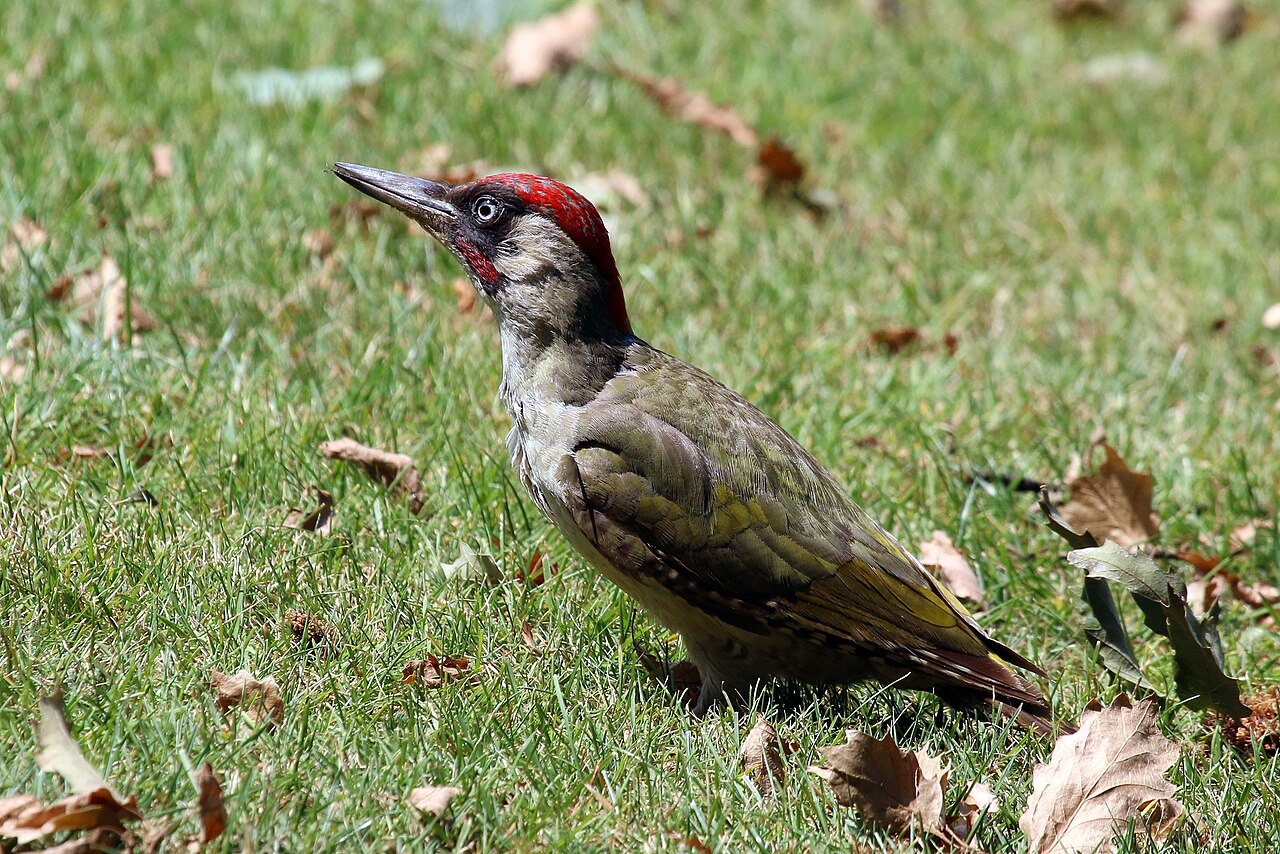
Big and heavily built, green above with a yellow rump that flares as it flies off, a red crown running back to the nape and a black mask round a pale iris. The male has a red centre to the black moustache, the female an all-black one. Juveniles are heavily spotted and barred. Flight heavy and deeply undulating, usually low over grass.
Confusion species
In Iberia the key comparison is with Iberian green woodpecker, which has a greyer face with far less black around the eye, lacks the full black mask and is now treated as a separate species. Grey-headed Woodpecker is smaller and softer green, with a grey head, red confined to the forecrown in the male and no mask, and a clearly descending, fading call series.
Habitat
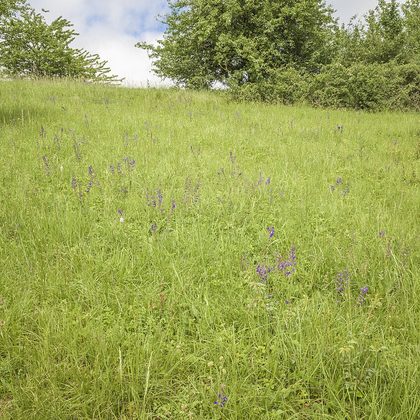
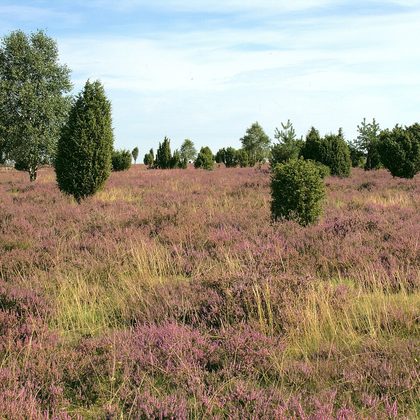
Half-open country: old estates, orchards, hedgerow timber, woodland edges and heaths, always with short ant-rich turf or bare sand within reach. Also golf courses, parks and large gardens with mature broadleaves in which to excavate a nest hole.
Where the bird is most at home, classified with EUNIS — the European standard for habitats.


Range and movements
All of Europe except Ireland, Iceland and the far north, east to Turkey and the Caucasus. In north-west and central Europe common on sandy soils, in dunes and on estates. In Iberia replaced by Iberian green woodpecker; true Picus viridis breeds there only in the Pyrenees and the extreme north-east. Resident.
- Resident
- Breeding (summer)
- Winter
- Passage
- dark = core range, pale = thinly spread
How and when to look
In March and April walk an estate, dune edge or heath with short turf early in the day and listen for the laugh; then scan bare grass patches and ant hills. Birds flushed from the ground show the yellow rump. Mild, snow-free winters give the best chances of prolonged ground feeding.
Conservation status
Increasing in north-west Europe over recent decades thanks to mild winters and more closely grazed grassland, though severe winters with lasting snow cover cause temporary crashes. The loss of ant-rich unimproved grassland to fertilising, rank growth and scrub encroachment remains the main threat.
Scientific name
Picus viridis | Linnaeus, 1758
Linnaeus described the species in 1758 and placed it straight away in the genus where it still stands. He introduced the genus Picus in that same work. Picus is the Latin word for 'woodpecker' and also the name of Picus, in Roman mythology the first king of Latium, who was turned into a woodpecker by the sorceress Circe. viridis is Latin for 'green', after the plumage. The specimen the first description was based on came from Sweden.