All species › Waterfowl › Ducks, geese and swans › Ferruginous duck
Ferruginous duck | Aythya nyroca
Witoogeend | Porrón pardo
A small, dark and retiring diving duck of overgrown marshes, and a rarity in western Europe. What usually catches the eye first is the pure white undertail beneath an otherwise chocolate-brown bird.

Click a thumbnail to switch the photo above.
Voice
Mostly silent. In display the male gives a soft, short, clicking chik or a wheezy sigh, audible only over a few tens of metres. The female utters a hoarse low gerr-gerr, chiefly when disturbed or flushing. Heard from April to June around breeding marshes.
No freely licensed recording is available for this species yet.
Identification
Small and finely built, with a high crown peaking behind the eye and a slim grey bill. The male is warm chestnut on head, breast and flanks with a blackish-brown mantle and a startling white iris. The female is duller brown with a dark iris. Both show a sharply cut white undertail, and in flight a broad brilliant white wingbar and white belly.
Confusion species
Female tufted duck can look brown but is larger, yellow-eyed, tufted and never shows such crisply bordered white beneath the tail. The real pitfall is Tufted by Pochard hybrids, which often have a hint of a tuft, a broader black bill tip and dingy rather than pure white undertail. Head shape, peaking behind the eye, helps too.
Habitat
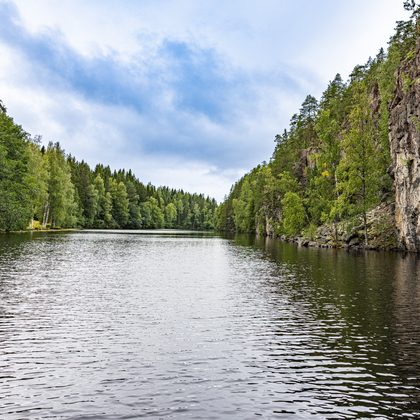
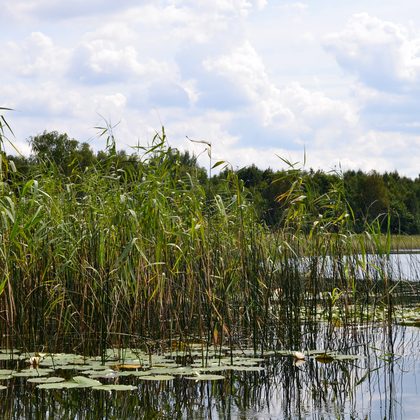
Shallow, warm, plant-rich freshwater marshes with abundant floating and emergent vegetation: fishponds, old river arms, rice fields and overgrown lagoons. Keeps close to the reed edge and rarely swims far out on open water. Dives briefly and shallowly for aquatic plants, seeds and invertebrates.
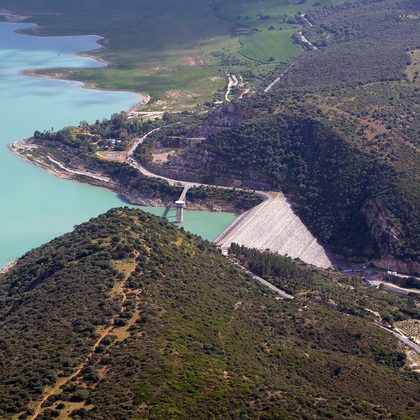
Where the bird is most at home, classified with EUNIS — the European standard for habitats.

Range and movements
A breeder of south-eastern Europe with strongholds in the Danube delta, Hungary and the Balkans, becoming scattered and rare westwards. Spain holds a small, fragile population in the Valencian lagoons and Andalusia. In the Netherlands it is a rare but almost annual visitor, typically on gravel pits and marsh reserves.
- Resident
- Breeding (summer)
- Winter
- Passage
- dark = core range, pale = thinly spread
How and when to look
Search silting-up pools with plenty of fringing vegetation from April to September, early in the morning when the bird ventures furthest from cover. Judge it in flight or while preening if you can: the white undertail and broad white wingbar together eliminate most hybrids.
Conservation status
Assessed as Near Threatened globally after a sustained decline. Marsh drainage, river canalisation, loss of shallow plant-rich water, lead shot and hunting pressure on migration are the core problems. In Spain the species is the target of reintroduction and habitat restoration projects; in western Europe it remains a vagrant.
Scientific name
Aythya nyroca | (Güldenstädt, 1770)
Güldenstädt described the species in 1770 as Anas nyroca; because it was later moved to another genus, the author and year stand in brackets. The genus Aythya was introduced in 1822 by Boie. Aythya is from Greek aithuia, an unidentified diving seabird mentioned by Aristotle and Hesychius. nyroca goes back to the Russian word nyrok, the name for pochards. The specimen the first description was based on came from southern Russia.