All species › Waterfowl › Ducks, geese and swans › Red-crested pochard
Red-crested pochard | Netta rufina
Krooneend | Pato colorado
A large, colourful diving duck with a bouffant orange head and a fire-red bill. In the Netherlands a scarce but increasing breeder of weedy lakes; in Spain a signature bird of lagoons and the Ebro delta.

Click a thumbnail to switch the photo above.
Voice
Quiet compared with dabbling ducks. In display the male gives a rasping, sneezing betz or tchep, the female a low rolling kerr-kerr. Heard mainly in March and April, when several males chase a single female across open water.
Recording: Philippe_Grange — CC0 · xeno-canto
Identification
The male has a rusty orange bouffant head, a bright red bill, black breast and underparts and white flanks that flash as a long white band in flight. The female is brown with a dark cap and a strikingly pale cheek and throat, and a grey bill with a pink tip. Both show a white wing bar running the whole length of the wing.
Confusion species
Females suggest female common scoter and Pochard. Red-crested is bigger and longer-bodied, with a cleanly cut pale cheek against the dark cap rather than the streaked head of a Scoter. The long white wing bar rules out Pochard at once.
Habitat
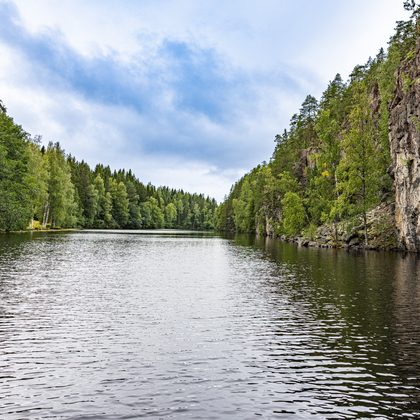
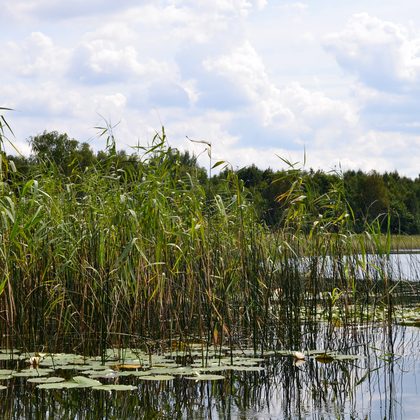
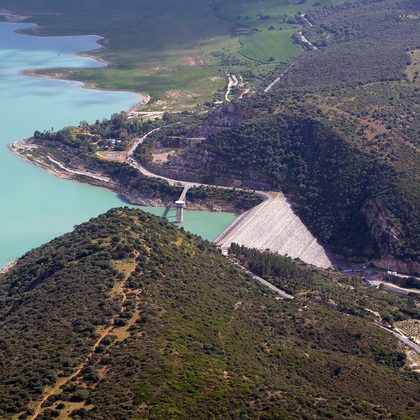
Large, shallow fresh and brackish waters rich in stoneworts and pondweed: peat lakes, gravel pits, lagoons, rice fields and delta lakes. Nests in dense bankside cover and on reed islets. Feeds by diving and by dabbling, and often grazes floating plants from the surface.
Where the bird is most at home, classified with EUNIS — the European standard for habitats.

Range and movements
Centred on southern and eastern Europe and Central Asia, with a stronghold in Spain: the Ebro delta, the Albufera of Valencia, the La Mancha lagoons and Doñana. The Netherlands lies at the north-west edge of the range, with breeding in the Delta, the border lakes and the South Holland lakes.
- Resident
- Breeding (summer)
- Winter
- Passage
- dark = core range, pale = thinly spread
How and when to look
Look on large clear lakes such as the Veerse Meer or the Nieuwkoopse Plassen in April and May, in the quiet hours just after dawn. Scan for orange globes standing out among Pochard; the male's high round head shows at long range.
Conservation status
In Europe the species is slowly increasing and spreading north-west, including in the Netherlands. In Spain the main concerns are lead shot, loss of submerged plants through turbidity and the drying out of lagoons. Escaped collection birds locally blur the assessment of genuinely wild breeding.
Scientific name
Netta rufina | (Pallas, 1773)
Pallas described the species in 1773 as Anas rufina; because it was later moved to another genus, the author and year stand in brackets. The genus Netta was introduced in 1829 by Kaup. Netta is Greek, from nētta 'duck'. rufina is Latin for 'golden-red', from rufus 'ruddy', after the rusty-red head of the male. The specimen the first description was based on came from the Caspian Sea.