All species › Birds of prey › Ospreys › Osprey
Osprey | Pandion haliaetus
Visarend | Águila pescadora
The only European raptor that plunges feet-first into water and lifts a fish clear of it. Over Dutch lakes it is almost a daily sight in August and September, while still barely breeding in the country.

Voice
At the nest and over hunting water a series of clear, slightly plaintive whistles: pyew-pyew-pyew, quickening as the bird becomes agitated. Heard mainly from April to July on the breeding grounds; migrants are usually silent.
Recording: British Library — CC BY-SA 4.0 · Wikimedia Commons
Identification
Long narrow wings with a marked kink at the carpal, giving a flattened M in gliding flight. White below with a dark carpal patch, a barred tail and a dark eye-stripe across the white head. Females show a heavier brown breast band; juveniles have pale scaling above and an orange eye.
Confusion species
At range it is mostly confused with a large gull: note the kinked arm, the dark carpal patches and the slow rowing beat. Hovering, it resembles no other raptor; Buzzard is more compact and broad-winged, and white-tailed eagle is far larger with plank-like wings.
Habitat
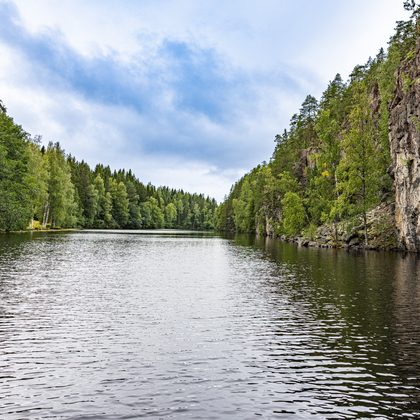
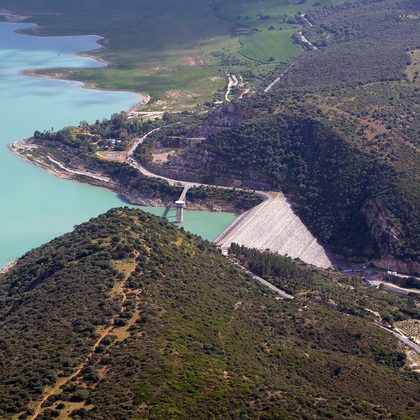
Clear, fish-rich water: large lakes, reservoirs, estuaries, coastal lagoons and fish farms. Nests in tall dead treetops, on pylons or on artificial poles, often some distance from water; on migration it will fish at any suitable pool.
Where the bird is most at home, classified with EUNIS — the European standard for habitats.

Range and movements
Breeds in Scandinavia, the Baltic states, Russia, Scotland and scattered across Germany and France, with reintroduced populations in Andalusia and the Balearics; the Netherlands has held a handful of pairs in the Biesbosch for some years but is mainly a busy migration corridor. Winters in West Africa, with growing numbers staying in Andalusia and around the Mediterranean, notably Doñana, the Bay of Cádiz and the Levante.
- Resident
- Breeding (summer)
- Winter
- Passage
- dark = core range, pale = thinly spread
How and when to look
Mid-August to mid-September, early morning over big lakes and fish ponds. Look for a bird hovering high with legs dangling; wait for the plunge and keep watching, because after a catch it shakes the water from its plumage in flight.
Conservation status
Clearly recovering across Europe since DDT was banned and persecution eased; nesting poles and artificial platforms have speeded the return. Threats include disturbance at the nest, drowning in fishing nets, turbine collisions along migration routes and illegal shooting around the Mediterranean.
Scientific name
Pandion haliaetus | (Linnaeus, 1758)
Linnaeus described the species in 1758 as Falco haliaetus; because it was later moved to another genus, the author and year stand in brackets. The genus Pandion was introduced in 1809 by De Savigny. Pandion is taken from Pandion, the mythical king of Athens and grandfather of Theseus. haliaetus comes through Latin from the Greek haliaetos 'sea eagle', from hals 'sea' and aetos 'eagle'. The specimen the first description was based on came from Sweden.