All species › Waders, gulls and terns › Avocets and stilts › Pied avocet
Pied avocet | Recurvirostra avosetta
Kluut | Avoceta común
The Avocet is a wader, snow white and black on long blue-grey legs. Its fine upturned bill sweeps sideways through soft mud and shallow water in search of small crustaceans.

Click a thumbnail to switch the photo above.
Voice
A clear, slightly plaintive kluut kluut — the Dutch name is a rendering of the call. Disturbance at a colony turns it into a persistent, nervous yelping, usually in chorus. Heard from March to July; largely silent outside the breeding season.
Recording: Ryan Hodnett — CC BY-SA 4.0 · Wikimedia Commons
Identification
Unmistakable white with a black crown and hindneck and bold black bands across the wing and scapulars. The black bill is long, fine and clearly upcurved, shorter and more strongly curved in females. Long blue-grey legs project well beyond the tail in flight. Juveniles show brown-black rather than jet-black markings.
Confusion species
No real lookalike, but distant birds are confused with black-winged stilt, which has a black back and wings, a dead straight bill and bright pink-red legs. On flooded fields small parties also get called black-headed gulls. The upturned bill and the scything feeding action settle it at once.
Habitat
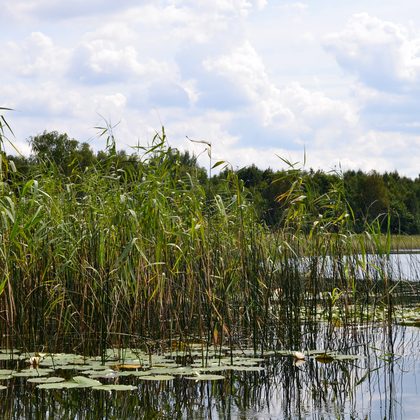
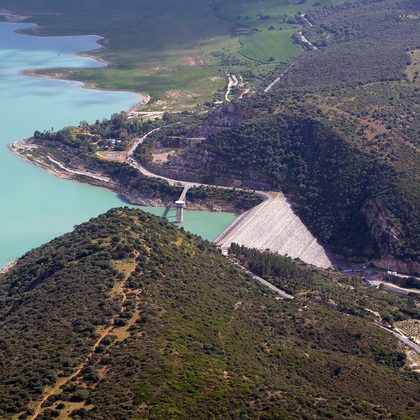
Shallow brackish and salt water over soft mud: saltmarsh, brackish pools, mudflats, salinas, dredged spoil and newly created wetlands. Nests colonially on bare or sparsely vegetated islets and shores free of ground predators.
Where the bird is most at home, classified with EUNIS — the European standard for habitats.


Range and movements
Breeds along north-west European coasts and at inland saline sites from Iberia to Central Asia. The North Sea coast, the Low Countries above all, holds an important share of the north-west European breeders; these winter on French and Iberian coasts, where the salinas of Cádiz, the Ebro delta and Doñana hold big concentrations. In Iberia it also breeds, in Doñana, the Cádiz salinas, the Ebro delta, Santa Pola and the lagoons of La Mancha.
- Resident
- Breeding (summer)
- Winter
- Passage
- dark = core range, pale = thinly spread
How and when to look
April and May on the North Sea, in the Delta or on the Wadden flats, on a falling tide, when breeding birds sweep across freshly exposed mud. In winter, the salt pans near Cádiz, the Marismas del Odiel or the Ebro delta in low morning light; at low water the birds spread out over the channels, at high tide they gather in the pans, and that is when they count and photograph best.
Conservation status
Increased strongly through the twentieth century thanks to protection and to newly created bare, wet pioneer habitat, but is now under pressure as those sites become overgrown, from predation by foxes and gulls, and from nests flooded by summer storms. Globally not threatened.
Scientific name
Recurvirostra avosetta | Linnaeus, 1758
Linnaeus described the species in 1758 and placed it straight away in the genus where it still stands. He introduced the genus Recurvirostra in that same work. Recurvirostra is Latin, from recurvus 'curved backwards' and rostrum 'bill', after the upturned bill. avosetta comes from avosetta, the Venetian name for the avocet; the word's further origin is uncertain. The specimen the first description was based on came from Italy.