All species › Waterfowl › Ducks, geese and swans › Red-breasted goose
Red-breasted goose | Branta ruficollis
Roodhalsgans | Barnacla cuellirroja
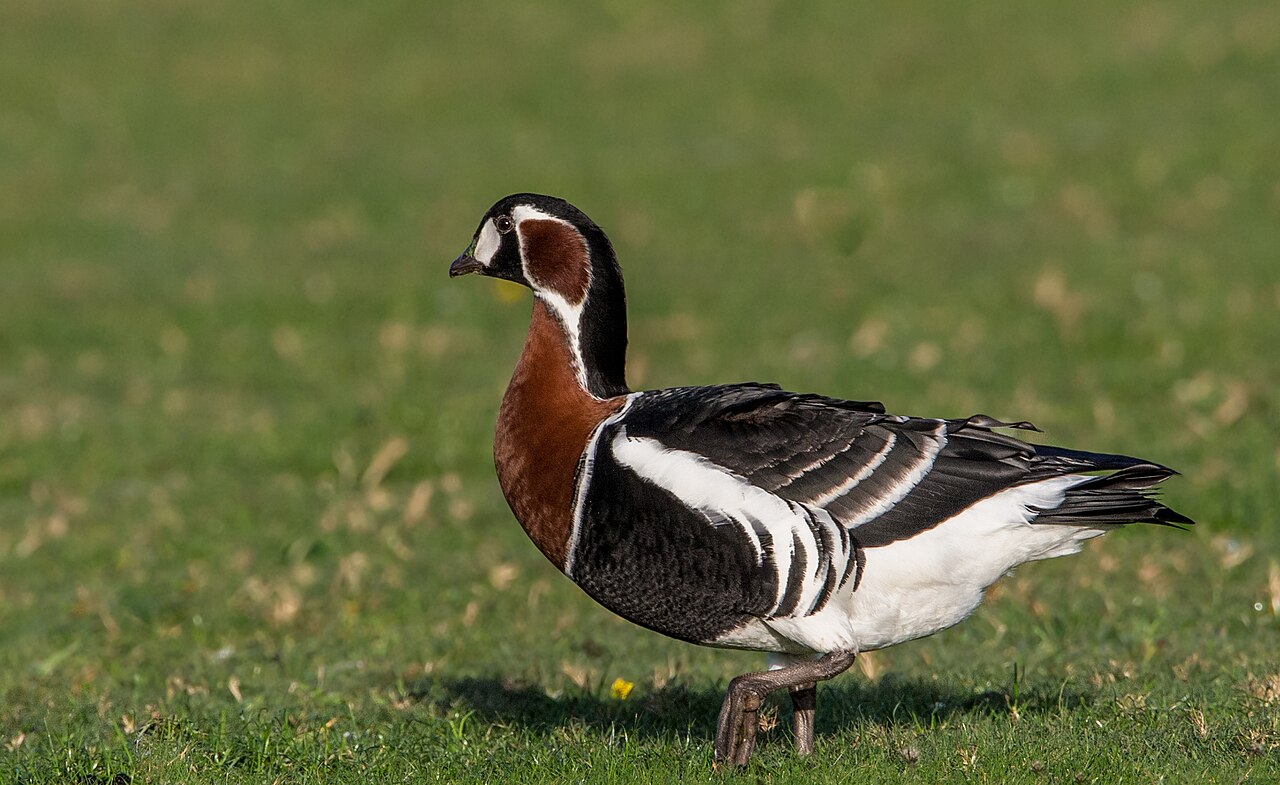
After Brent the smallest goose in the Western Palearctic: chestnut, black and white in sharp blocks. In the Netherlands it turns up almost invariably within flocks of White-fronted or Barnacle Geese.
Voice
High, shrill and hurried, quite unlike the baying of grey geese: a disyllabic, slightly squeaky kik-wik or kee-kwik, becoming a shrill chorus from a flock. In the Netherlands it is heard mainly as a mixed goose flock lifts, and the call often betrays the bird before it is picked out.
Recording: Grégoire Chauvot — CC0 · Wikimedia Commons
Identification
Small and short-necked, with a rusty-red cheek patch framed in white, a chestnut neck and breast cut off by a white flank line, and otherwise black with a white rear. A white spot between bill and eye is the best long-range mark. First-winters are duller, with weaker white lines and pale covert fringes.
Confusion species
No other European goose shows the chestnut, but a Brent Goose in poor light can mislead at long range. Brent, though, is uniformly dark on head and breast and shows no white on the face at all. Escaped Red-breasted Geese are frequent: check for rings, worn feathers and unnatural tameness.
Habitat
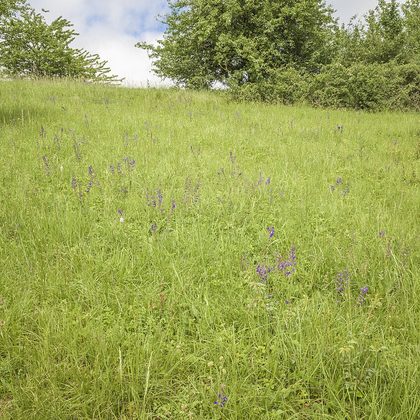
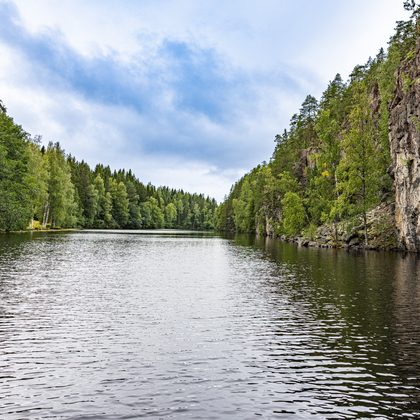
Winters on steppe grassland, winter cereals and stubble fields, always within reach of a large lake or reservoir used as a roost. In the Netherlands it feeds on polder grassland and winter wheat among other geese. Breeds on Siberian tundra at Taimyr and Gydan, characteristically beside Peregrine or Rough-legged Buzzard nests.
Where the bird is most at home, classified with EUNIS — the European standard for habitats.


Range and movements
Breeds only in northern Siberia and winters almost entirely on the western Black Sea coast in Bulgaria and Romania. Small numbers stray to western Europe; a handful reach the Netherlands each winter, mostly in Friesland, the Flevo polders and Zeeland. In Spain it is an exceptional vagrant.
- Resident
- Breeding (summer)
- Winter
- Passage
- dark = core range, pale = thinly spread
How and when to look
Work the classic goose areas from December to February: the Frisian wet grasslands, the Ooijpolder and the Zeeland polders. Drive or walk the dykes in late morning when flocks feed quietly, and grind through every White-fronted Goose flock with a scope; the bird only stands out in side view.
Conservation status
The world population is small and packed onto a few Black Sea roosts, which makes it vulnerable. Changing crops, hunting pressure, disturbance and wind farms along the flyway are the main threats, while on the tundra the decline of protective raptor nests reduces breeding success.
Scientific name
Branta ruficollis | (Pallas, 1769)
Pallas described the species in 1769 as Anser ruficollis; because it was later moved to another genus, the author and year stand in brackets. The genus Branta was introduced in 1769 by Scopoli. Branta is a Latinised form of Old Norse brandgás, 'burnt goose', that is, black goose. ruficollis is Latin, from rufus 'red' and collum 'neck': 'red-necked'. The specimen the first description was based on came from the lower Ob River.