All species › Passerines › Wagtails and pipits › Rock pipit
Rock pipit | Anthus petrosus
Oeverpieper | Bisbita costero
The bird of the tideline. Rock pipit lives on the rocky coasts of north-west Europe, Iceland, the Faroes and Scandinavia, and never strays further from salt water than the top of the boulder beach: it forages in stranded wrack, walks over wet rock between the waves and nests in a crevice in the cliff. Of all the pipits it is the darkest, the heaviest and the least obviously marked — a dingy, olive-grey bird you only notice when it moves. Around most of Britain and Ireland it is a resident that many people walk past every week without ever putting a name to; in the Netherlands and along the German and French coasts it is a winter visitor to sea walls, groynes and saltmarsh, and in Spain it is a scarce, highly localised winter visitor along the Cantabrian coast and in Galicia.

Voice
The call is a single hard, full note: feest or pseet, explosive and sharply pointed, far stronger than the thin voice of a meadow pipit and usually given once rather than in a run. It is essentially the same as a water pipit's call; the distinction some observers draw — slightly fuller and slightly less sharp in rock pipit — is too fine to rely on in the field, so on a saltmarsh sound offers no escape route. The song suits a bird that has to compete with surf: a loud, penetrating series of accelerating, faintly metallic notes running into a descending trill, delivered in a steep song flight from a rock or a cliff top with a stiff-winged glide back to the same stone. Along the cliffs of Cornwall, Pembrokeshire, western Ireland or the Hebrides it runs from March into June, and it is striking how loudly this drab bird sings.
Recording: Tanguy Loïs — CC BY-SA 4.0 · xeno-canto
Identification
The same length as water pipit at 15.5–17 cm, but heavier built, broader-chested and more compact, with a stout dark bill and dark brown to blackish legs. That is more or less the end of the clear-cut features, because the rest of the bird is deliberately vague. The upperparts are dull olive-grey to grey-brown with indistinct, smudged streaking; the underparts are not white but dingy grey-buff, and the streaking on them is broad, softly edged and more olive than black, so that the whole bird reads as blurred and dirty rather than crisply marked. The face is flat: there is barely a supercilium, at most a pale eye-ring, which leaves the head looking blank next to a water pipit's. The best hard character is in the tail: the outer feathers are not clean white but grey-white to dull grey, visible on a flying bird in decent light. The Scandinavian form littoralis, which winters on North Sea coasts, departs from all this in spring: from March it acquires a greyer head, a paler supercilium and a pink-washed breast, moving towards water pipit. It walks heavily and deliberately, pumping the tail, and when flushed goes low over the water to land on the rocks twenty metres on.
Confusion species
Water pipit is the only real rival, and the problem is well known and unsolved. What works: the ground colour of the underparts (dingy grey-buff with vague olive streaks against clean white with sharp dark streaks), the supercilium (vague against white and obvious) and the outer tail feathers (grey-white against pure white). What does not work: leg colour, since both are dark, and the call, which overlaps too much. What often decides it without being a character at all is the habitat. A dark-legged pipit walking the rocks between waves, or on the granite of a harbour wall, is a rock pipit; a dark-legged pipit at an inland cress bed is a water pipit. On saltmarsh and the tideline, where they mix, a proportion of birds stays unnamed, and there is no shame in that. In spring the difficulty reverses: littoralis then looks most like a water pipit, and only tail pattern and the dullness of the streaking still separate them. Meadow and tree pipits are smaller, warmer brown and pale-legged, and with a little experience are separable on size alone. Buff-bellied pipit follows next and adds a third uncertainty.
Habitat
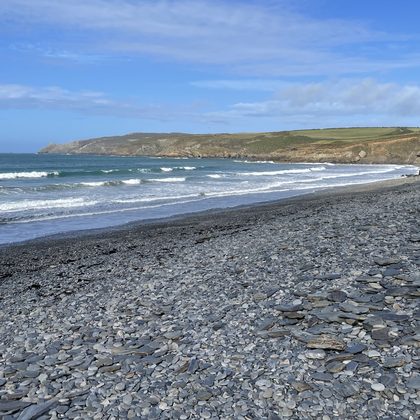
The splash zone of rocky coasts, and almost nothing else. Cliffs and rock platforms, boulder beaches, wrack beds and the strandline, cliff slopes with thrift and sea campion, islets and skerries, harbour walls and breakwaters. The food — kelp flies, springtails, small snails and sandhoppers — comes out of stranded seaweed, so the bird literally works the spray zone. The nest is in a crevice, under an overhanging turf or beneath a stone, always within a few tens of metres of the sea. In winter artificial ground is added: the granite and concrete of sea walls, groynes, locks and quays, and the upper parts of saltmarsh.
Where the bird is most at home, classified with EUNIS — the European standard for habitats.


Range and movements
Breeds along the rocky coasts of Ireland, Britain, Brittany and Normandy, north-west Iberia, the Faroes, Iceland, Norway, the Swedish Baltic coast and north-west Russia — the whole of that range lying within the area of this guide, so the Rock Pipit is a breeding bird here and not merely a winter visitor, even though it does not breed in the Netherlands. The south-western birds — in Britain, Ireland and Brittany — are essentially sedentary and hold the same stretch of rock all year; the species is common right round almost the whole coastline there and thins out only along the soft, sandy shores, where it is mainly a winter bird. In Iberia a small, very localised population breeds on the rocky coast of Galicia and western Cantabria. Scandinavian and Russian birds of the form littoralis leave in October and winter on the southern North Sea, the Channel and the Atlantic coast south to Spain and Portugal, reaching English east-coast marshes in numbers and occupying cliffs, jetties and harbours right along the Cantabrian coast, more thinly on into Portugal and northern Catalonia; in Mediterranean Iberia it is a rarity. In the Netherlands it is accordingly a common winter visitor: several thousand birds on the dykes and groynes of the Delta, along the Wadden coast and on the islands, from mid-October into April, with the occasional summer record and a handful of breeding attempts in the south-western Delta.
- Resident
- Breeding (summer)
- Winter
- Passage
- dark = core range, pale = thinly spread
How and when to look
Walk a groyne, a harbour wall or a granite sea defence at low water in November or December and look down rather than out: the bird is among the stones, will often let you within five metres and then flies off a way with one hard call. Take the time to register what you are looking at — dark legs, dingy grey underparts, blurred streaking, no supercilium — because that is exactly the image you need in order to separate a water pipit later. For the breeding bird, go to a rocky coast in May: Brittany, Cornwall, Ireland or western Scotland give the best odds, and a cliff in Galicia or Asturias works just as well. It sings from the cliff top and holds almost every boulder beach, arriving with a bill full of kelp flies for young in a crevice below.
Conservation status
Not globally threatened (LC). Rock pipit has one great advantage over almost every other European songbird: its habitat cannot be farmed. Rocky coasts are not fertilised, drained or ploughed, and the food supply in stranded wrack is as dependable as the tide. Numbers are accordingly stable across nearly the whole range, and the British and Irish coasts alone hold several tens of thousands of pairs. What does bear on it is local and specific: the mechanical clearing of stranded seaweed from tourist beaches removes the food supply outright, oil pollution hits precisely the splash zone in which the bird feeds, and on small islands introduced rats are a genuine problem for a species that nests in crevices. Severe winters with prolonged ice on North Sea coasts can hit the wintering birds hard, but recovery is quick.
Scientific name
Anthus petrosus | (Montagu, 1798)
Montagu described the species in 1798 as Alauda petrosa; because it was later moved to another genus, the author and year stand in brackets. The genus Anthus was introduced in 1805 by Bechstein. Anthus is the Latin word for a small bird of grasslands mentioned by Pliny the Elder. petrosus is Latin for 'rocky', from petra 'rock', after the rocky coasts the bird inhabits. The specimen the first description was based on came from the coast of Wales.