All species › Tubenoses › Petrels and shearwaters › Scopoli's shearwater
Scopoli's shearwater | Calonectris diomedea
Scopoli's pijlstormvogel | Pardela cenicienta mediterránea
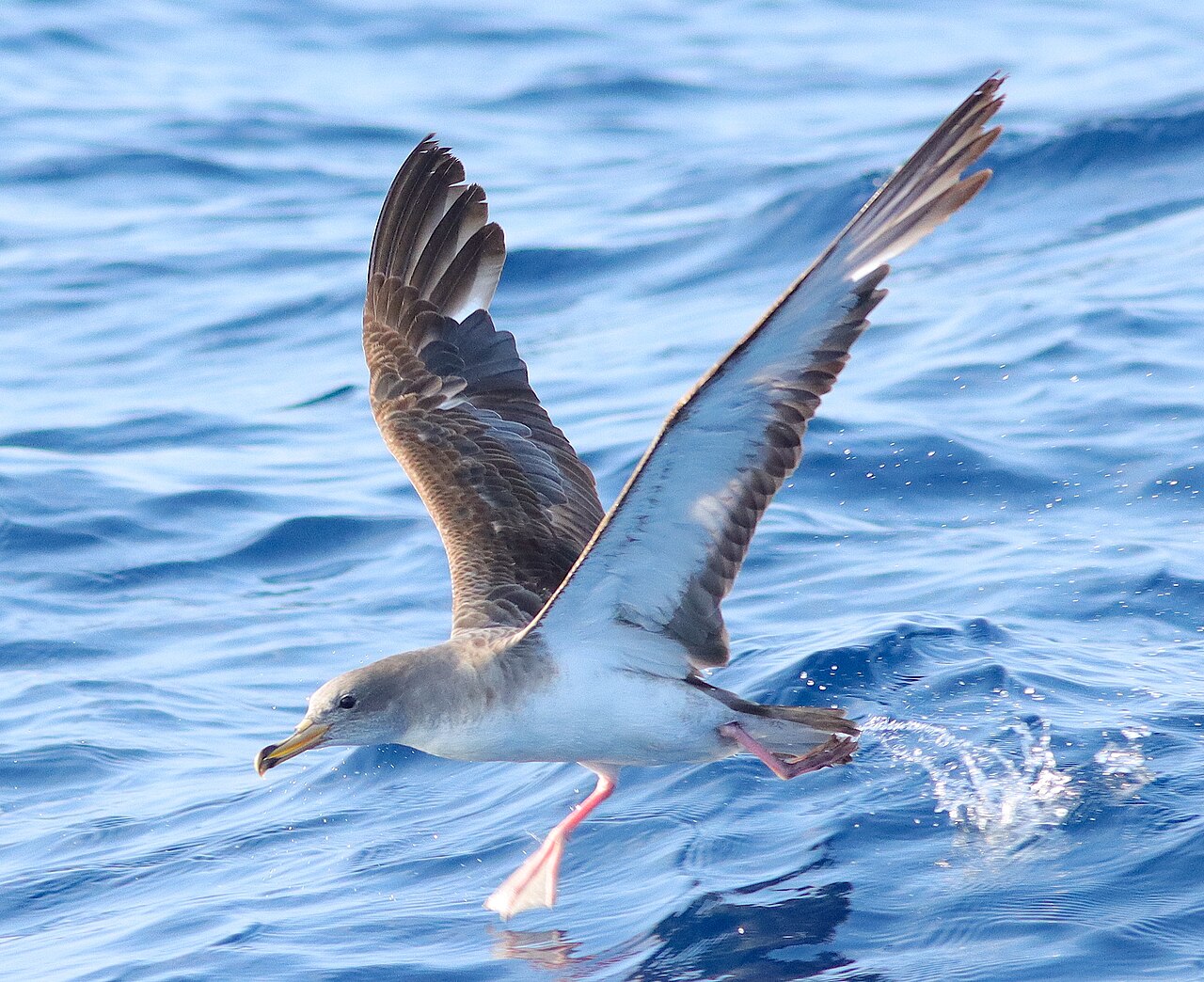
Scopoli's shearwater is the large shearwater of the Mediterranean. Until recently it was treated together with cory's shearwater as a single species and it has been handled as a separate one since about 2011. It is slightly smaller and finer built than its Atlantic counterpart, and the only field character that really works sits on the underwing.
Voice
Silent at sea; noisy at the colony after dark. The call is a nasal, wailing two-part aa-oo, rougher and shorter than the three-part call of cory's shearwater and often finished with a hiccup. Males call higher and more nasally, females lower and hoarser. Over an occupied colony on Cabrera or Zembra this becomes a continuous crying chorus from April to August that keeps going all night.
Recording: Cedric Mroczko — CC BY-SA 4.0 · Wikimedia Commons
Identification
A large, long-winged seabird with a greyish-brown head and back grading into white underparts without a sharp border, so no cap and no collar. The bill is yellow with a dark band before the tip, but slimmer and shallower than in cory's shearwater. The decisive feature is on the underwing: a pale wedge runs from the secondaries through the bases of the outer primaries into the wingtip, so the hand looks two-toned from below rather than evenly dark. The dark trailing edge is also narrower. Flight is sailing with long arcs, but a little lighter and with slightly faster beats than in the heavier Atlantic bird.
Confusion species
Cory's shearwater is bulkier, has a thicker bill and a wholly dark hand from below with no pale wedge; the two overlap around Gibraltar and off Morocco, where many birds are best left unnamed. Great shearwater has a black cap, white collar, black bill and a dark belly patch. Yelkouan and Balearic Shearwaters are clearly smaller and darker, with fast shallow beats and much shorter glides. Sooty shearwater is wholly dark with a silvery stripe on the underwing.
Habitat
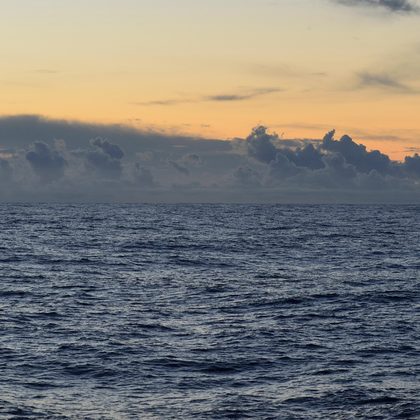
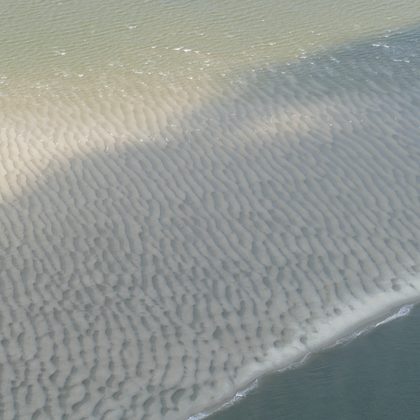
Outside the breeding season a bird of open water, favouring the shelf edge, seamounts and the fronts where warm and cool water meet. It forages in low shearing flight, picking small fish and squid from the surface and making shallow plunges; it follows sardine and anchovy shoals driven up by tuna and dolphins and gathers in numbers behind trawlers. It breeds in crevices and burrows on rocky islets and steep cliffs, coming ashore only in darkness.
Where the bird is most at home, classified with EUNIS — the European standard for habitats.

Range and movements
A breeding bird of almost the whole Mediterranean. In Spain it breeds on the Chafarinas Islands, the Columbretes, the Balearics (Cabrera, Menorca, Ibiza and Formentera) and several islets off the Catalan and Murcian coasts; elsewhere it breeds on Corsica, Sardinia, Sicily, Malta, in the Adriatic, the Aegean, on Crete and in the Dodecanese, and the largest colony in the world is on Zembra off Tunisia. After breeding nearly the entire population leaves the Mediterranean through the Strait of Gibraltar in October and November for the central and South Atlantic, returning to the colonies between late February and March. Outside the Mediterranean it is seen regularly off the Atlantic coasts of Andalusia and Portugal on passage; in the North Sea and the Netherlands it is a real rarity, since large shearwaters passing headlands there are seldom identified to species and the number of accepted records is tiny. To see one, go to the Mediterranean.
- Breeding (summer)
- Passage
- dark = core range, pale = thinly spread
How and when to look
The easiest option in Europe is an evening boat trip off Cabrera, the Columbretes or the Menorcan coast in June or July: birds then gather in rafts of tens to hundreds on the water before going in to the colony after dark, and at that range the pale wedge in the wingtip is easy to check. From land the Strait of Gibraltar works best in October, with a light westerly wind and a scope on the deep water off Punta Carnero or Tarifa, though there it flies mixed in with Cory's shearwater. On the Levante coast, calm days in August give good chances from headlands such as Cabo de la Nao, when the birds follow the trawlers.
Conservation status
Not globally threatened (IUCN: Least Concern), but the Mediterranean population is getting smaller. The main causes are bycatch on longlines and in gillnets, rats and feral cats in the colonies, and disturbance by recreation on the breeding islands. Because the birds mature late and lay a single egg a year, adult mortality weighs heavily; clearing rats from breeding islands and modifying longline gear have already produced results in several places.
Scientific name
Calonectris diomedea | (Scopoli, 1769)
Scopoli described the species in 1769 as Procellaria diomedea; because it was later moved to another genus, the author and year stand in brackets. The genus Calonectris was introduced in 1915 by Mathews & Iredale. Calonectris combines the Ancient Greek kalos 'good, noble' with the genus name Nectris, used for shearwaters by the German naturalist Heinrich Kuhl in 1820. diomedea refers to the Greek hero Diomedes, whose grieving companions were turned into white seabirds after his death. The specimen the first description was based on came from the Tremiti Islands, Italy.