All species › Tubenoses › Petrels and shearwaters › Sooty shearwater
Sooty shearwater | Ardenna grisea
Grauwe pijlstormvogel | Pardela sombría
The sooty shearwater breeds on islands off New Zealand and Tierra del Fuego and then loops tens of thousands of kilometres through the Atlantic. Watch one pass the north-west European coast in September and you are looking at a bird that sat on a nest at the other end of the world a few months earlier.
Voice
Entirely silent in the North Sea and off the Spanish coast; this species does not call in Europe. At the southern-hemisphere colonies it is deafening at night: a hoarse, two-part inhaling and exhaling groan, koo-oo-oo-ah, rising from thousands of burrows at once. That sound belongs only to November to April on islands off New Zealand, Chile and the Falklands.
No freely licensed recording is available for this species yet.
Identification
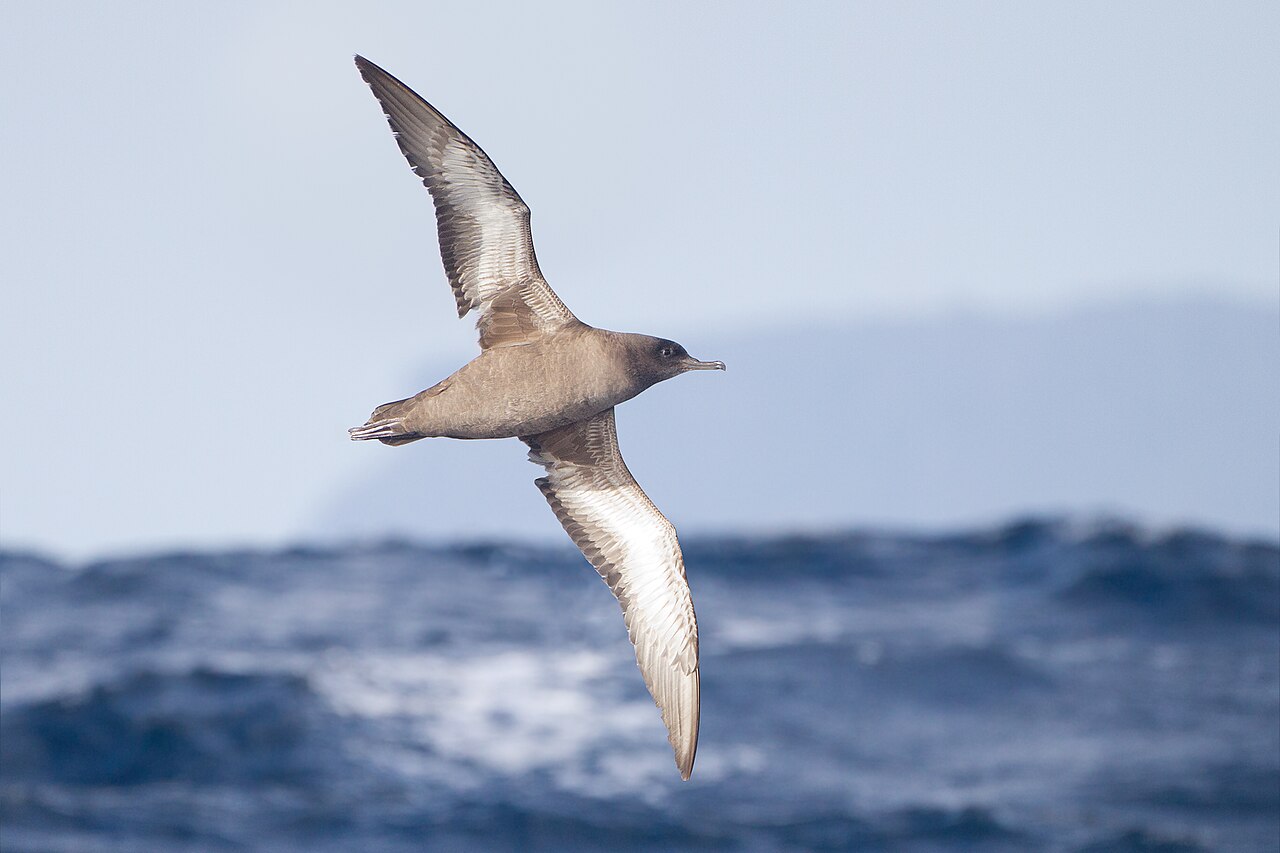
Large, uniformly dark and very fast. The silhouette is a long narrow cigar with fairly long, pointed, scythe-shaped wings set well back, and a tapering tail. The flight is its signature: a few powerful stiff beats followed by a long glide in which the bird banks steeply over the crests, towering up and diving down again — in a strong wind it shoots through the field of view in high arcs, far quicker and more direct than any gull. From above and at range uniformly dark brown to black. The clinching mark is underneath: an elongated silvery-white panel across the primary coverts that flashes like a mirror as the bird banks, so it alternately looks black and silver. The bill is long, thin and dark.
Confusion species
Yelkouan shearwater is smaller and more compact, with a dirty white belly and pale axillaries, and is never uniformly dark below. Manx shearwater is sharply black and white and much smaller. The dark morph of northern fulmar is the hardest: it has a thick neck, blunt head, short yellow bill and much stiffer, straighter wings without the silvery underwing panel, and it does not tower so high above the swell. Great skua is bulkier and broader-winged, with white flashes at the base of the primaries on both wings and a slower, raptor-like beat. Arctic Skua is slimmer with pale underparts and elongated central tail feathers.
Habitat
Wholly pelagic outside the breeding season, over the continental shelf and shelf edges, pursuing small fish, squid and krill by diving; it can reach depths of tens of metres. Breeds in self-dug burrows on grassy and wooded island slopes in the southern Pacific and Atlantic. In European waters purely a visitor, always at sea and never ashore.
Where the bird is most at home, classified with EUNIS — the European standard for habitats.
Range and movements
Does not breed in the map area. From July to November it moves clockwise through the North Atlantic; the main route runs along the western coasts of Ireland and Britain and across the Bay of Biscay, with a smaller share entering the North Sea. Along the southern North Sea coast it is a scarce but annual migrant, with tens to a few hundred birds in a good autumn, almost always on north-westerly winds. Off Galicia and in the Bay of Biscay it is numerous, with thousands on peak days in September and October; in the Strait of Gibraltar it is scarcer.
- Resident
- Breeding (summer)
- Winter
- Passage
- dark = core range, pale = thinly spread
How and when to look
Seawatches on the southern North Sea coast in a firm north-westerly in September and October are the best chance there; dams, piers and headlands that sit on the flight line do the work. Do not look for colour but for flight style: a dark bird arcing far higher and faster than the gulls around it. Galicia is incomparably better: Estaca de Bares or Cabo Vilán in September on a north-westerly produces hundreds to thousands in a morning, often close under the headland. A ferry across the Bay of Biscay in the same period is a good alternative.
Conservation status
Near Threatened. The world population still runs to many millions, but numbers have been falling for decades. Historical and still-permitted harvest of chicks on New Zealand islands, bycatch in longline and trawl fisheries, and shifts in food supply driven by ocean warming are the main causes. In European waters bycatch is the principal issue; the migration route through the Bay of Biscay overlaps with intensive fishing.
Scientific name
Ardenna grisea | (Gmelin, 1789) (GBIF: Puffinus griseus)
Gmelin described the species in 1789 as Procellaria grisea; because it was later moved to another genus, the author and year stand in brackets. The genus Ardenna was introduced in 1853 by Reichenbach. Ardenna goes back to Artenna, the spelling the Italian naturalist Ulisse Aldrovandi used for a seabird in 1603 and which Reichenbach cited when naming the genus. grisea is medieval Latin for 'grey'. The specimen the first description was based on came from New Zealand.