All species › Waders, gulls and terns › Sandpipers and snipes › Upland sandpiper
Upland sandpiper | Bartramia longicauda
Bartrams ruiter | Correlimos batitú
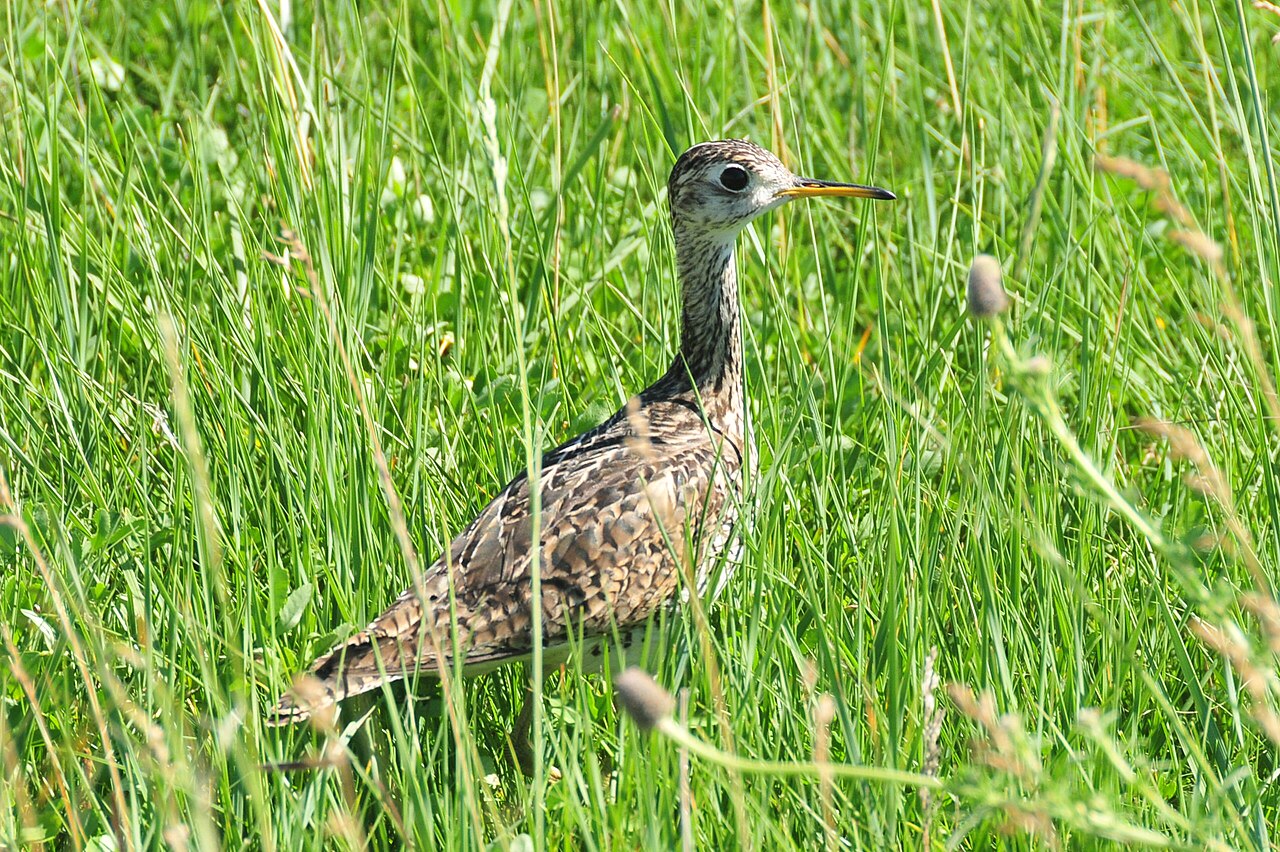
A wader that ignores water. The upland sandpiper walks short grass on airfields, golf courses and machair, perches on posts and walls, and holds its wings up for a moment after landing. The tiny dove-like head with its large dark eye makes it unmistakable.
Voice
In flight a bubbling, rising quip-ip-ip-ip. On the breeding grounds a drawn-out whistle that climbs and then sighs away, whooo-oo-lee-wheeloo, delivered high in the air or from a fence post. In Europe the species is almost always silent, and the bubbling call is heard at best as a bird flushes.
Recording: Jonathon Jongsma — CC BY-SA 3.0 · Wikimedia Commons
Identification
A medium-sized, slim wader with a strikingly small round head on a long thin neck. The eye is large, dark and ringed with fine white in an otherwise plain pale face. The bill is short, straight and yellow with a dark tip. The upperparts are marbled golden brown and black, the breast and flanks marked with dark chevrons. The legs are long and yellow, the tail long and clearly projecting beyond the wingtips. In flight the primaries are dark, there is no wingbar, and the outer tail feathers show fine barring.
Confusion species
On a first view most observers think juvenile Ruff: also gold-scaled above, also long yellow legs. But Ruff has a longer, slightly drooping bill, a small eye in a fuller head, a scaled rather than marbled mantle, no long tail projection, and in flight the white ovals beside the rump. Buff-breasted sandpiper shares the large dark eye in a plain face, but is far smaller, shorter in neck and tail, evenly buff below without chevrons, with black legs and silvery-white underwings. The three features that never fail on upland sandpiper are the disproportionately small head with its bulging dark eye, the long thin neck raised above the grass like a periscope, and the long tail overshooting the wingtips. Note also that the bird almost never stands in water, which by itself rules out most of the alternatives.
Habitat
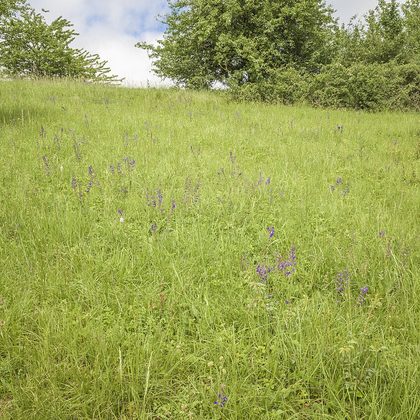
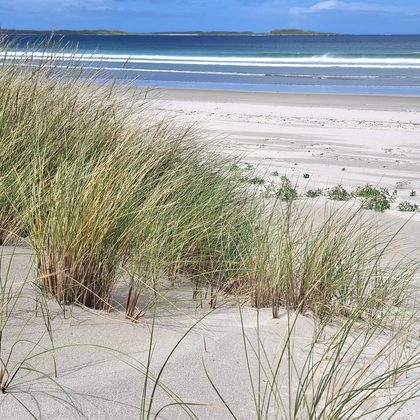
Dry, close-grazed grassland and prairie: in Europe airfields, golf courses, mown verges, machair, dune grassland and stubble. It does not seek out water. It moves like a plover, in short runs and pauses, flattens itself into the grass when alarmed, and afterwards often perches on a post or a wall.
Where the bird is most at home, classified with EUNIS — the European standard for habitats.


Range and movements
Breeds on the prairies and hay meadows of North America and winters on the pampas of South America. That long ocean-crossing route delivers a few European records a year in September and October, concentrated on the Isles of Scilly, in south-west England and on the Northern Isles of Scotland and Ireland; elsewhere in the map area, from the Iberian Peninsula to the Azores, it is a great rarity.
How and when to look
Work close-grazed grassland, golf courses and small airfields on Atlantic coasts in late September, within a few days of a fast depression that has crossed from Newfoundland. Walk the edges and watch for a bird that suddenly stands tall: the long neck and small head above the grass is usually what you see first, long before any plumage detail.
Conservation status
Not globally threatened, but numbers are far below what they once were. Nineteenth-century market hunting and the later conversion of prairie to arable farmland cut the population hard, and in the eastern United States it appears on several state endangered lists. In the core northern prairies numbers have been reasonably steady in recent decades, for as long as extensively grazed grassland survives.
Scientific name
Bartramia longicauda | (Bechstein, 1812)
Bechstein described the species in 1812 as Tringa longicauda; because it was later moved to another genus, the author and year stand in brackets. The genus Bartramia was introduced in 1831 by Lesson. Bartramia honours the American naturalist William Bartram (1739–1823). longicauda combines Latin longus 'long' and cauda 'tail'. The specimen the first description was based on came from North America.