All species › Waders, gulls and terns › Gulls and terns › Whiskered tern
Whiskered tern | Chlidonias hybrida
Witwangstern | Fumarel cariblanco
The whiskered tern is the largest and most Sterna-like of the three marsh terns, broad-winged and powerful rather than dancing. Over water lilies and rice fields it picks prey from the surface without ever plunging.

Click a thumbnail to switch the photo above.
Voice
Hoarse and rasping, and persistent at colonies: a grating krsheck or kerrsh, lower and fuller than black tern. When a colony is disturbed the sound swells into a continuous chorus. Heard mainly from May to July over breeding sites; away from the colony the species is usually silent.
Recording: Sharadapte — CC BY-SA 4.0 · Wikimedia Commons
Identification
In breeding plumage dark slate-grey underparts between a jet-black cap and a striking white cheek stripe, with white undertail coverts and blood-red bill and legs. The upperwing is pale silvery grey, rump and tail grey. In winter it turns white with a streaked crown, a dark ear patch and a black bill, the body clean white with no breast-side patch. Juveniles show a brown-scaled mantle contrasting with grey wings.
Confusion species
Unmistakable in breeding dress, but winter and juvenile birds closely recall Black and white-winged terns. Whiskered is larger and heavier, with a longer, thicker bill, broader wings and a uniformly grey rump, and it lacks the dark breast-side patch of black tern. At range it can even be taken for a small common tern.
Habitat
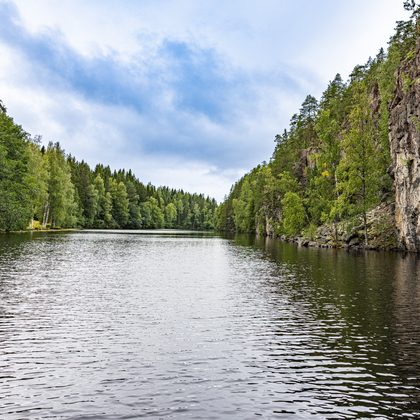
Shallow, warm fresh and brackish marshes rich in floating-leaved plants: old river arms, fish ponds, rice fields and silting lagoons. Colonies float on beds of water lily, yellow water lily or water soldier. It forages low over water and wet meadows, plucking dragonflies, tadpoles and aquatic insects from the surface.
Where the bird is most at home, classified with EUNIS — the European standard for habitats.



Range and movements
Centred on southern and eastern Europe, and numerous in Spain, with large colonies in the Ebro delta, the Albufera of Valencia and the marismas of Doñana. It is expanding north and now breeds regularly in the Netherlands, mainly in the peat marshes of Gelderland and Overijssel. Winters in sub-Saharan Africa and around the Mediterranean.
- Resident
- Breeding (summer)
- Winter
- Passage
- dark = core range, pale = thinly spread
How and when to look
Visit a peat marsh or rice-field complex in May and June in the early morning, when the air is still and birds hunt low over the vegetation. In the Netherlands search among black terns at water-soldier beds; a white-bellied marsh tern with a red bill stands out at once.
Conservation status
Not globally threatened and expanding its European range, helped by rice cultivation and fish farming. Locally it is vulnerable to water management that strands or floods the floating nests, and to the loss of floating-leaved vegetation through eutrophication and carp stocking. In the Netherlands it remains a rare and strictly protected breeder.
Scientific name
Chlidonias hybrida | (Pallas, 1811)
Pallas described the species in 1811 as Sterna hybrida; because it was later moved to another genus, the author and year stand in brackets. The genus Chlidonias was introduced in 1822 by Rafinesque. Chlidonias is from Ancient Greek khelidonios 'swallow-like', from khelidon 'swallow'. hybrida is Latin for 'hybrid': the describer took the bird for a cross between the white-winged tern and the common tern. The specimen the first description was based on came from the lower Volga, Russia.