All species › Waders, gulls and terns › Plovers and lapwings › American Golden-Plover
American Golden-Plover | Pluvialis dominica
Amerikaanse goudplevier | Chorlito dorado americano | Batuiruçu
The American Golden-Plover is a slender plover of open grassland that makes one of the longest migrations of any shorebird, between the North American tundra and the pampas of Argentina. In the guide area it is mainly a passage migrant: in autumn and spring flocks rest on the grasslands of the puna, on river sandbars and on pastures in the lowlands.
Voice
A clear, two-syllabled kloo-eet or queedle, often in flight.
Recording: AUDEVARD Aurélien — CC BY-NC-SA 4.0 · xeno-canto
Identification
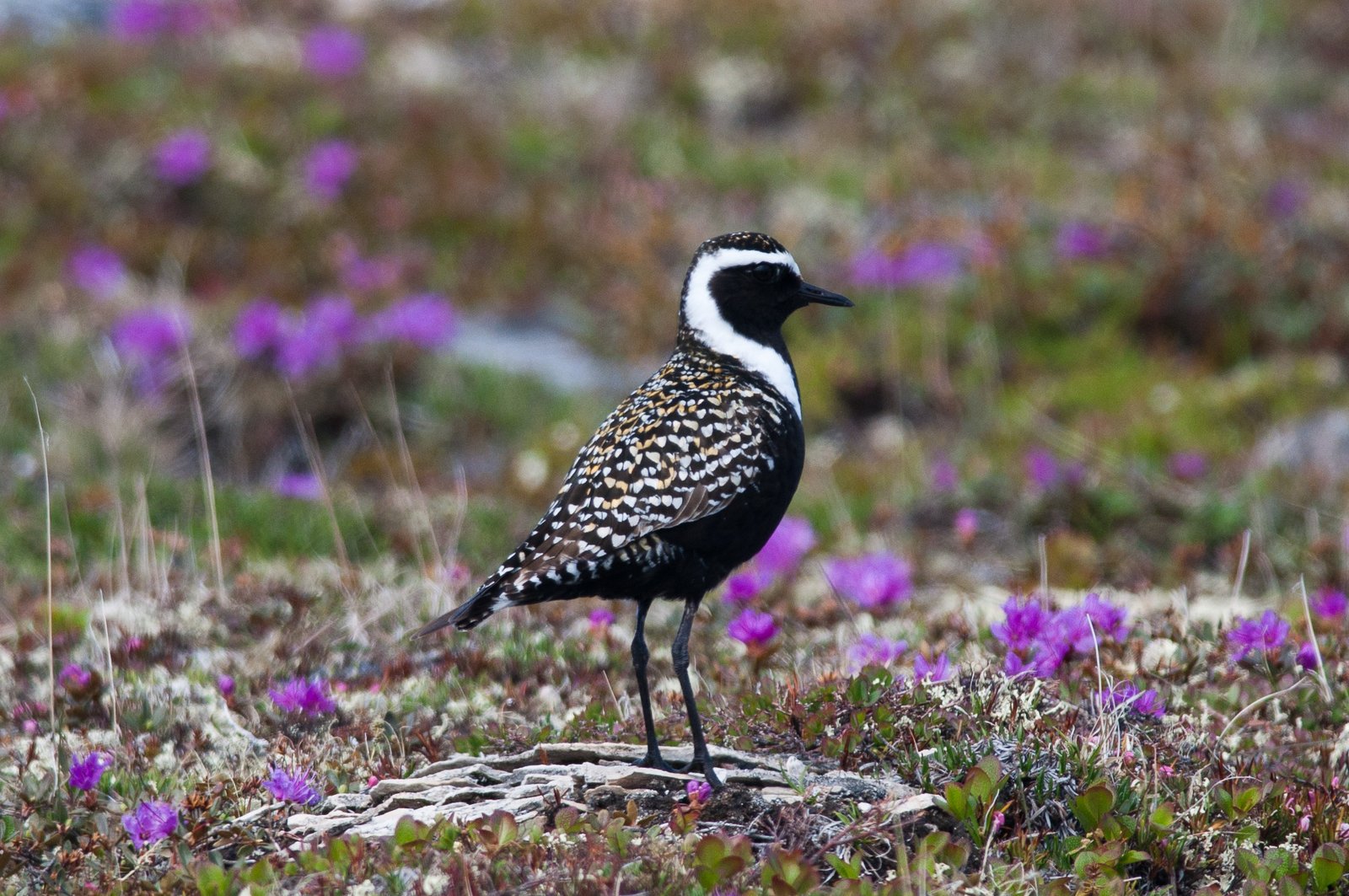
24–28 cm, a slender plover with a rather small, round head, a short, thin black bill, long wings projecting well beyond the tail and long, dark grey legs. In non-breeding and juvenile plumage greyish brown, with pale and golden spots on the upperparts, a dark crown, a prominent white supercilium and a faintly streaked, greyish brown breast. In breeding plumage, sometimes already seen in March and April, the face and underparts are black, with a white band running from the forehead down the side of the neck to the breast, where it ends, and the upperparts are black with golden spots. In flight grey axillaries and underwings and a faint wing bar. The sexes are nearly alike.
Confusion species
Grey Plover Pluvialis squatarola is larger and greyer, with a heavier bill, black axillaries, a white rump and a clear white wing bar, and keeps to the coast. Upland Sandpiper Bartramia longicauda, which uses the same grasslands, has a small head on a long neck, a long tail and yellow legs. Buff-breasted Sandpiper Calidris subruficollis is smaller, with a plain, warm buff face and underparts and yellow legs.
Habitat
On migration on short grassland and pastures, on the puna and on bofedales up to about 4500 m, on sandbars and shores of rivers and lakes, on airfields and on bare fields; scarcer on coastal mudflats. It feeds by walking and pecking, taking insects, crustaceans, berries and seeds. It does not breed in the guide area.
Where the bird is most at home, classified by the vegetation units of the Andes and the west coast.


Range and movements
In Colombia a passage migrant in the lowlands east of the Andes and rare elsewhere. In Ecuador a passage migrant mainly in the Amazonian lowlands and rare in the Andes and on the coast. In Peru a passage migrant in the Amazonian lowlands and on the puna of the south, scarce on the coast. In Bolivia a passage migrant in the lowlands and on the altiplano, and locally a winter visitor in the northern savannas. A rare visitor to the Galápagos. Breeds on the tundra of Alaska and northern Canada and winters mainly on the grasslands of Argentina, Uruguay and southern Brazil.
- Resident
- Winter visitor (c. Oct–Mar)
- Passage (Mar–Apr, Oct–Nov)
- dark = core range, pale = thinly spread
How and when to look
In October and November and again in March and April on wet grasslands and bofedales around Lake Titicaca and on sandbars of Amazonian rivers; flocks often stand widely spaced across the grass and take off together.
Conservation status
Least Concern. The population fell sharply through hunting in the 19th century and now appears to be declining through the conversion of grassland to cropland on the wintering grounds.
Scientific name
Pluvialis dominica | (Müller, 1776)
Müller described the species in 1776 as Charadrius Dominicius; because it was later moved to another genus, the author and year stand in brackets. The genus Pluvialis was introduced in 1760 by Brisson. The genus name is from Latin pluvialis, 'relating to rain', from pluvia, 'rain'; the birds were believed to flock when rain was imminent. The species name refers to Santo Domingo (Hispaniola), not necessarily the type locality. The specimen the first description was based on came from Hispaniola.