All species › Waders, gulls and terns › Plovers and lapwings › Tawny-throated Dotterel
Tawny-throated Dotterel | Oreopholus ruficollis
Andesplevier | Chorlo cabezón | Batuíra-de-papo-ferrugíneo
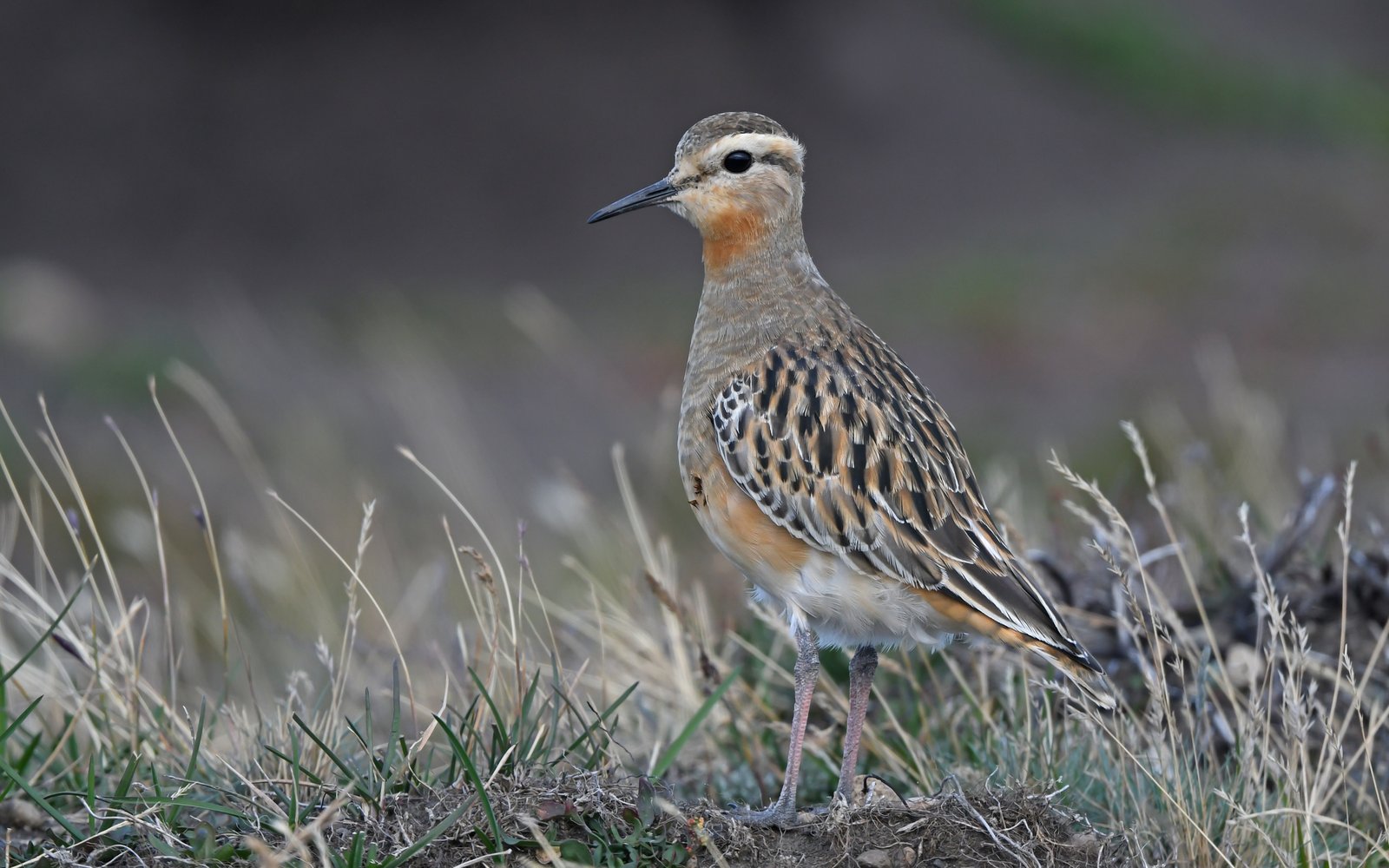
The Tawny-throated Dotterel is a slender, long-legged plover of dry, open plains that recalls a small curlew or thick-knee more than a sand plover. It lives far from water, on the grasslands of the puna and in the coastal desert and lomas of Peru. Its streaked, sandy back blends with the ground until it walks or takes off.
Voice
A soft, melancholy, descending whistle and a short, trilled call, often in flight and in the evening.
Recording: Bernabe Lopez-Lanus — CC BY-NC-SA 3.0 · xeno-canto
Identification
25–29 cm, with a small, round head, a thin black bill and long, pink to flesh-coloured legs. The head, neck and breast are grey, with a pale supercilium and a dark eye-stripe. The throat is tawny orange, the belly buff with a black patch in the centre. The upperparts are buff with broad black streaks. In flight the pale wing bar and pale underwing stand out. The sexes are alike; juveniles are duller, without a clear belly patch.
Confusion species
American Golden-Plover Pluvialis dominica, on migration on the same grasslands, has spotted rather than streaked upperparts and lacks the tawny throat and the black belly patch. Puna Plover Anarhynchus alticola is much smaller, with a short bill and white front. Upland Sandpiper Bartramia longicauda has a longer tail, yellow legs and a streaked breast.
Habitat
Dry puna and altiplano with short grass and bare ground, between about 3000 and 4600 m; in Peru also at sea level in the coastal desert, the lomas and on dry fields. It lives in pairs or small groups, runs quickly and feeds on insects and seeds. The nest is a scrape on bare ground.
Where the bird is most at home, classified by the vegetation units of the Andes and the west coast.


Range and movements
In Peru on the puna of the centre and south and along the coast in the lomas and desert of the centre and south. In Bolivia on the altiplano in the west. In Ecuador only as a very rare visitor; absent from Colombia and the Galápagos. Outside the guide area in northern Chile and western and southern Argentina; birds from Patagonia move north in the southern winter.
- Resident
- Summer visitor (c. Apr–Sep)
- Passage (Mar–Apr, Oct–Nov)
- dark = core range, pale = thinly spread
How and when to look
Drive slowly across the puna grasslands, for example between Arequipa and Puno, or search the lomas south of Lima during the fog season; birds often stand motionless and only become visible when they walk away.
Conservation status
Least Concern. The species is widespread but locally scarce; overgrazing and the conversion of lomas may play a role locally.
Scientific name
Oreopholus ruficollis | (Wagler, 1829)
Wagler described the species in 1829 as Charadrius ruficollis; because it was later moved to another genus, the author and year stand in brackets. The genus Oreopholus was introduced in 1835 by Jardine & Selby. The genus name comes from Greek oros, 'mountain', and poleō, 'to range over', so 'haunting mountains', after the Chilean Andes. The species name comes from Latin rufus, 'rufous', and collum, 'neck', after the tawny throat and neck. The specimen the first description was based on came from Canelones, Uruguay.