All species › Waders, gulls and terns › Plovers and lapwings › Pied Plover
Pied Plover | Hoploxypterus cayanus
Cayennekievit | Avefría de Cayena | Batuíra-de-esporão
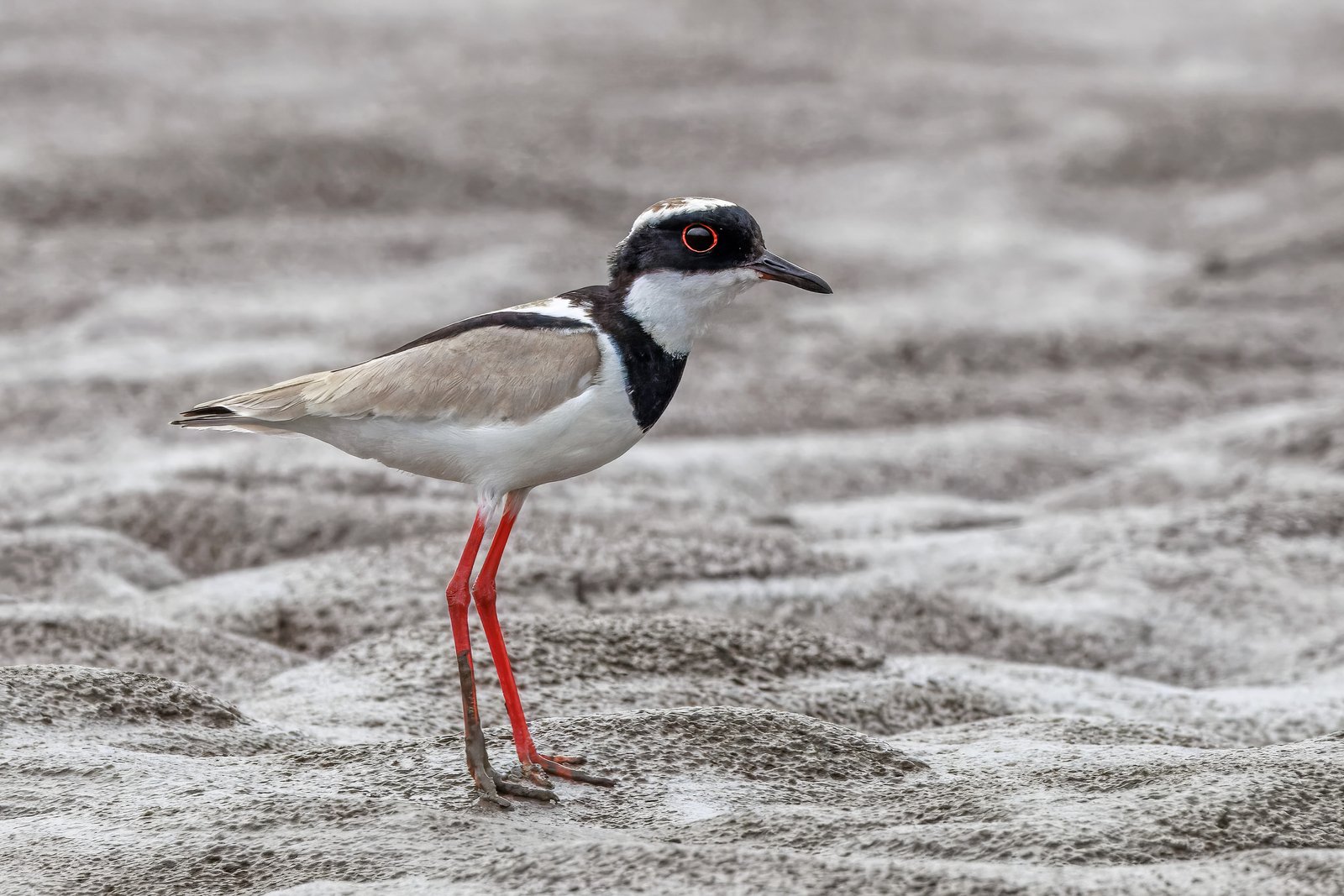
The Pied Plover is a small, black-and-white patterned lapwing of the sandbars along the large rivers of Amazonia and the Orinoco. Despite its English name it is closely related to the lapwings of the genus Vanellus. It has a small spur at the bend of the wing, as many lapwings do.
Voice
A soft, plaintive, two-note kee-oo, often repeated; when disturbed a sharper, rapid keek-keek.
Recording: Jacob Wijpkema — CC BY-NC-SA 4.0 · xeno-canto
Identification
21–24 cm, a compact lapwing with a fairly short black bill, a red eye-ring and long, pink to red legs. The crown is black, bordered by a white band running behind the eye to the nape. A broad black band runs from the base of the bill through the eye to the side of the neck and forms a black breast band. The back and scapulars are greyish brown, with a black V-shaped band across the scapulars; the underparts are white. In flight the black wingtips, the white wing bar, the white rump and the black tail band stand out. The sexes are alike; juveniles are duller, with pale feather fringes.
Confusion species
Collared Plover Anarhynchus collaris is smaller, without the black crown and black scapular band, with a narrow black breast band and a white forehead. Southern Lapwing Vanellus chilensis is much larger, with a crest, a grey head and a black breast. Black Skimmer Rynchops niger, which uses the same sandbars, has a red, flattened bill and is a tern-like bird.
Habitat
Sand and gravel bars of broad lowland rivers, shores of lakes and oxbows, muddy river edges and wet savannas, almost only below 500 m. It walks and pecks insects, small crustaceans and other invertebrates. The nest is a scrape on a bare sandbar and is made in the dry season, when the water is low.
Where the bird is most at home, classified by the vegetation units of the Andes and the west coast.


Range and movements
In Colombia in the lowlands east of the Andes, in the Llanos and Amazonia, and locally in the Caribbean lowlands. In Ecuador in the Amazonian lowlands. In Peru in the Amazonian lowlands. In Bolivia in the lowlands of the north and east, including the Beni. Absent from the Galápagos and west of the Andes in Ecuador and Peru. Outside the guide area in Venezuela, the Guianas, Brazil and Paraguay.
- Resident
- dark = core range, pale = thinly spread
How and when to look
In the dry season, when the sandbars are exposed, on river trips in the Amazonian lowlands, for example along the Napo or the Madre de Dios; pairs often walk close to the waterline and stay there as the boat passes.
Conservation status
Least Concern. The species is widespread; disturbance of sandbars by people and cattle may affect breeding locally.
Scientific name
Hoploxypterus cayanus | (Latham, 1790)
Latham described the species in 1790 as Charadrius cayanus; because it was later moved to another genus, the author and year stand in brackets. The genus Hoploxypterus was introduced in 1856 by Bonaparte. The genus name probably comes from Greek hoplon, 'weapon', oxys, 'sharp', and pteron, 'wing', after the sharp spur at the bend of the wing. The species name refers to Cayenne in French Guiana, not necessarily the type locality. The specimen the first description was based on came from Cayenne, French Guiana.