All species › Waders, gulls and terns › Plovers and lapwings › Diademed Sandpiper-Plover
Diademed Sandpiper-Plover | Phegornis mitchellii
Diadeemplevier | Chorlito cordillerano | Batuíra-de-diadema
The Diademed Sandpiper-Plover is a small plover of the highest Andean bogs that resembles a sandpiper with its long, thin bill. It is the only species of the genus Phegornis. It lives at low densities along mountain streams and in bofedales, often close to the snowline.
Voice
A soft, high, plaintive whistle, sometimes repeated; often only audible at close range.
Recording: Andrew Spencer — CC BY-NC-SA 3.0 · xeno-canto
Identification
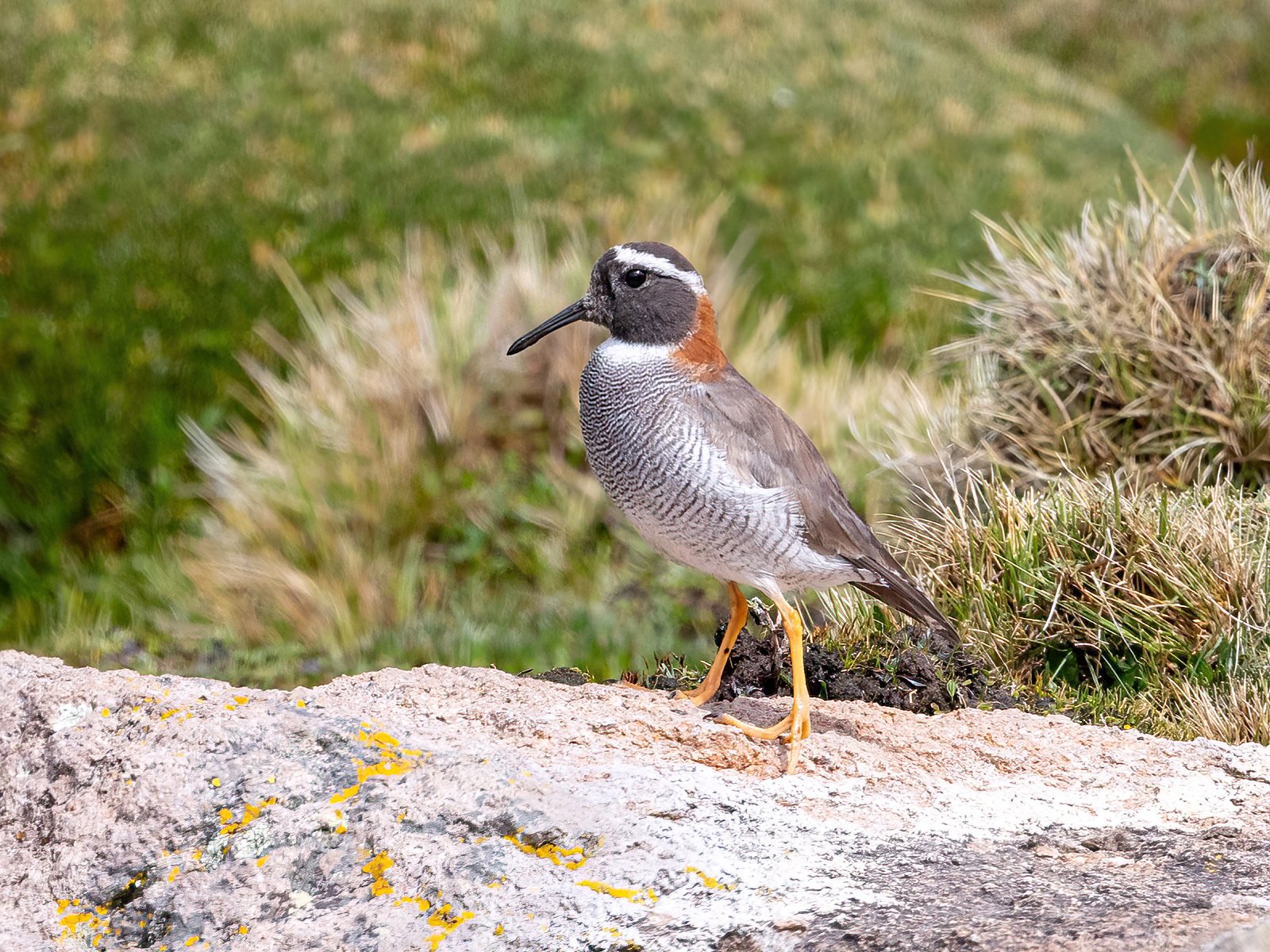
16–19 cm, with a fairly long, thin, slightly decurved black bill and short, orange-yellow legs. The head is blackish, with a white band running like a diadem from above the eye around the back of the crown. The nape and hindneck are chestnut. The throat is white, the breast and belly white with fine dark barring. The upperparts are greyish brown. The sexes are nearly alike; juveniles are duller, with a less distinct diadem and no rufous nape.
Confusion species
Puna Plover Anarhynchus alticola has a short bill, a white front and an unbarred breast and lacks the white diadem and the rufous nape. Baird's Sandpiper Calidris bairdii, on migration in the same bogs, is brown-scaled without a black head and has black legs. Puna Snipe Gallinago andina has a much longer bill and a striped head.
Habitat
Bofedales, high bogs with cushion plants, wet grasslands and the gravel banks of mountain streams, mostly between 3800 and 5000 m. It walks quietly along the water's edge and between the cushion plants, picking insects and larvae from the ground and from shallow water. The nest is a scrape among stones or cushion plants.
Where the bird is most at home, classified by the vegetation units of the Andes and the west coast.


Range and movements
In Peru in the high Andes of the centre and south. In Bolivia in the high Andes of the west. Absent from Colombia, Ecuador and the Galápagos. Outside the guide area in the Andes of Chile and Argentina.
- Resident
- dark = core range, pale = thinly spread
How and when to look
Search along streams and in bofedales above 4000 m, for example in the Cordillera Blanca, around Marcapomacocha or in the Cordillera Real of Bolivia; walk slowly along the water's edge, as the birds often sit still among the cushion plants.
Conservation status
Near Threatened. The population is small and spread over a narrow altitudinal range; the bogs are threatened by overgrazing, mining, water extraction and the melting of glaciers.
Scientific name
Phegornis mitchellii | (Fraser, 1845)
Fraser described the species in 1845 as Leptopus (Leptodactylus) Mitchellii; because it was later moved to another genus, the author and year stand in brackets. The genus Phegornis was introduced in 1846 by Gray. The genus name comes from Greek phengos, 'light, splendour' (from phainō, 'to shine'), and ornis, 'bird'. The species name honours David William Mitchell (1813–1859), English zoologist and artist, Secretary of the Zoological Society of London from 1847 to 1859. The specimen the first description was based on came from Chile (probably Colchagua).